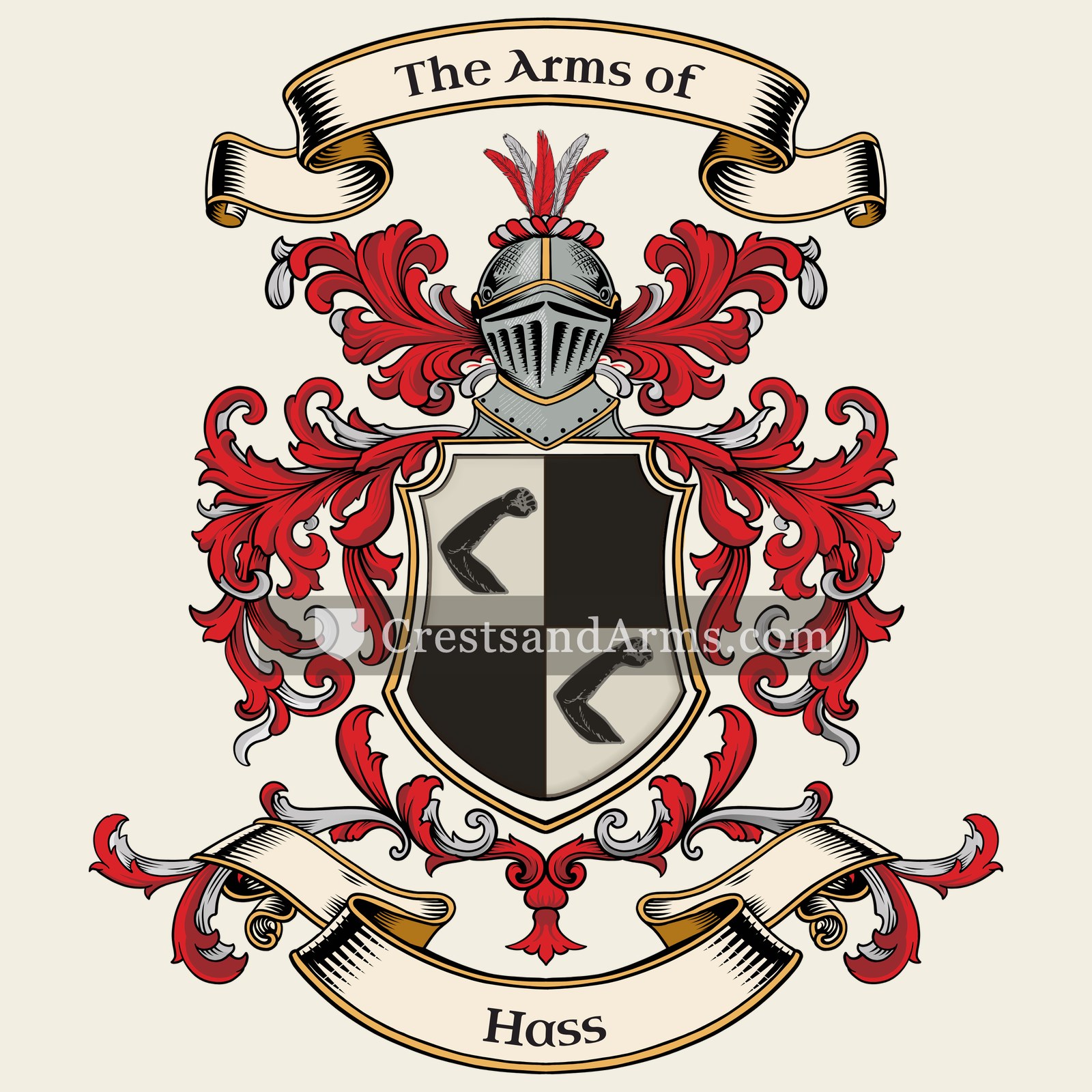
A record of documented arms, meaning and origin, researched for the Hass family of Germany.
Reg. 8876 · German, G–I
Coat of Arms & Family Crest Details
Symbols on this shield
armA person of action, industrious and laborious
Colours
Silver (Argent)Means: Peace and sincerity
Black (Sable)Means: Constancy
Historical info
Source
J. B. Rietstap, Armorial Général, Gouda: G. B. van Goor Zonen, 1884–87
Blazon (the actual original written record)
“Ec.: aux 1 et 4 les armes de 1536: aux 2 et 3 de sa. à une sirène de carn., les cheveux épars, les mains étendues (armes anciennes d'Emmerich) Cq. cour. C.: la sirène, entre un vol d'arg. et de gu. L.: à dextre d'arg. et de gu., à sen. d'or et de gu.”
GermanyGörlitz Silésie, c. 1559
Digital archive packCoat of arms PNG, gold border print PDF, vector SVG and the certificate of authenticity. Sent to your email in minutes.
Map of Germany showing where the Hass arms are recorded
The Hass arms were recorded in Görlitz Silésie, c. 1559.
This is where the arms were entered in the register. Families often moved to other parts of the country, so the same name can turn up in more than one region.
The body that granted and recorded arms in Germany in this period.
Ferdinand I, Holy Roman Emperor
Sovereign of the period
Ferdinand I, Holy Roman Emperor
1556–1564
Reigning in Germany when the Hass arms are first recorded.
How Arms Worked in Germany
In the Holy Roman Empire, coats of arms were often granted to individuals by the Emperor or his representatives. These arms were then passed down through the generations to all legitimate descendants of the original holder. Younger branches of a family usually kept the same shield design without needing to change it, as the arms belonged to the entire lineage.
Granting authority
The Holy Roman Emperor held the sole power to grant new coats of arms throughout his vast imperial territories.
How they got arms
Families typically obtained their coats of arms through a formal imperial grant or by proving their noble status to the authorities.
Where arms were recorded
These grants were officially recorded in the Imperial Chancery registers, which began keeping formal records of such honors during the Middle Ages.
The family's standing
Recorded among the armigerous families of Germany.
Origin & History of the Hass Family in Germany
The surname Hass has deep roots in the historical region of Silesia, where members of the family were documented as residents of Görlitz by the year 1559. During this era, Görlitz was a thriving center of trade and culture located along the Neisse River, serving as a vital crossroads for merchants and craftspeople. The name itself likely originated as a descriptive nickname or a shortened form of a longer Germanic given name, reflecting the common naming customs of the late Middle Ages. Families like the Hass line often held positions within the local urban society, contributing to the development of the town’s economy and civic life. As the family grew, they became part of the resilient population that navigated the complex religious and political shifts defining Central Europe during the sixteenth century.
Hass Meaning & Related Branches
Root word
Hasso
A Germanic personal name derived from the word for a spear.
This name
HassA patronymic surname indicating descent from a person named Hasso or a nickname for a harsh person.
also spelled
Haas
Hasse
Hassz
Has
Related arms
Haasvariant spelling
Hasvariant spelling
Brucknerrecorded with Hass, same area
Büttnerrecorded with Hass, same area
Documented Sources
J. B. Rietstap, Armorial Général, Gouda: G. B. van Goor Zonen, 1884–87
Jecht, Richard. Geschichte der Stadt Görlitz. 1926
Stadtarchiv Görlitz. Ratsarchiv der Stadt Görlitz, Bürgerbücher
Digital archive packCoat of arms PNG, gold border print PDF, vector SVG and the certificate of authenticity. Sent to your email in minutes.


 armA person of action, industrious and laborious
 armA person of action, industrious and laborious