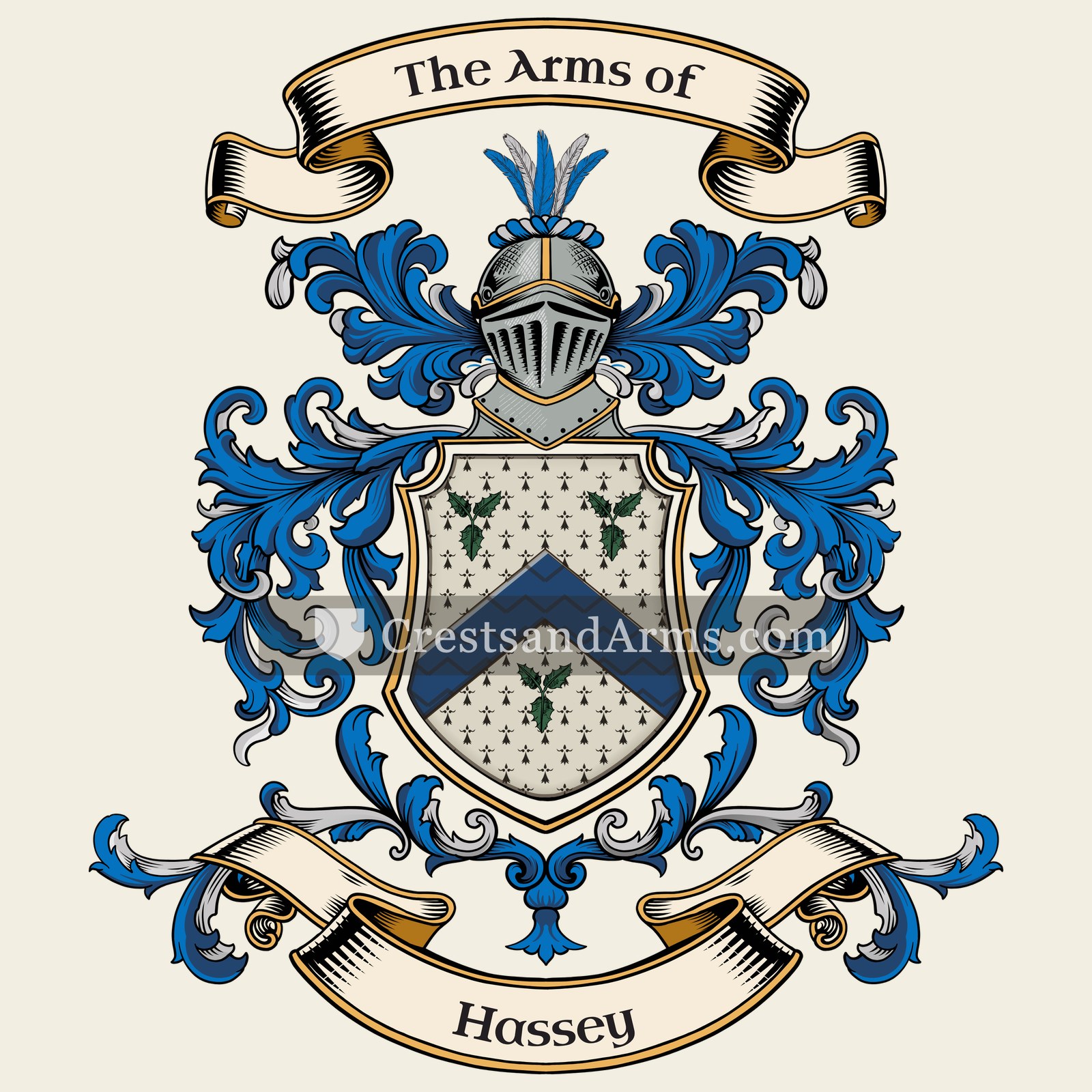
A record of documented arms, meaning and origin, researched for the Hassey family of France.
Reg. 0003 · French, G–I
Coat of Arms & Family Crest Details
Symbols on this shield
chevronProtection, and faithful service completed
hollyTruth, and protection through winter
Colours
ErmineMeans: Dignity
Blue (Azure)Means: Loyalty and truth
Green (Vert)Means: Hope
Historical info
Source
Sir Bernard Burke, The General Armory of England, Scotland, Ireland and Wales, London: Harrison & Sons, 1884
Blazon (the actual original written record)
“Erm. a chev. az. betw. three holly leaves vert”
FranceNormandy, c. 1663
Where the Hassey Arms Were Recorded
Normandy
Map of France showing where the Hassey arms are recorded
The Hassey arms were recorded in Normandy, c. 1663.
This is where the arms were entered in the register. Families often moved to other parts of the country, so the same name can turn up in more than one region.
The body that granted and recorded arms in France in this period.
Louis XIV of France
Sovereign of the period
Louis XIV of France
1643–1715
Reigning in France when the Hassey arms are first recorded.
How Arms Worked in France
In France, a coat of arms was a mark of honor that passed down through the male line to all legitimate descendants. Families often used the same shield without changes to show their shared heritage. If a branch wanted to stand out, they could add a small mark to their shield to show their specific place in the family tree.
Granting authority
The Juge d'armes de France acted as the official authority that regulated and verified coats of arms across the country.
How they got arms
Families typically inherited their arms from ancestors, though they could also receive them through royal grants or by proving their noble status.
Where arms were recorded
Coats of arms were officially recorded in the Armorial Général de France, which began its main collection in the year 1696.
The family's standing
Recorded among the armigerous families of France.
Origin & History of the Hassey Family in France
The family name Hassey traces its roots back to the northern regions of France, with documented evidence confirming that family members were established in Normandy by 1663. During this period, the name was closely tied to the social and agricultural structures of the French countryside. Families living in Normandy at this time often worked as skilled laborers or landowners who managed the fertile soil of the coastal plains. As the seventeenth century progressed, the political and religious climate of France began to shift, which encouraged many families from this region to seek new opportunities in other parts of the world. The presence of the Hassey name in these early records highlights a history of resilience and movement, as these ancestors navigated the challenges of life in a changing European landscape before eventually expanding their influence across the Atlantic.
Related Branches & Arms
Root word
Hasse
A Germanic personal name derived from the word for house or enclosure.
This name
HasseyA locational or patronymic surname indicating a descendant of someone living near a specific enclosure or dwelling.
also spelled
Hasse
Hassie
Hassy
Related arms
Duebeckrecorded with Hassey, same area
Huerecorded with Hassey, same area
Lempreurrecorded with Hassey, same area
Longspeerecorded with Hassey, same area
Documented Sources
Sir Bernard Burke, The General Armory of England, Scotland, Ireland and Wales, London: Harrison & Sons, 1884
Archives départementales de la Seine-Maritime, Série B, Fonds de la justice seigneuriale
Boudet, Jacques, Histoire de la Normandie, 1970
Le Maho, Jacques, La vie rurale en Normandie au XVIIe siècle, 1985
Digital archive packCoat of arms PNG, gold border print PDF, vector SVG and the certificate of authenticity. Sent to your email in minutes.


 chevronProtection, and faithful service completed
 hollyTruth, and protection through winter
 chevronProtection, and faithful service completed
 hollyTruth, and protection through winter