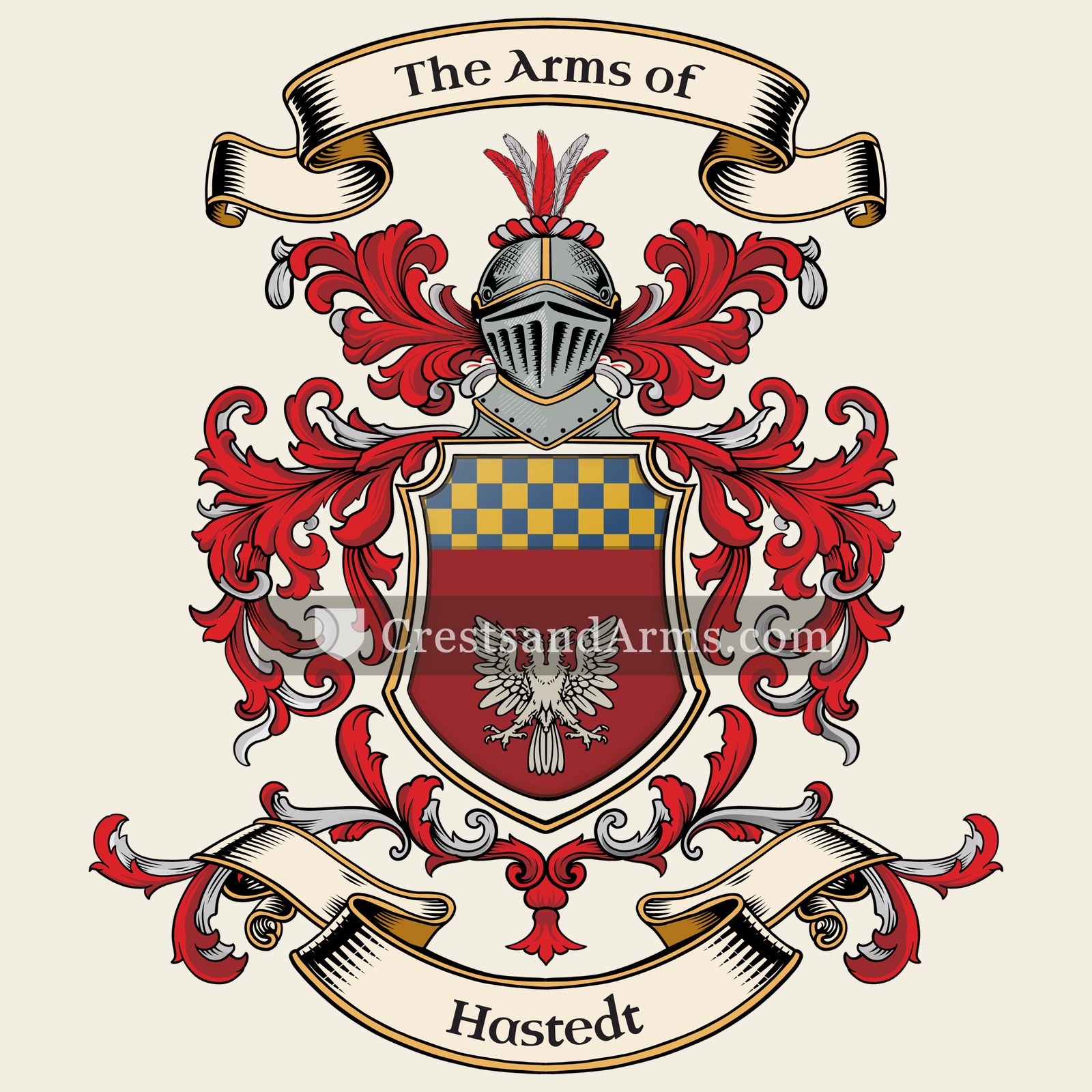
A record of documented arms, meaning and origin, researched for the Hastedt family of England.
Reg. 3635 · English, G–I
Coat of Arms & Family Crest Details
Symbols on this shield
chiefAuthority, wisdom and dominion
chequyConstancy, and the counting-board
eagleNobility, strength and a keen mind
Colours
Red (Gules)Means: Military strength
Gold (Or)Means: Generosity
Blue (Azure)Means: Loyalty and truth
ErmineMeans: Dignity
Historical info
Source
Sir Bernard Burke, The General Armory of England, Scotland, Ireland and Wales, London: Harrison & Sons, 1884
Blazon (the actual original written record)
“Gu. an eagle displ. erm. a chief chequy or and az”
BerksSunnings · Berks, c. 1620
Where the Hastedt Arms Were Recorded
Berks
Map of England showing where the Hastedt arms are recorded
The Hastedt arms were recorded in Berks, c. 1620.
Berkshire sat on the road west from London with the royal castle at Windsor in the middle of it. Court families bought estates within reach, and an estate near the court almost always came with a coat of arms.
This is where the arms were entered in the register. Families often moved to other parts of the country, so the same name can turn up in more than one region.
The body that granted and recorded arms in England in this period.
James VI and I
Sovereign of the period
James VI and I
1603–1625
Reigning in England when the Hastedt arms are first recorded.
How Arms Worked in England
English heraldry allowed arms to be shared by all legitimate descendants of the original owner. These symbols were treated as personal property that moved through the generations to all children. While the eldest son kept the original design, other family members could use the same shield without needing to change it or register their own unique versions.
Granting authority
The College of Arms in London has regulated the use of coats of arms throughout England and Wales since 1484.
How they got arms
Families typically obtained their coats of arms through a formal grant from the Crown or by proving their ancient right to them.
Where arms were recorded
All official coats of arms are recorded in the registers kept at the College of Arms, which date back to the fifteenth century.
The family's standing
Recorded among the armigerous families of Berks.
Origin & History of the Hastedt Family in England
The family name Hastedt originates from the northern regions of Germany, where it functioned as a topographical surname. In the German language, the name is derived from the term "Haste," which refers to a specific type of enclosure or a fenced piece of land, combined with the suffix "stedt," meaning a place or a settlement. This suggests that the earliest ancestors were likely farmers or landowners who lived near a distinct boundary or a protected homestead. By the year 1620, records confirm that members of the Hastedt family were well-established in the region of Berks, Germany. During this period, families in this area were often deeply connected to the local agricultural economy and the governance of small rural villages. As the family grew, they maintained a strong presence in these northern territories, preserving their name through generations of land stewardship and local community involvement.
Related Branches & Arms
Root word
Hagastad
A place or settlement located within an enclosed or fenced area.
This name
HastedtDerived from a topographic location referring to a dweller by a fenced-in homestead or enclosure.
also spelled
Hastedt
Documented Sources
Sir Bernard Burke, The General Armory of England, Scotland, Ireland and Wales, London: Harrison & Sons, 1884
Bahlow, Hans, Deutsches Namenlexikon: Familien- und Vornamen nach Ursprung und Sinn erklärt, 1967
Heintze, Albert, Die deutschen Familiennamen, geschichtlich, geographisch, sprachlich, 1903
Niedersächsisches Landesarchiv, Kirchenbücher der Region Hannover, 1600–1650
Digital archive packCoat of arms PNG, gold border print PDF, vector SVG and the certificate of authenticity. Sent to your email in minutes.


 chiefAuthority, wisdom and dominion
 chequyConstancy, and the counting-board
 eagleNobility, strength and a keen mind
 chiefAuthority, wisdom and dominion
 chequyConstancy, and the counting-board
 eagleNobility, strength and a keen mind