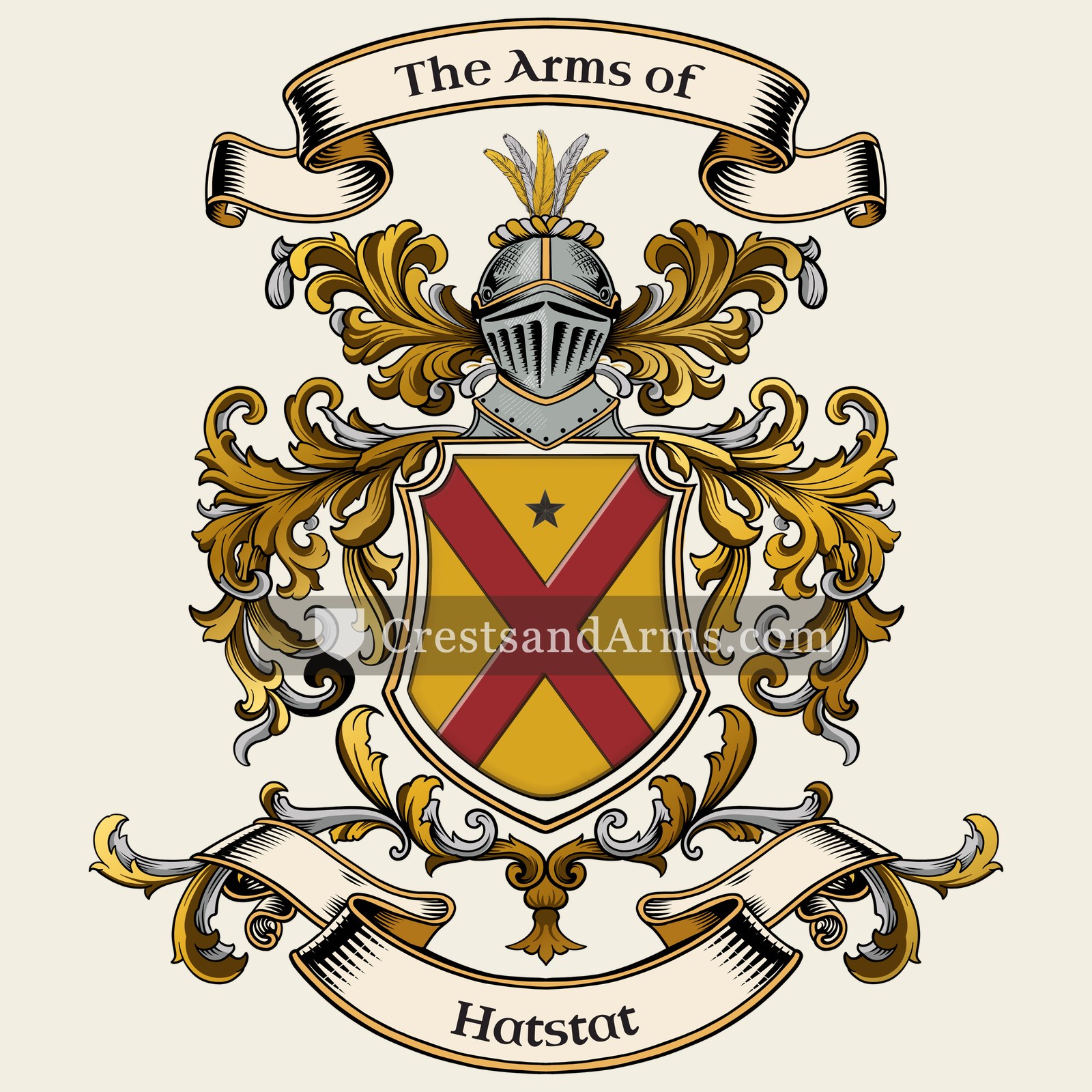
A record of documented arms, meaning and origin, researched for the Hatstat family of France.
Reg. 3867 · French, G–I
Coat of Arms & Family Crest Details
Symbols on this shield
saltireResolution, and St Andrew's cross
mulletThe third son, and a divine quality from above
Colours
Gold (Or)Means: Generosity
Red (Gules)Means: Military strength
Black (Sable)Means: Constancy
Historical info
Source
J. B. Rietstap, Armorial Général, Gouda: G. B. van Goor Zonen, 1884–87
Blazon (the actual original written record)
“D'or au saut. de gu. (souvent acc. en chef d'une étoile (8) de sa.) C.: un écran en forme d'éventail échancré, aux armes de l'écu.”
AlsaceBâle · Alsace, c. 1663
Where the Hatstat Arms Were Recorded
Alsace
Map of France showing where the Hatstat arms are recorded
The Hatstat arms were recorded in Alsace, c. 1663.
Alsace lay between France and the German lands and belonged to both at different times. Its families held small estates and served whichever side ruled, and men who served in arms carried arms of their own.
This is where the arms were entered in the register. Families often moved to other parts of the country, so the same name can turn up in more than one region.
The body that granted and recorded arms in France in this period.
Louis XIV of France
Sovereign of the period
Louis XIV of France
1643–1715
Reigning in France when the Hatstat arms are first recorded.
How Arms Worked in France
In France, a coat of arms was a mark of honor that passed down through the male line to all legitimate descendants. Families often used the same shield without changes to show their shared heritage. If a branch wanted to stand out, they could add a small mark to their shield to show their specific place in the family tree.
Granting authority
The Juge d'armes de France acted as the official authority that regulated and verified coats of arms across the country.
How they got arms
Families typically inherited their arms from ancestors, though they could also receive them through royal grants or by proving their noble status.
Where arms were recorded
Coats of arms were officially recorded in the Armorial Général de France, which began its main collection in the year 1696.
The family's standing
Recorded among the armigerous families of Alsace.
Origin & History of the Hatstat Family in France
The Hatstat family name is deeply rooted in the historical region of Alsace, a territory located along the border of modern-day France and Germany. By 1663, records confirm that members of the family were established in this area, which was a crossroads for European culture and trade. During the seventeenth century, Alsace was a complex region recovering from the devastation of the Thirty Years' War, and families like the Hatstats often lived in small agricultural communities or bustling market towns. The name itself likely evolved from the local Germanic dialects spoken in the Upper Rhine valley, reflecting the linguistic shifts that occurred as the region transitioned between different political powers. Living in this volatile borderland required the family to be resilient and adaptable as they navigated the changing social and religious landscapes of the era.
Related Branches & Arms
Root word
Hatt
Derived from the Germanic personal name Hatto meaning brave or hardy.
This name
HatstatA locational or patronymic surname likely referring to a descendant of Hatto or a dweller near a specific landmark.
also spelled
Hatstat
Hattstat
Documented Sources
J. B. Rietstap, Armorial Général, Gouda: G. B. van Goor Zonen, 1884–87
Archives départementales du Bas-Rhin, Registres paroissiaux et d'état civil
Grasser, Jean-Pierre, Histoire de l'Alsace, 1988
Livet, Georges, L'Alsace et les Alsaciens à travers l'histoire, 1981
Digital archive packCoat of arms PNG, gold border print PDF, vector SVG and the certificate of authenticity. Sent to your email in minutes.


 saltireResolution, and St Andrew's cross
 mulletThe third son, and a divine quality from above
 saltireResolution, and St Andrew's cross
 mulletThe third son, and a divine quality from above