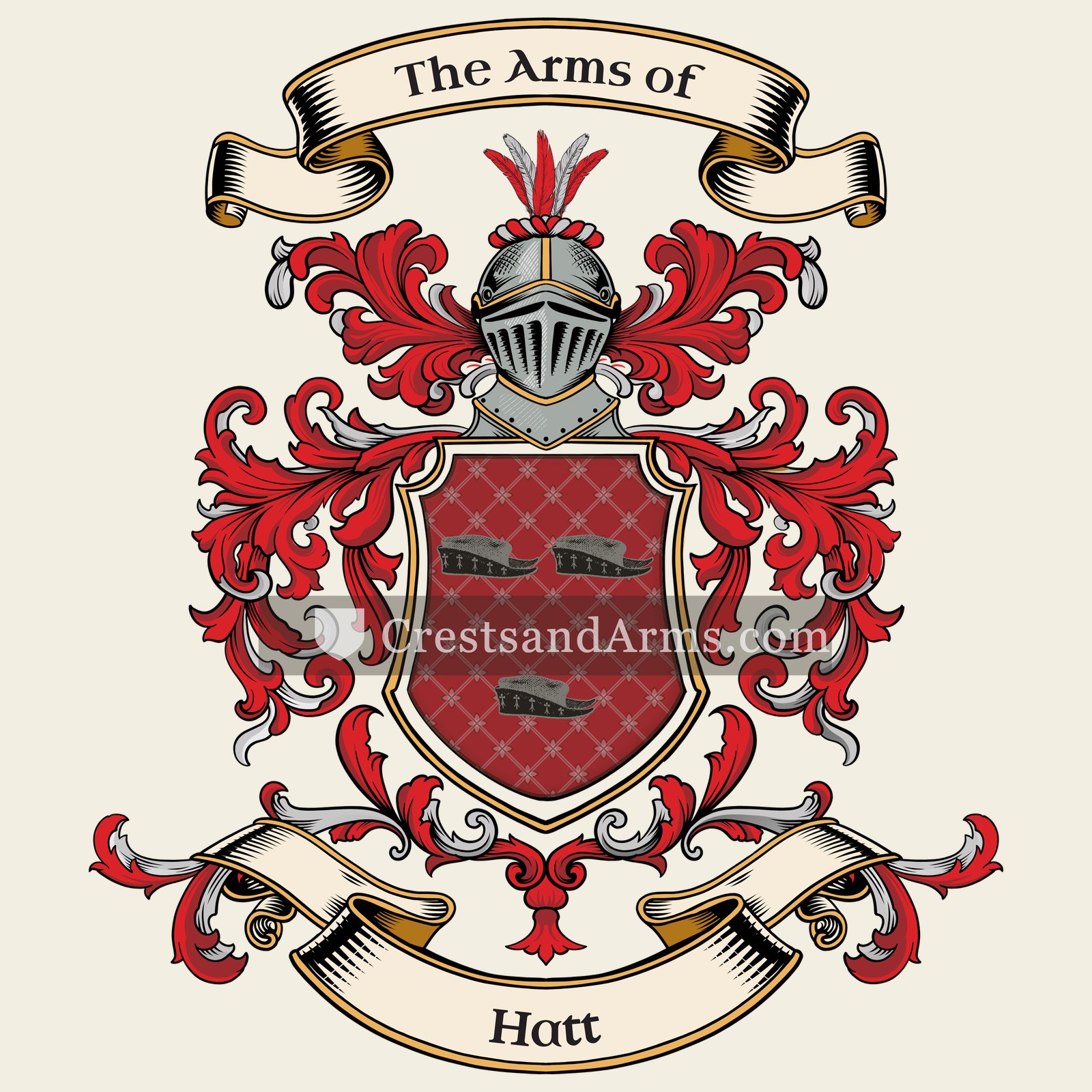
A record of documented arms, meaning and origin, researched for the Hatt family lines. Documented in 2 countries.
Reg. 6074 · Danish, G–I
Coat of Arms & Family Crest Details
Symbols on this shield
hat or capDignity, and the honour of office
Colours
Red (Gules)Means: Military strength
Black (Sable)Means: Constancy
Historical info
Source
J. B. Rietstap, Armorial Général, Gouda: G. B. van Goor Zonen, 1884–87
Blazon (the actual original written record)
“De gu. à trois chapeaux de sa, entourés chacun d'une corde d'or. C.: trois pl. d'aut., une de sa. entre deux de gu.”
Denmarkc. 1722
Where the Hatt Arms Were Recorded
Sjaælland
Map of Denmark showing where the Hatt arms are recorded
The Hatt arms were recorded in Denmark, c. 1722.
Arms such as these were typically recorded in Sjaælland.
Zealand held the Danish court, the crown's offices and Copenhagen itself. Families who served the king kept estates within reach of it, and royal service was the ordinary route to a coat of arms.
This is where the arms were entered in the register. Families often moved to other parts of the country, so the same name can turn up in more than one region.
The body that granted and recorded arms in Denmark in this period.
Frederik IV of Denmark
Sovereign of the period
Frederik IV of Denmark
1699–1730
Reigning in Denmark when the Hatt arms are first recorded.
How Arms Worked in Denmark
Danish heraldry during this period was closely tied to noble status and royal favor rather than being open to all citizens. Arms were typically granted by the monarch to individuals, and these symbols were then shared by all members of the noble house. If a family line died out, the right to use those specific arms ended with them.
Granting authority
The Danish royal chancery held the power to issue and regulate official coats of arms for the kingdom.
How they got arms
Families usually received their arms through a formal royal grant that confirmed their noble status and rights.
Where arms were recorded
These grants were officially recorded in the Danish Royal Chancery records starting in the sixteenth century.
The family's standing
Recorded among the armigerous families of Denmark.
Origin & History of the Hatt Family in Denmark
The family name Hatt has deep roots in the Danish landscape, with documented evidence placing members of the family on the island of Sjælland as early as 1722. During this period, the name was closely tied to the social and agricultural structures of rural Denmark. Families often lived in small village communities where their identity was shaped by the local parish and their work on the land. Because surnames were not strictly regulated in the early 18th century, the name likely emerged from a specific local nickname or a reference to a person's trade or physical appearance. As the family grew, they became part of the broader history of the Danish peasantry, navigating the transition from traditional farming life to the more structured society of the modern era. Their presence in Sjælland highlights the long-standing connection between the family and the historical development of the Danish countryside.
Coat of Arms & Family Crest Details
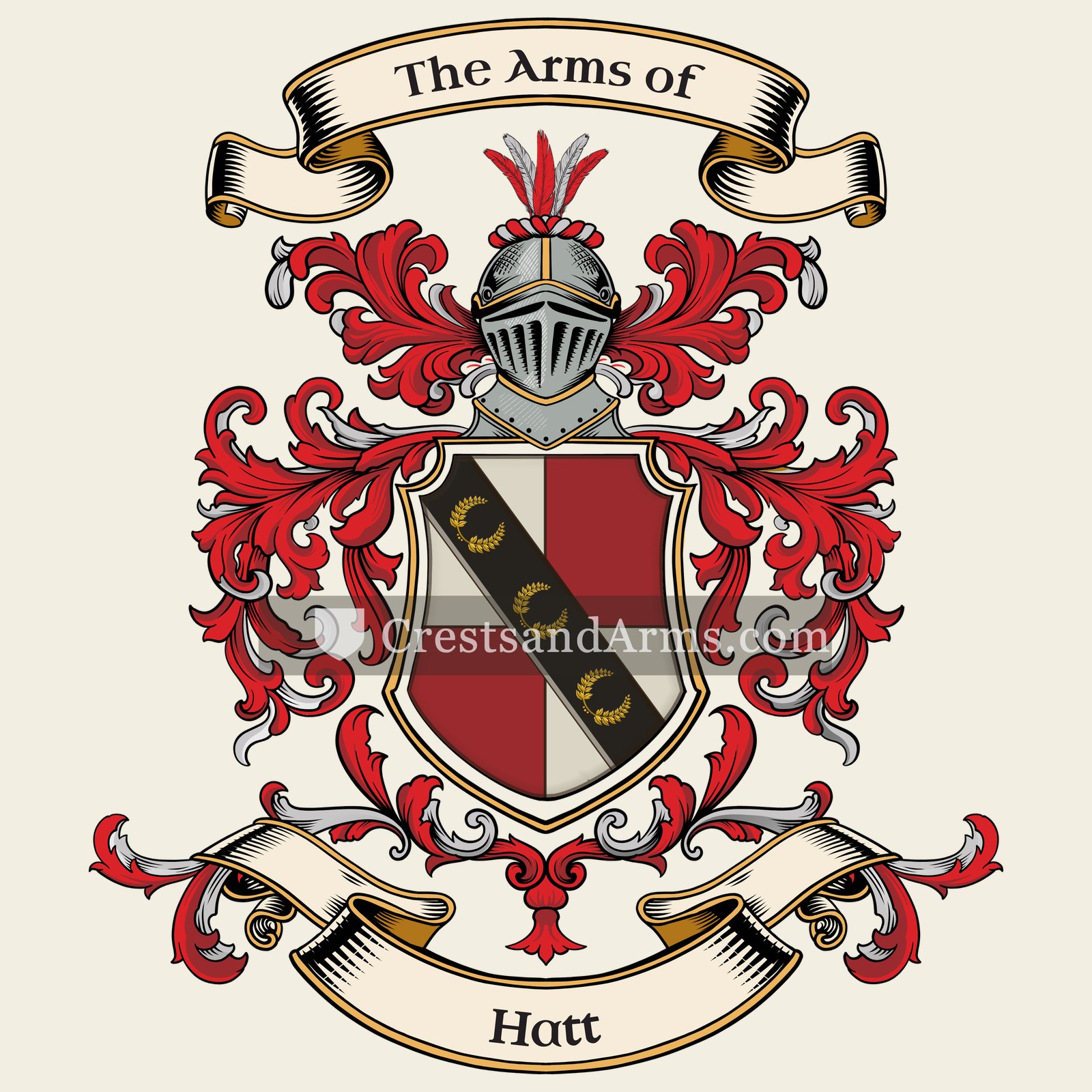
Symbols on this shield
bendDefence, and the scarf of a commander
wreathHonour, and a victory crowned
Colours
Silver (Argent)Means: Peace and sincerity
Red (Gules)Means: Military strength
Black (Sable)Means: Constancy
Gold (Or)Means: Generosity
Historical info
Source
Sir Bernard Burke, The General Armory of England, Scotland, Ireland and Wales, London: Harrison & Sons, 1884
Blazon (the actual original written record)
“Quarterly, ar. and gu. on a bend sa. three chaplets or”
BerksBerks, c. 1620
Where the Hatt Arms Were Recorded
Berks
Map of England showing where the Hatt arms are recorded
The Hatt arms were recorded in Berks, c. 1620.
Berkshire sat on the road west from London with the royal castle at Windsor in the middle of it. Court families bought estates within reach, and an estate near the court almost always came with a coat of arms.
This is where the arms were entered in the register. Families often moved to other parts of the country, so the same name can turn up in more than one region.
The body that granted and recorded arms in England in this period.
James VI and I
Sovereign of the period
James VI and I
1603–1625
Reigning in Denmark when the Hatt arms are first recorded.
How Arms Worked in England
English heraldry allowed arms to be shared by all legitimate descendants of the original owner. These symbols were treated as personal property that moved through the generations to all children. While the eldest son kept the original design, other family members could use the same shield without needing to change it or register their own unique versions.
Granting authority
The College of Arms in London has regulated the use of coats of arms throughout England and Wales since 1484.
How they got arms
Families typically obtained their coats of arms through a formal grant from the Crown or by proving their ancient right to them.
Where arms were recorded
All official coats of arms are recorded in the registers kept at the College of Arms, which date back to the fifteenth century.
The family's standing
Recorded among the armigerous families of Berks.
Origin & History of the Hatt Family in England
The family name Hatt has deep roots in the English countryside, with historical evidence placing members of the family in the county of Berkshire by the early 17th century. The name itself is likely topographic in origin, meaning it was often used to describe people who lived near a specific landmark, such as a small hill or a dwelling with a distinctive roof. During the 1600s, families like the Hatts were typically part of the yeoman class, which consisted of independent farmers who owned or rented their own land. Living in Berkshire provided these families with access to fertile soil and proximity to the growing trade routes near the River Thames. As the family established their lives in these rural communities, they became part of the local social fabric, participating in parish life and contributing to the agricultural economy that defined the region at the time. Their presence in the historical record during this era reflects the steady growth of stable, land-owning families who helped shape the development of English village life.
Related Branches & Arms
Root word
Hatt
Old Norse word for a head covering or hood.
This name
HattAn occupational name for a maker or seller of hats.
also spelled
Hat
Documented Sources
J. B. Rietstap, Armorial Général, Gouda: G. B. van Goor Zonen, 1884–87
Hatt, Gudmund. Oldtidsagre. 1949
Nielsen, Oluf. Kjøbenhavns Diplomatarium. 1872
Rigsarkivet, Danske Kancelli, Sjællandske Registre
Rigsarkivet, Kirkebøger for Sjællands Stift
Digital archive packCoat of arms PNG, gold border print PDF, vector SVG and the certificate of authenticity. Sent to your email in minutes.


 hat or capDignity, and the honour of office
 hat or capDignity, and the honour of office

 bendDefence, and the scarf of a commander
 wreathHonour, and a victory crowned