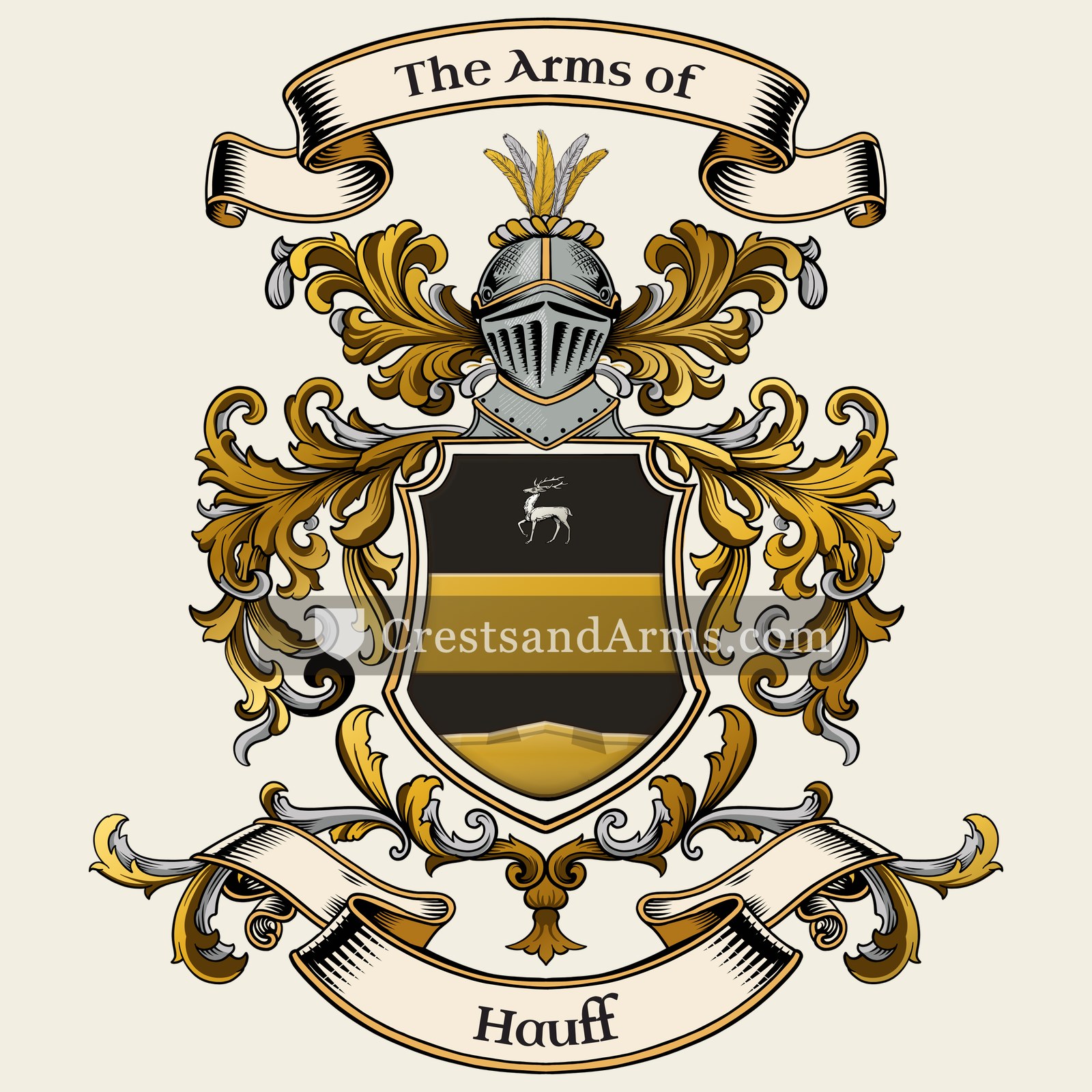
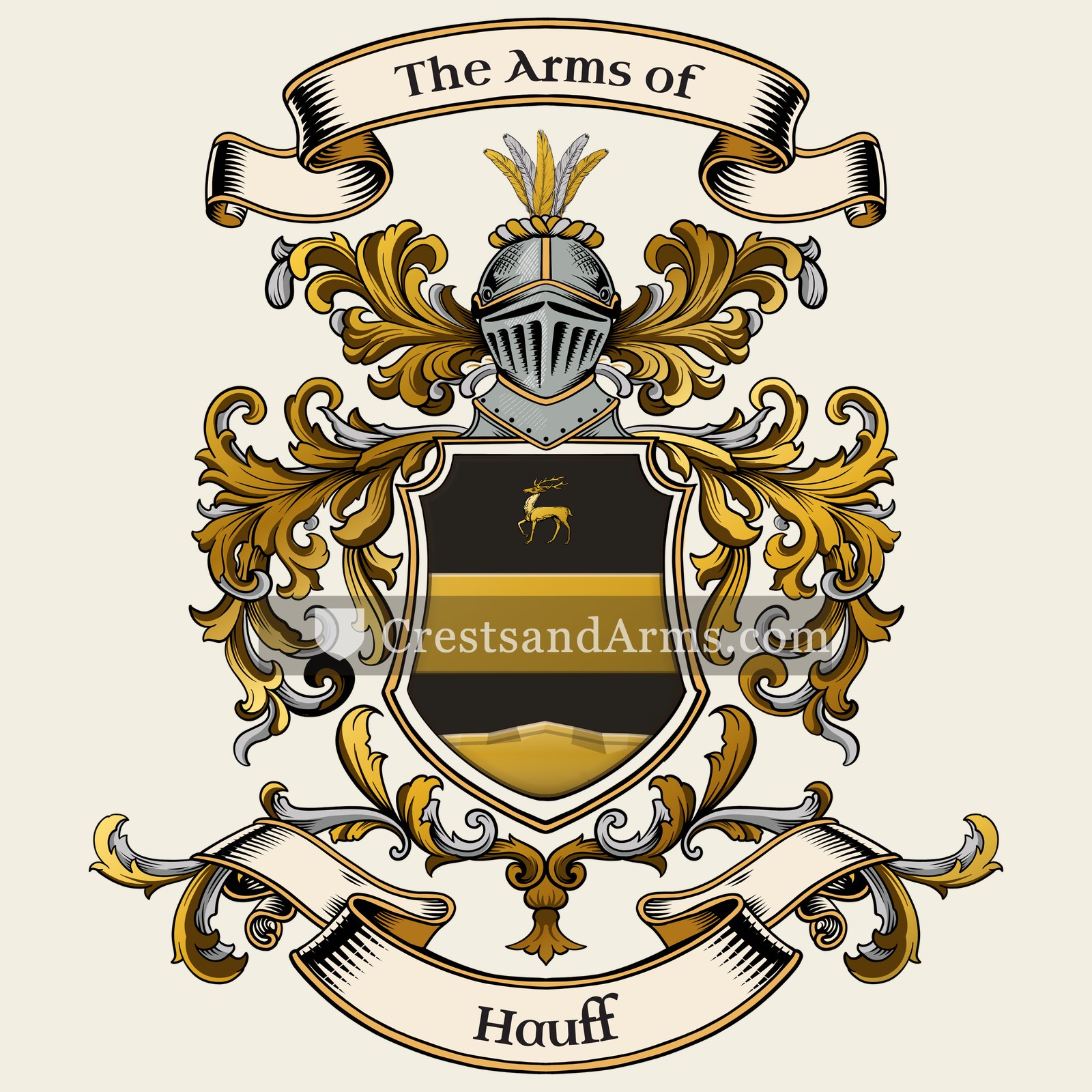
A record of documented arms, meaning and origin, researched for the Hauff family lines. Documented in 2 countries.
Reg. 4077 · Russian, G–I
Coat of Arms & Family Crest Details
Symbols on this shield
fessThe military belt, and readiness to serve
mountThe ground held, and steadfastness upon it
stagPeace and harmony, and one who will not fight unprovoked
Colours
Black (Sable)Means: Constancy
Gold (Or)Means: Generosity
Historical info
Source
J. B. Rietstap, Armorial Général, Gouda: G. B. van Goor Zonen, 1884–87
Blazon (the actual original written record)
“De sa. à la fasce d'or, acc. en chef d'un cerf naiss. au nat., mouv. de la fasce, et en p. d'un tertre de trois coupeaux d'or, mouv. de la p. Cq. cour. C.: un cerf élancé au nat. L. d'or et de sa. [D'après le diplôme de 1604, le tertre était de sin.]”
Russiac. 1604
Where the Hauff Arms Were Recorded
Moscow
Map of Russia showing where the Hauff arms are recorded
The Hauff arms were recorded in Russia, c. 1604.
Arms such as these were typically recorded in Moscow.
Moscow held the Russian court, and rank there came from service rather than land. Families who served the Tsar were entered in the registers of nobility, and that entry is where their arms are recorded.
This is where the arms were entered in the register. Families often moved to other parts of the country, so the same name can turn up in more than one region.
The body that granted and recorded arms in Russia in this period.
Boris Godunov
Sovereign of the period
Boris Godunov
1598–1605
Reigning in Russia when the Hauff arms are first recorded.
How Arms Worked in Russia
Russian heraldry was strictly tied to the nobility and the state service system. Families proved their ancient status or earned new rank to receive an official grant from the Tsar. These symbols were then inherited by all legitimate children of the noble line. If a family lacked proof of their status, they were often excluded from the official records entirely.
Granting authority
The Herald Master's Office acted as the central state body that strictly regulated and verified all noble heraldic symbols.
How they got arms
Families typically received their arms through a formal state grant or by proving their noble status to the government authorities.
Where arms were recorded
All approved coats of arms were officially recorded in the General Armorial of the Noble Families of the Russian Empire starting in 1797.
The family's standing
Recorded among the armigerous families of Russia.
Origin & History of the Hauff Family in Russia
The Hauff family name first appeared in the historical record of Moscow in 1604, marking the arrival of individuals who were likely part of the growing community of European specialists invited to Russia during the late Rurikid and early Romanov eras. At this time, Moscow was a center of trade and diplomacy, attracting craftsmen, military experts, and merchants from across the continent. Members of the Hauff family were among those who integrated into the professional circles of the Russian capital, often serving in roles that required technical knowledge or administrative skill. By settling in the city during this period of transition, the family became part of the diverse social fabric that defined Moscow before the major reforms of the eighteenth century. Their presence reflects the long history of international movement into Russia, where families like the Hauffs adapted to local customs while maintaining their distinct identity within the urban landscape.
Coat of Arms & Family Crest Details
Symbols on this shield
fessThe military belt, and readiness to serve
mountThe ground held, and steadfastness upon it
stagPeace and harmony, and one who will not fight unprovoked
Colours
Black (Sable)Means: Constancy
Gold (Or)Means: Generosity
Historical info
Source
J. B. Rietstap, Armorial Général, Gouda: G. B. van Goor Zonen, 1884–87
Blazon (the actual original written record)
“De sa. à une fasce, acc. en chef d'un cerf naiss., mouv. de la fasce, et en p. d'un tertre de trois coupeaux, le tout d'or. Cq. cour. C.: un cerf élancé d'or [Armes du littérateur Wilhelm Hauff, né le 29 nov. 1802, décédé le 18 sept. 1827.]”
WurttembergWurttemberg, c. 1604
Where the Hauff Arms Were Recorded
Wurttemberg
Map of Germany showing where the Hauff arms are recorded
The Hauff arms were recorded in Wurttemberg, c. 1604.
Wurttemberg was southern German country of small estates and well-off market towns. Both landowners and leading townsmen kept arms there, so the region carries far more names than its size suggests.
This is where the arms were entered in the register. Families often moved to other parts of the country, so the same name can turn up in more than one region.
The body that granted and recorded arms in Germany in this period.
Emperor Rudolf II
Sovereign of the period
Emperor Rudolf II
1576–1612
Reigning in Russia when the Hauff arms are first recorded.
How Arms Worked in Germany
In the Holy Roman Empire, coats of arms were often granted to individuals by the Emperor or his representatives. These arms were then passed down through the generations to all legitimate descendants of the original holder. Younger branches of a family usually kept the same shield design without needing to change it, as the arms belonged to the entire lineage.
Granting authority
The Holy Roman Emperor held the sole power to grant new coats of arms throughout his vast imperial territories.
How they got arms
Families typically obtained their coats of arms through a formal imperial grant or by proving their noble status to the authorities.
Where arms were recorded
These grants were officially recorded in the Imperial Chancery registers, which began keeping formal records of such honors during the Middle Ages.
The family's standing
Recorded among the armigerous families of Wurttemberg.
Origin & History of the Hauff Family in Germany
The family name Hauff traces its roots back to the southwestern region of Germany, specifically within the historic territory of Württemberg. By the early 17th century, records confirm that members of the Hauff family were well-established in this area, living as part of the local agrarian and artisan communities. The name itself is thought to be derived from a descriptive term for a small hill or a mound of earth, suggesting that the earliest ancestors likely lived near a prominent geographical feature in the landscape. As the family grew during the 1600s, they became deeply integrated into the social and religious life of the region, often appearing in church registers that documented births, marriages, and deaths. This period was marked by significant upheaval in Germany, yet the Hauff family maintained a consistent presence in Württemberg, contributing to the local economy and the development of their community through generations of steady work and civic participation.
Related Branches & Arms
Root word
Haufe
A Middle High German term for a heap, pile, or crowd.
This name
HauffA topographic or occupational name referring to someone living near a mound or a leader of a group.
also spelled
Hauf
Howf
Related arms
Haufvariant spelling
Documented Sources
J. B. Rietstap, Armorial Général, Gouda: G. B. van Goor Zonen, 1884–87
Baehr, Stephen L., The Paradise Myth in Eighteenth-Century Russia: Utopian Patterns in Early Secular Russian Literature and Culture, 1991
Russian State Archive of Ancient Acts (RGADA), Fond 141: Prikaznye dela starykh let
Digital archive packCoat of arms PNG, gold border print PDF, vector SVG and the certificate of authenticity. Sent to your email in minutes.


 fessThe military belt, and readiness to serve
 mountThe ground held, and steadfastness upon it
 stagPeace and harmony, and one who will not fight unprovoked
 fessThe military belt, and readiness to serve
 mountThe ground held, and steadfastness upon it
 stagPeace and harmony, and one who will not fight unprovoked