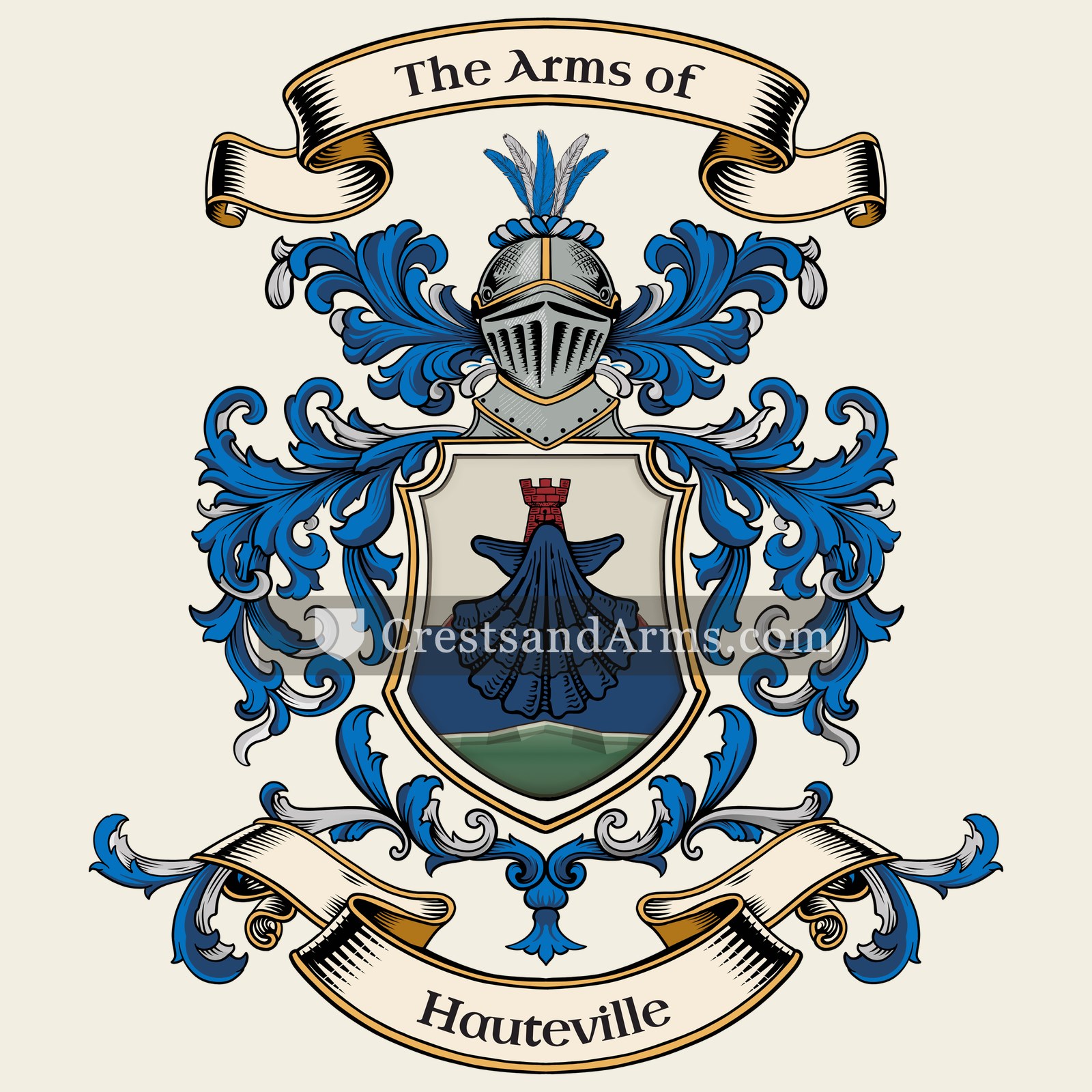
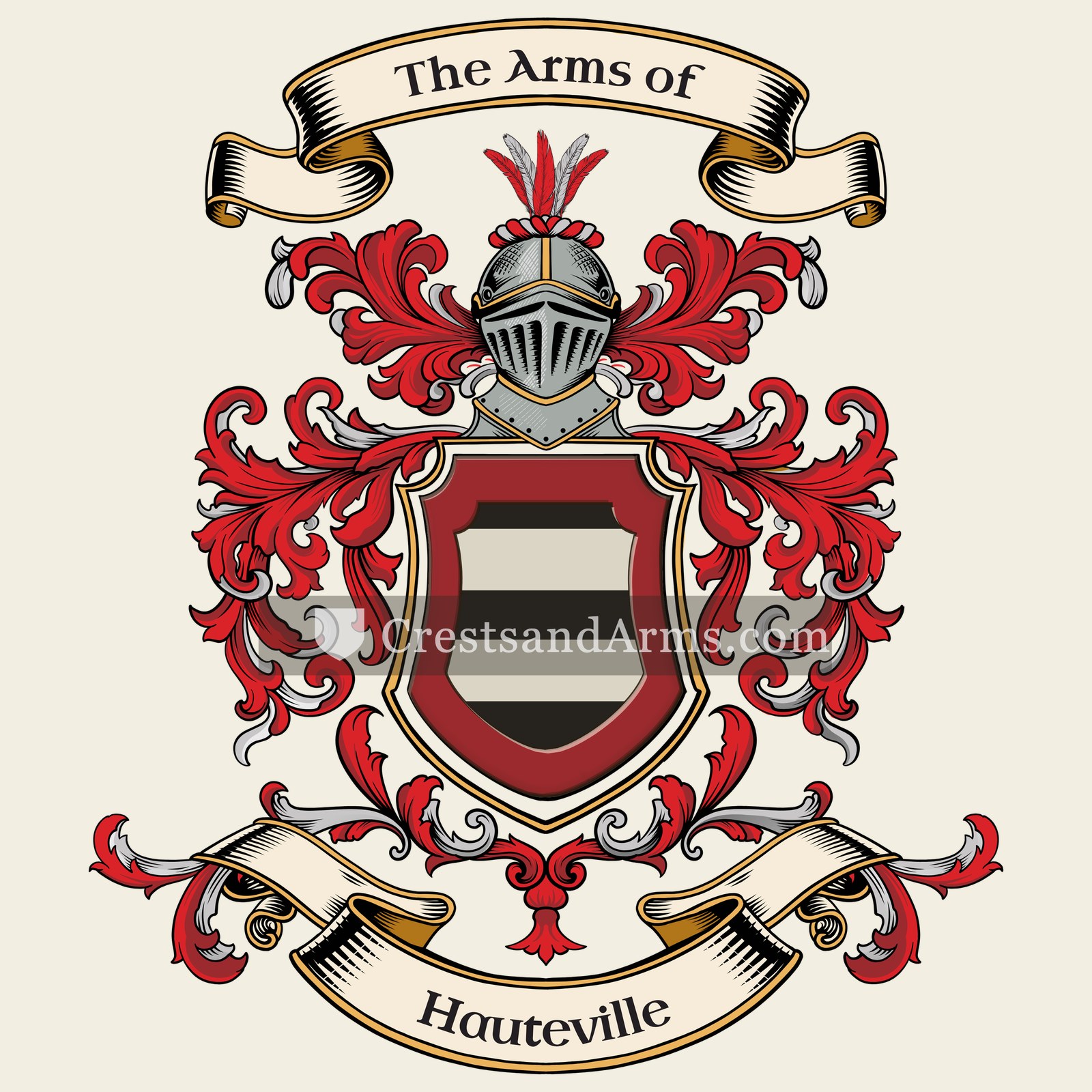
A record of documented arms, meaning and origin, researched for the Hauteville family lines. Documented in 2 countries.
Reg. 4254 · German, G–I
Coat of Arms & Family Crest Details
Symbols on this shield
mountThe ground held, and steadfastness upon it
escallopThe pilgrim's shell, and a long journey made
towerGrandeur and solidity, and a stronghold defended
armA person of action, industrious and laborious
Colours
Silver (Argent)Means: Peace and sincerity
Blue (Azure)Means: Loyalty and truth
Green (Vert)Means: Hope
Red (Gules)Means: Military strength
Historical info
Source
J. B. Rietstap, Armorial Général, Gouda: G. B. van Goor Zonen, 1884–87
Blazon (the actual original written record)
“Coupé: au 1 parti: a. d'arg. à un château de trois tours de gu., couvertes de toits pointus d'azur, girouettées d'or, posé sur une terrasse de sin.; b. d'azur à un dextrochère, arm. au nat., la main de carn. tenant une épée d'arg., garnie d'or; au 2 de gu. à une coquille d'arg.”
Germanyc. 1765
Where the Hauteville Arms Were Recorded
Bavaria
Map of Germany showing where the Hauteville arms are recorded
The Hauteville arms were recorded in Germany, c. 1765.
Arms such as these were typically recorded in Bavaria.
Bavaria was a country of old landed families and walled market towns. Estates passed down the same line for centuries, and both the landowners and the leading townsmen kept arms, which is why so many Bavarian names sit in the registers.
This is where the arms were entered in the register. Families often moved to other parts of the country, so the same name can turn up in more than one region.
The body that granted and recorded arms in Germany in this period.
Francis I, Holy Roman Emperor
Sovereign of the period
Francis I, Holy Roman Emperor
1745–1765
Reigning in Germany when the Hauteville arms are first recorded.
How Arms Worked in Germany
In the Holy Roman Empire, coats of arms were often granted to individuals by the Emperor or his representatives. These arms were then passed down through the generations to all legitimate descendants of the original holder. Younger branches of a family usually kept the same shield design without needing to change it, as the arms belonged to the entire lineage.
Granting authority
The Holy Roman Emperor held the sole power to grant new coats of arms throughout his vast imperial territories.
How they got arms
Families typically obtained their coats of arms through a formal imperial grant or by proving their noble status to the authorities.
Where arms were recorded
These grants were officially recorded in the Imperial Chancery registers, which began keeping formal records of such honors during the Middle Ages.
The family's standing
Recorded among the armigerous families of Germany.
Origin & History of the Hauteville Family in Germany
The history of the Hauteville family in Germany centers on their presence in the Bavarian region during the mid-eighteenth century. While the name is famously associated with the medieval Norman dynasty that conquered Sicily, the German branch represents a distinct migration pattern that took root in the Holy Roman Empire by 1765. These early family members were likely part of the professional or administrative classes who moved across European borders to serve in local government or agricultural management. Settling in Bavaria allowed the family to integrate into the social fabric of the region during a time of significant political change. By establishing themselves in this area, the family transitioned from their historical roots in Western Europe to become a part of the local Bavarian population. This period serves as the primary anchor for their documented existence in German records and highlights their role as settlers in a changing landscape.
Coat of Arms & Family Crest Details
Symbols on this shield
fessThe military belt, and readiness to serve
Colours
Silver (Argent)Means: Peace and sincerity
Black (Sable)Means: Constancy
Red (Gules)Means: Military strength
Historical info
Source
J. B. Rietstap, Armorial Général, Gouda: G. B. van Goor Zonen, 1884–87
Blazon (the actual original written record)
“D'arg. à trois fasces de sa.; à la bord. de gu.”
NormandieNormandie, c. 1663
Where the Hauteville Arms Were Recorded
Normandie
Map of France showing where the Hauteville arms are recorded
The Hauteville arms were recorded in Normandie, c. 1663.
Normandie held a dense crowd of knightly families on some of the best farmland in France. Its men had fought and settled abroad for generations, and a family that sent sons to war needed a shield they could be recognised by.
This is where the arms were entered in the register. Families often moved to other parts of the country, so the same name can turn up in more than one region.
The body that granted and recorded arms in France in this period.
Louis XIV of France
Sovereign of the period
Louis XIV of France
1643–1715
Reigning in Germany when the Hauteville arms are first recorded.
How Arms Worked in France
In France, a coat of arms was a mark of honor that passed down through the male line to all legitimate descendants. Families often used the same shield without changes to show their shared heritage. If a branch wanted to stand out, they could add a small mark to their shield to show their specific place in the family tree.
Granting authority
The Juge d'armes de France acted as the official authority that regulated and verified coats of arms across the country.
How they got arms
Families typically inherited their arms from ancestors, though they could also receive them through royal grants or by proving their noble status.
Where arms were recorded
Coats of arms were officially recorded in the Armorial Général de France, which began its main collection in the year 1696.
The family's standing
Recorded among the armigerous families of Normandie.
Origin & History of the Hauteville Family in France
The Hauteville family name finds its roots in the northern region of France known as Normandy. While the name is famously associated with the medieval knights who conquered southern Italy, the branch of the family documented in 1663 reflects a long-standing presence within the French countryside. During this period, the family lived as part of the local landed gentry or agricultural society in the Norman territories. The name itself is descriptive, derived from the French words for high and town, which suggests that the original ancestors likely settled on elevated land or near a prominent village. By the mid-seventeenth century, the Hautevilles were firmly established as a part of the regional fabric of Normandy. They lived through the shifting social and political changes of the French provinces, maintaining their identity as a family with deep ties to the northern landscape.
Related Branches & Arms
Root word
Altus Villa
Latin for high or elevated settlement or farmstead.
This name
HautevilleRefers to a residence or estate situated on high ground or a hill.
also spelled
Hautevil
Otvil
Documented Sources
J. B. Rietstap, Armorial Général, Gouda: G. B. van Goor Zonen, 1884–87


 mountThe ground held, and steadfastness upon it
 escallopThe pilgrim's shell, and a long journey made
 towerGrandeur and solidity, and a stronghold defended
 armA person of action, industrious and laborious
 mountThe ground held, and steadfastness upon it
 escallopThe pilgrim's shell, and a long journey made
 towerGrandeur and solidity, and a stronghold defended
 armA person of action, industrious and laborious

 fessThe military belt, and readiness to serve