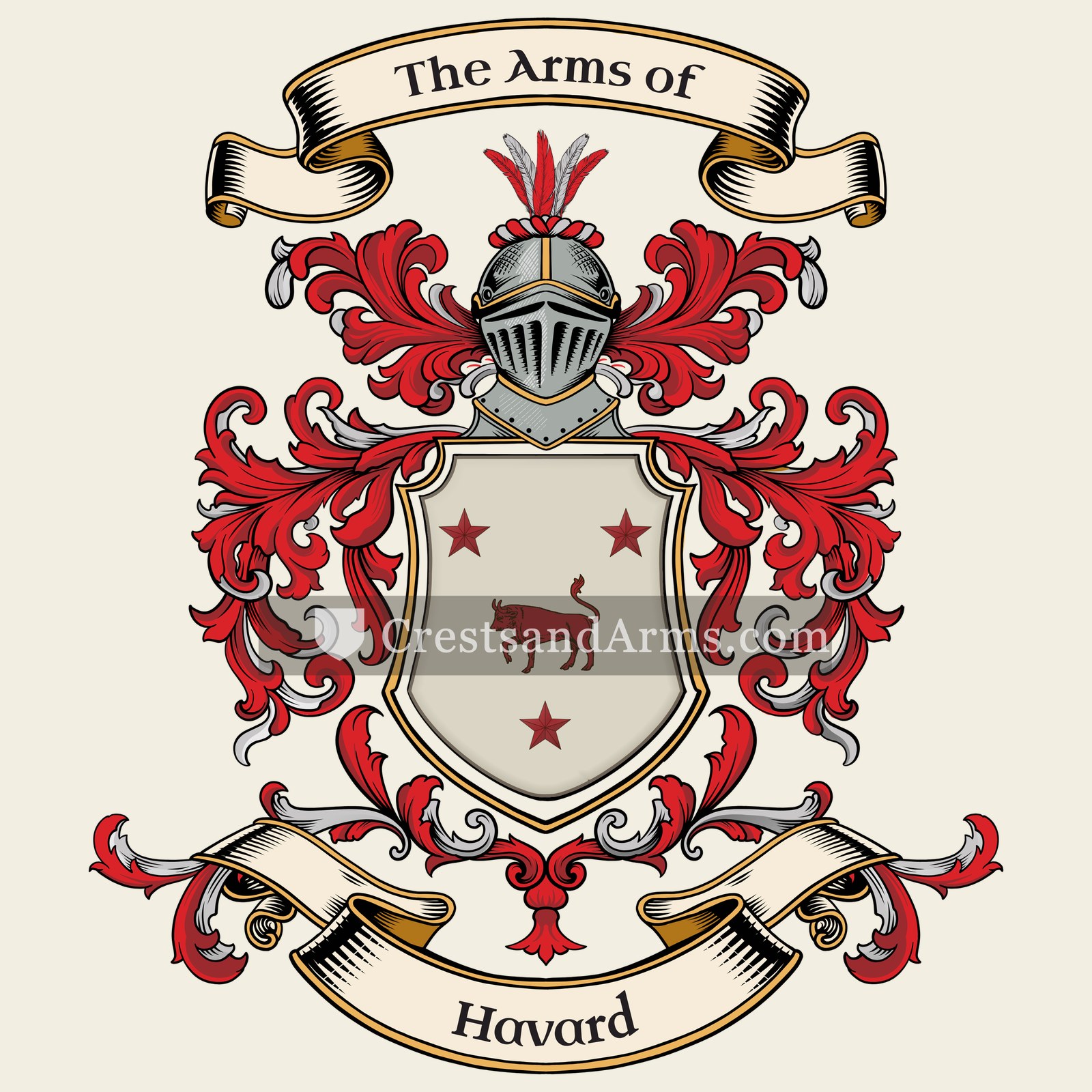
A record of documented arms, meaning and origin, researched for the Havard family of Wales.
Reg. 2367 · Welsh, G–I
Coat of Arms & Family Crest Details
Symbols on this shield
bullValour and generosity
mulletThe third son, and a divine quality from above
Colours
Silver (Argent)Means: Peace and sincerity
Red (Gules)Means: Military strength
Historical info
Source
Sir Bernard Burke, The General Armory of England, Scotland, Ireland and Wales, London: Harrison & Sons, 1884
Blazon (the actual original written record)
“Ar. a bull's head cabossed betw. three mullets gu”
BreconDevyncock · Brecon, c. 1647
Where the Havard Arms Were Recorded
Brecon
Map of Wales showing where the Havard arms are recorded
The Havard arms were recorded in Brecon, c. 1647.
Brecon was mid-Welsh hill country, held in small estates by families who stayed for generations. Land was worth less than in the lowlands, but holding it still brought arms.
This is where the arms were entered in the register. Families often moved to other parts of the country, so the same name can turn up in more than one region.
The body that granted and recorded arms in Wales in this period.
Charles I of England
Sovereign of the period
Charles I of England
1625–1649
Reigning in Wales when the Havard arms are first recorded.
How Arms Worked in Wales
English heraldry allowed arms to be shared by all legitimate descendants of the original owner. These symbols were treated as personal property that moved through the generations to all children. While the eldest son kept the original design, other family members could use the same shield without needing to change it or register their own unique versions.
Granting authority
The College of Arms in London has regulated the use of coats of arms throughout England and Wales since 1484.
How they got arms
Families typically obtained their coats of arms through a formal grant from the Crown or by proving their ancient right to them.
Where arms were recorded
All official coats of arms are recorded in the registers kept at the College of Arms, which date back to the fifteenth century.
The family's standing
Recorded among the armigerous families of Brecon.
Origin & History of the Havard Family in Wales
The surname Havard has deep roots in the border regions between England and Wales, particularly within the historic county of Breconshire. The name is thought to originate from the Old Norse personal name Havardr, which translates to high guardian or high warden. Following the Norman Conquest, families bearing this name settled in the Welsh Marches and became prominent landowners in the area surrounding the town of Brecon. By the mid-seventeenth century, the Havard family was well-established in the region, as evidenced by records showing their presence in Brecon during the year 1647. These early family members were often involved in local governance and the social life of the town, helping to shape the community during a period of significant political change in Britain. Over the centuries, the family name became synonymous with the history of the Brecon area, reflecting a long legacy of settlement and local influence.
Related Branches & Arms
Root word
Hafvarðr
Old Norse name composed of elements meaning summer and guardian.
This name
HavardA surname of Norse origin meaning guardian of the summer or summer protector.
also spelled
Havart
Haverd
Documented Sources
Sir Bernard Burke, The General Armory of England, Scotland, Ireland and Wales, London: Harrison & Sons, 1884
Charles, B. G., The Place-Names of Pembrokeshire, 1992
Morgan, T. J. and Morgan, P., Welsh Surnames, 1985
The National Library of Wales, Breconshire Quarter Sessions Records
Digital archive packCoat of arms PNG, gold border print PDF, vector SVG and the certificate of authenticity. Sent to your email in minutes.


 bullValour and generosity
 mulletThe third son, and a divine quality from above
 bullValour and generosity
 mulletThe third son, and a divine quality from above