Map of Wales showing where the Hawkinson arms are recorded
The Hawkinson arms were recorded in Monmouth, c. 1647.
Monmouthshire lay on the Welsh border, where land was held in return for military service. Families were expected to arm and to fight, and fighting households carried shields of their own.
This is where the arms were entered in the register. Families often moved to other parts of the country, so the same name can turn up in more than one region.
The body that granted and recorded arms in Wales in this period.
Charles I of England
Sovereign of the period
Charles I of England
1625–1649
Reigning in Wales when the Hawkinson arms are first recorded.
How Arms Worked in Wales
English heraldry allowed arms to be shared by all legitimate descendants of the original owner. These symbols were treated as personal property that moved through the generations to all children. While the eldest son kept the original design, other family members could use the same shield without needing to change it or register their own unique versions.
Granting authority
The College of Arms in London has regulated the use of coats of arms throughout England and Wales since 1484.
How they got arms
Families typically obtained their coats of arms through a formal grant from the Crown or by proving their ancient right to them.
Where arms were recorded
All official coats of arms are recorded in the registers kept at the College of Arms, which date back to the fifteenth century.
The family's standing
Recorded among the armigerous families of Monmouth.
Origin & History of the Hawkinson Family in Wales
The surname Hawkinson is a patronymic name, meaning it was originally formed to identify a person as the son of a man named Hawk or Hawkin. While the name has strong roots in English naming traditions, its presence in Wales is tied to the movement of families across the border into the borderlands of Monmouthshire. By 1647, records confirm that members of the family were established in the town of Monmouth, a region that served as a vital gateway between the Welsh mountains and the English lowlands. During this period, Monmouth was a center of significant political and social change due to the aftermath of the English Civil War. Families like the Hawkinsons living in this area often adapted to the local culture while maintaining their distinct identity. Over time, these early settlers became part of the unique social fabric of the Welsh border, blending the traditions of their ancestors with the developing history of the region.
Coat of Arms & Family Crest Details
Symbols on this shield
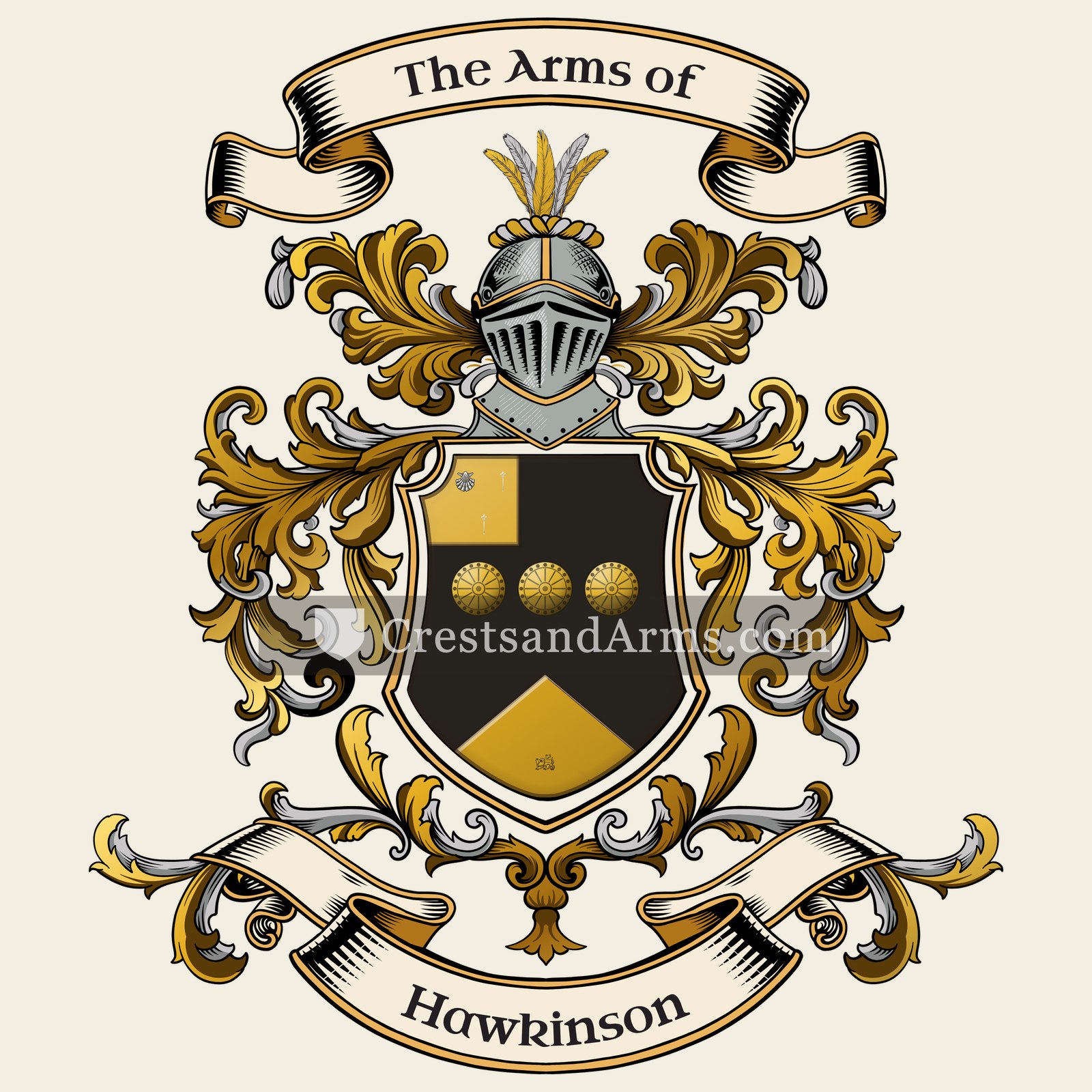
cantonA mark of honour granted by the sovereign
escallopThe pilgrim's shell, and a long journey made
lionCourage, strength and royalty
roundelA coin, and one who has been to the crusades
batonAuthority and office held under the crown
Colours
Black (Sable)Means: Constancy
Gold (Or)Means: Generosity
Historical info
Source
Sir Bernard Burke, The General Armory of England, Scotland, Ireland and Wales, London: Harrison & Sons, 1884
Blazon (the actual original written record)
“Sa. on a point wavy a lion pass. or, in chief three bezants: in 1571 an addition was granted by Cook, Clarenceux, viz., on a canton or, an escallop betw. two palmers' staves sa. Crest (granted with the first of these coats, in token of a remarkable victory over the Moors)—A demi Moor ppr. bound and captive, with annulets on his arms and ears or”
EnglandPlymouth, c. 1520
Digital archive packCoat of arms PNG, gold border print PDF, vector SVG and the certificate of authenticity. Sent to your email in minutes.
Map of England showing where the Hawkinson arms are recorded
The Hawkinson arms were recorded in Plymouth, c. 1520.
This is where the arms were entered in the register. Families often moved to other parts of the country, so the same name can turn up in more than one region.
The body that granted and recorded arms in England in this period.
Henry VIII of England
Sovereign of the period
Henry VIII of England
1509–1547
Reigning in Wales when the Hawkinson arms are first recorded.
How Arms Worked in England
English heraldry allowed arms to be shared by all legitimate descendants of the original owner. These symbols were treated as personal property that moved through the generations to all children. While the eldest son kept the original design, other family members could use the same shield without needing to change it or register their own unique versions.
Granting authority
The College of Arms in London has regulated the use of coats of arms throughout England and Wales since 1484.
How they got arms
Families typically obtained their coats of arms through a formal grant from the Crown or by proving their ancient right to them.
Where arms were recorded
All official coats of arms are recorded in the registers kept at the College of Arms, which date back to the fifteenth century.
The family's standing
Recorded among the armigerous families of England.
Origin & History of the Hawkinson Family in England
The surname Hawkinson is a patronymic name, which means it originated as a way to identify a person as the son of a man named Hawk or Hawkin. This name was a common diminutive form of the name Henry in medieval England. By the early 16th century, the family had established roots in the coastal regions of the country, specifically around Plymouth. During this period, the name appeared in local records as families began to settle into more permanent roles within their communities. These early ancestors were likely tradespeople or laborers who contributed to the growing maritime economy of the port city. As the family grew, the name became a fixed identifier that was passed down through generations, marking their transition from individuals known by their father’s name to a distinct family lineage.
Coat of Arms & Family Crest Details
Symbols on this shield
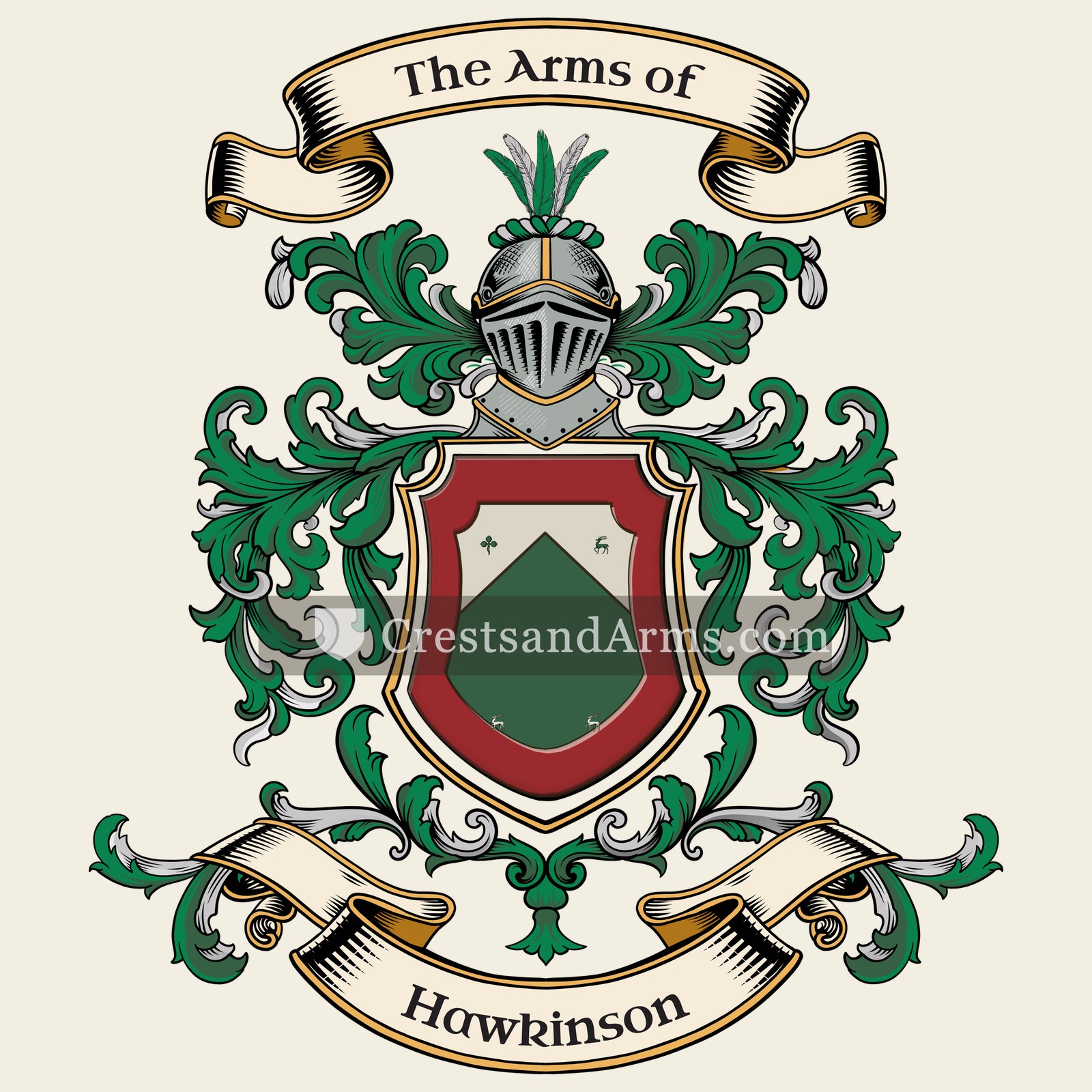
bordureA difference between branches of one family
trefoilPerpetuity, and the Trinity
stagPeace and harmony, and one who will not fight unprovoked
Colours
Silver (Argent)Means: Peace and sincerity
Green (Vert)Means: Hope
Red (Gules)Means: Military strength
Historical info
Source
Sir Bernard Burke, The General Armory of England, Scotland, Ireland and Wales, London: Harrison & Sons, 1884
Blazon (the actual original written record)
“Per chev. ar. and vert a trefoil counterchanged betw. three hinds trippant ppr. a bordure gu”
WexfordEnniscorthy Castle · Wexford, c. 1645
Digital archive packCoat of arms PNG, gold border print PDF, vector SVG and the certificate of authenticity. Sent to your email in minutes.
Map of Ireland showing where the Hawkinson arms are recorded
The Hawkinson arms were recorded in Wexford, c. 1645.
Wexford was the corner of Ireland closest to Wales, settled early by Norman families. They held their land under arms and kept it for generations, which is why so many Wexford names carry recorded shields.
This is where the arms were entered in the register. Families often moved to other parts of the country, so the same name can turn up in more than one region.
The body that granted and recorded arms in Ireland in this period.
Charles I of England
Sovereign of the period
Charles I of England
1625–1649
Reigning in Wales when the Hawkinson arms are first recorded.
How Arms Worked in Ireland
The Ulster King of Arms granted coats of arms to individuals who proved their social standing and good character. These symbols were typically inherited by all legitimate descendants of the original holder. If a family branch wanted a unique look, they could apply for a specific change to their design through the office to ensure their identity remained distinct.
Granting authority
The Ulster King of Arms acted as the official body that regulated and issued all coats of arms throughout Ireland.
How they got arms
Families obtained their arms through formal grants issued by the office after proving their eligibility and paying the required fees.
Where arms were recorded
All official grants were recorded in the registers held by the Ulster King of Arms starting from the year 1552.
The family's standing
Recorded among the armigerous families of Wexford.
Origin & History of the Hawkinson Family in Ireland
The family name Hawkinson is primarily of English and Scandinavian origin, but its presence in Ireland offers a unique look at the movement of people during the seventeenth century. By 1645, records confirm that members of the family were established in County Wexford. This region was a major point of contact between native Irish populations and settlers arriving from across the Irish Sea. The Hawkinsons likely arrived as part of the broader migration patterns that reshaped the social and economic landscape of southeastern Ireland during this period. Living in Wexford, a bustling port town with deep ties to trade and maritime activity, the family would have been positioned at a crossroads of cultural exchange. Their presence there suggests they were part of the growing community of merchants or landholders who helped define the local history of the region during a time of significant political transition.
Hawkinson Meaning & Related Branches
Root word
Hawk
A bird of prey often associated with keen sight and hunting.
This name
HawkinsonSon of the person known as Hawk, a nickname for a sharp-eyed or aggressive individual.
also spelled
Hawkyins
Haukins
Documented Sources
Sir Bernard Burke, The General Armory of England, Scotland, Ireland and Wales, London: Harrison & Sons, 1884
Bradney, Joseph Alfred, A History of Monmouthshire from the Coming of the Normans into Wales down to the Present Time, 1904
The National Archives, Kew, State Papers Domestic, Charles I, 1647
Digital archive packCoat of arms PNG, gold border print PDF, vector SVG and the certificate of authenticity. Sent to your email in minutes.


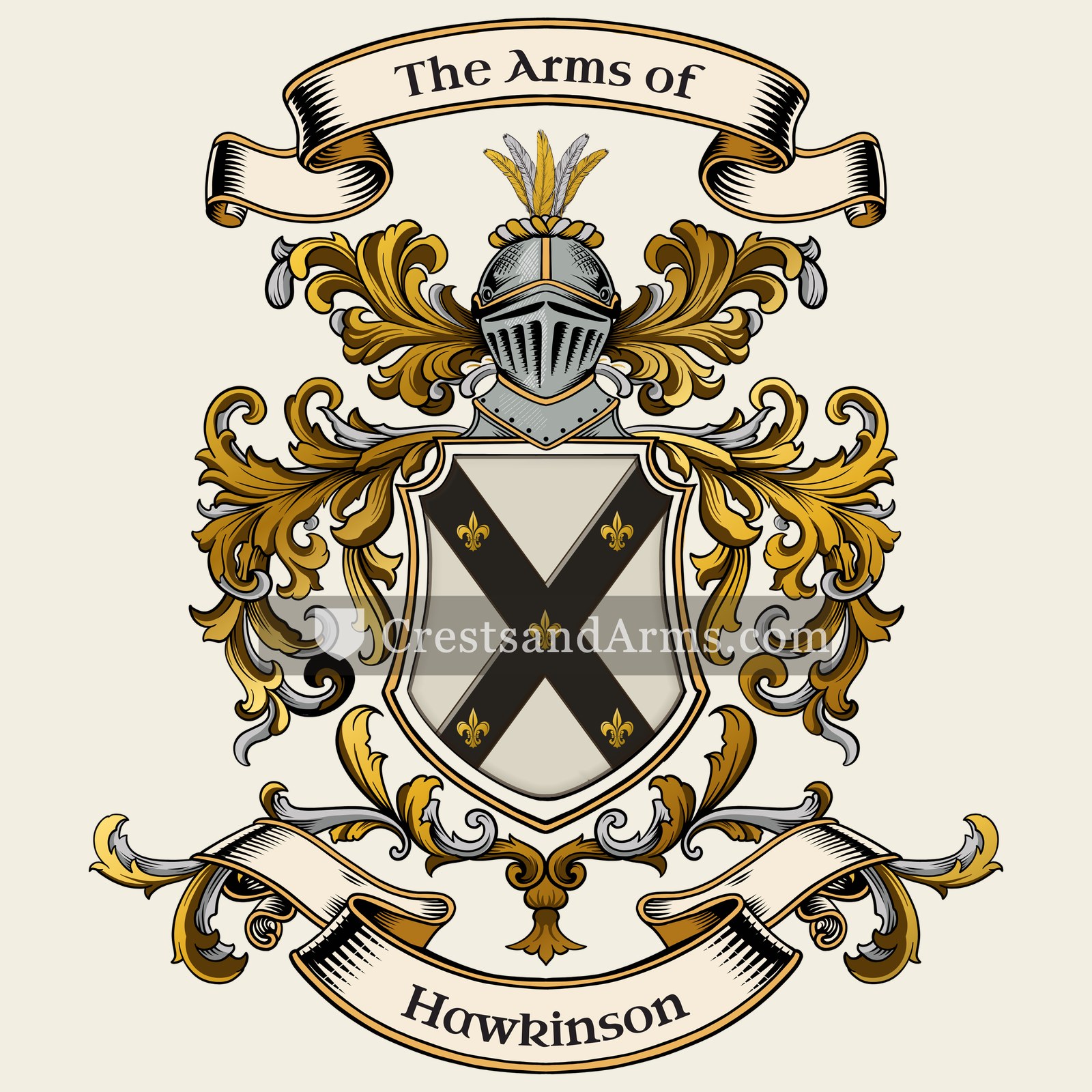
 saltireResolution, and St Andrew's cross
 fleur de lisPurity, light, and the sixth son
 saltireResolution, and St Andrew's cross
 fleur de lisPurity, light, and the sixth son


 cantonA mark of honour granted by the sovereign
 escallopThe pilgrim's shell, and a long journey made
 lionCourage, strength and royalty
 roundelA coin, and one who has been to the crusades
 batonAuthority and office held under the crown

 bordureA difference between branches of one family
 trefoilPerpetuity, and the Trinity
 stagPeace and harmony, and one who will not fight unprovoked