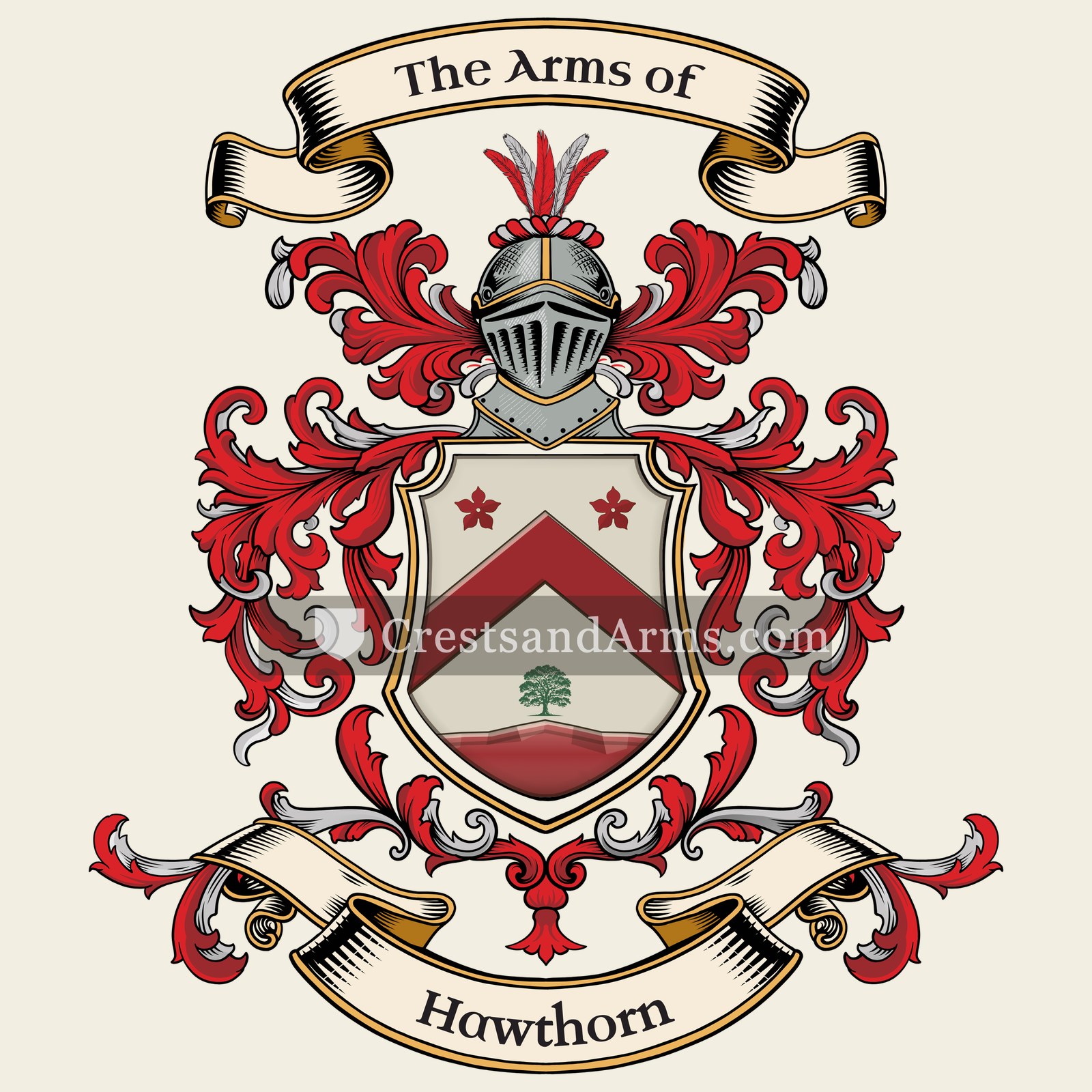
A record of documented arms, meaning and origin, researched for the Hawthorn family of Scotland.
Reg. 4854 · Scottish, G–I
Coat of Arms & Family Crest Details
Symbols on this shield
chevronProtection, and faithful service completed
mountThe ground held, and steadfastness upon it
cinquefoilHope and joy
treeLife, endurance and deep roots
Colours
Silver (Argent)Means: Peace and sincerity
Red (Gules)Means: Military strength
Green (Vert)Means: Hope
Historical info
Source
Sir Bernard Burke, The General Armory of England, Scotland, Ireland and Wales, London: Harrison & Sons, 1884
Blazon (the actual original written record)
“Ar. a chev. betw. two cinquefoils in chief gu. and a hawthorn tree vert, flowered ppr. growing out of a mount in base of the third”
WigtownCastlewig · Wigtown, c. 1769
Where the Hawthorn Arms Were Recorded
Wigtown
Map of Scotland showing where the Hawthorn arms are recorded
The Hawthorn arms were recorded in Wigtown, c. 1769.
Wigtown was Scotland's south-western corner, farming country facing Ireland. Its lairds held small estates for generations, and long unbroken holding is what fills a register of arms.
This is where the arms were entered in the register. Families often moved to other parts of the country, so the same name can turn up in more than one region.
The body that granted and recorded arms in Scotland in this period.
George III of Great Britain
Sovereign of the period
George III of Great Britain
1760–1801
Reigning in Scotland when the Hawthorn arms are first recorded.
How Arms Worked in Scotland
Scottish heraldry is unique because it treats a coat of arms as a piece of personal property protected by law. Only one person can own a specific design at any given time. When a family grows, the head keeps the original shield while other relatives must apply for their own distinct version with slight changes to prove their specific identity.
Granting authority
The Court of the Lord Lyon acts as the official body that regulates and controls all heraldic matters throughout Scotland.
How they got arms
Individuals obtain a legal right to their arms through a formal petition process that confirms their identity and family connection.
Where arms were recorded
All valid coats of arms are officially entered into the Public Register of All Arms and Bearings starting from 1672.
The family's standing
Recorded among the armigerous families of Wigtown.
Origin & History of the Hawthorn Family in Scotland
The surname Hawthorn is a locational name that likely originated from people who lived near a prominent hawthorn bush or a hedge made of these thorny shrubs. In the Old English language, the name combines the words for hedge and thorn. While the name appears in various parts of Britain, the Hawthorn family established a notable presence in the town of Wigtown in southwestern Scotland by the late 18th century. Records from 1769 confirm that members of the family were living and working in this area during a time of significant agricultural and social change. Families in this region often relied on local trade and farming, and the Hawthorns were part of the tight-knit community that helped shape the history of Wigtown. Over many generations, the family name became firmly rooted in the local landscape, reflecting a long connection to the Scottish countryside.
Related Branches & Arms
Root word
Hagathorn
Old English term for a hedge or enclosure made of thorn bushes.
This name
HawthornA topographic name for someone who lived near a prominent hawthorn tree or a thorny hedge.
also spelled
Hauthorne
Hauthorn
Related arms
Hathornvariant spelling
Documented Sources
Sir Bernard Burke, The General Armory of England, Scotland, Ireland and Wales, London: Harrison & Sons, 1884
Black, George F., The Surnames of Scotland: Their Origin, Meaning, and History, 1946
National Records of Scotland, Wigtown Parish Registers, 1769
Digital archive packCoat of arms PNG, gold border print PDF, vector SVG and the certificate of authenticity. Sent to your email in minutes.


 chevronProtection, and faithful service completed
 mountThe ground held, and steadfastness upon it
 cinquefoilHope and joy
 treeLife, endurance and deep roots
 chevronProtection, and faithful service completed
 mountThe ground held, and steadfastness upon it
 cinquefoilHope and joy
 treeLife, endurance and deep roots