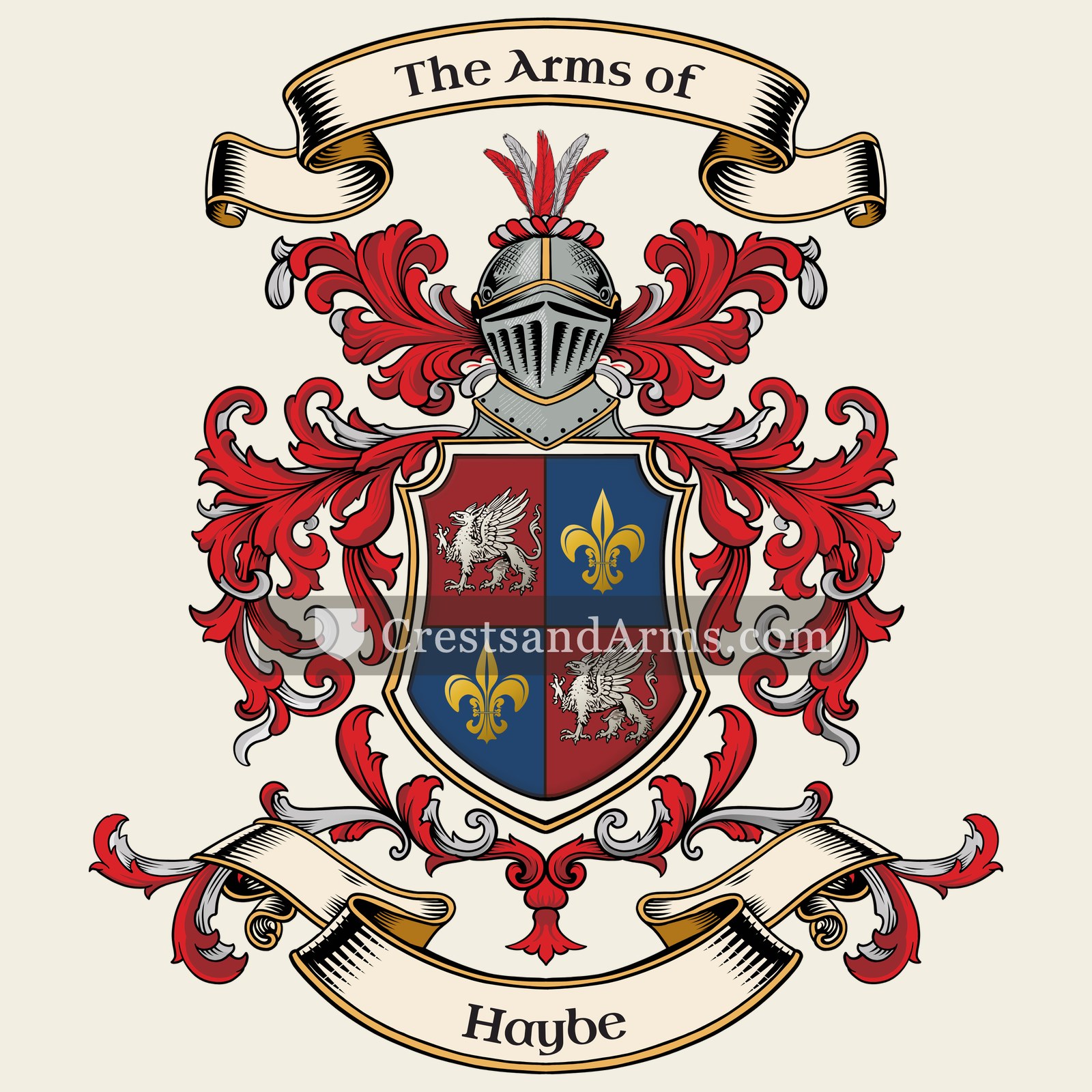
A record of documented arms, meaning and origin, researched for the Haybe family of Germany.
Reg. 7506 · German, G–I
Coat of Arms & Family Crest Details
Symbols on this shield
griffinValour and vigilance, guarding great treasure
fleur de lisPurity, light, and the sixth son
Colours
Red (Gules)Means: Military strength
Blue (Azure)Means: Loyalty and truth
Silver (Argent)Means: Peace and sincerity
Gold (Or)Means: Generosity
Historical info
Source
J. B. Rietstap, Armorial Général, Gouda: G. B. van Goor Zonen, 1884–87
Blazon (the actual original written record)
“Ec.: aux 1 et 4 de gu. à un griffon d'arg.; aux 2 et 3 d'azur à une fleur-de-lis d'or. Cq. cour. C.: le griffon, iss. L.: à dextre d'arg. et de gu., à sen. d'or et d'azur.”
BavariaBavaria, c. 1813
Digital archive packCoat of arms PNG, gold border print PDF, vector SVG and the certificate of authenticity. Sent to your email in minutes.
Map of Germany showing where the Haybe arms are recorded
The Haybe arms were recorded in Bavaria, c. 1813.
Bavaria was a country of old landed families and walled market towns. Estates passed down the same line for centuries, and both the landowners and the leading townsmen kept arms, which is why so many Bavarian names sit in the registers.
This is where the arms were entered in the register. Families often moved to other parts of the country, so the same name can turn up in more than one region.
The body that granted and recorded arms in Germany in this period.
Frederick William III of Prussia
Sovereign of the period
Frederick William III of Prussia
1797–1840
Reigning in Germany when the Haybe arms are first recorded.
How Arms Worked in Germany
Prussian heraldry was strictly tied to social rank and noble status rather than being a free choice for every citizen. These symbols were treated as permanent family property that moved through the generations to all legitimate heirs. If a family branch wanted to change their design to stand out, they had to apply for official permission to alter their specific version of the shield.
Granting authority
The Prussian Heroldsamt acted as the central state office that managed and strictly controlled all noble titles and coats of arms.
How they got arms
Families usually obtained their arms through formal royal grants or by proving their long-standing noble status to the state authorities.
Where arms were recorded
All official coats of arms were kept in the rolls of the Prussian Heroldsamt, which functioned from 1706 until 1918.
The family's standing
Recorded among the armigerous families of Bavaria.
Origin & History of the Haybe Family in Germany
The family name Haybe traces its roots to the historical region of Bavaria, where records confirm the presence of family members as early as 1813. During this period, Bavaria was undergoing significant political changes as it transitioned from a kingdom within the Confederation of the Rhine to a sovereign state following the Napoleonic Wars. Families living in this region at the time often worked in agriculture or local trade, as the economy was heavily centered on rural production and small-scale craftsmanship. The name likely developed from local linguistic variations common to the Upper Bavarian dialect, reflecting the specific geographic identity of the people living in the foothills of the Alps. As the nineteenth century progressed, the family would have experienced the modernization of the Bavarian state, which brought new administrative record-keeping practices and improved infrastructure to the region.
Related Branches & Arms
Root word
Hag
An enclosed area or hedge used for protection.
This name
HaybeA dweller near a fenced enclosure or a hedge.
also spelled
Haiby
Hibe
Haybe
Haib
Documented Sources
J. B. Rietstap, Armorial Général, Gouda: G. B. van Goor Zonen, 1884–87


 griffinValour and vigilance, guarding great treasure
 fleur de lisPurity, light, and the sixth son
 griffinValour and vigilance, guarding great treasure
 fleur de lisPurity, light, and the sixth son