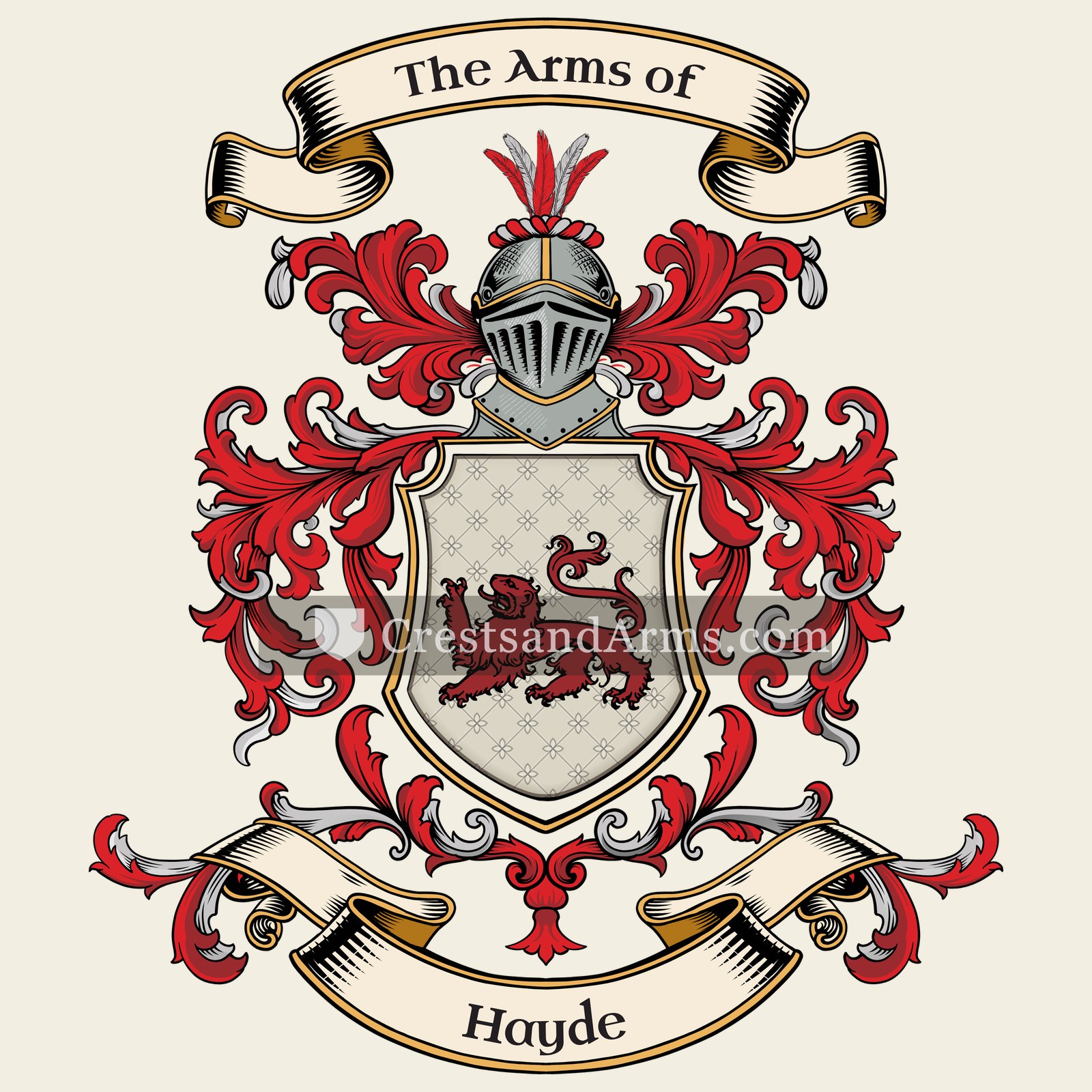
A record of documented arms, meaning and origin, researched for the Hayde family of Germany.
Reg. 6594 · German, G–I
Coat of Arms & Family Crest Details
Symbols on this shield
lionCourage, strength and royalty
Colours
Silver (Argent)Means: Peace and sincerity
Red (Gules)Means: Military strength
Historical info
Source
J. B. Rietstap, Armorial Général, Gouda: G. B. van Goor Zonen, 1884–87
Blazon (the actual original written record)
“D'arg. au lion reg. de gu. C.: un chapeau pyramidal de gu., retr. d'herm., sommé de quatre pl. d'aut., alt. d'arg. et de gu. et ch. d'un cordon componé d'azur et d'arg., br. en barre sur ledit chapeau”
SilesiaSilesia, c. 1765
Where the Hayde Arms Were Recorded
Map of Germany showing where the Hayde arms are recorded
The Hayde arms were recorded in Silesia, c. 1765.
Silesia was farming country in the east of the German lands, held in large estates by families who stayed put for generations. Owning land was what entitled a family to arms, so the region fills a good deal of the register.
This is where the arms were entered in the register. Families often moved to other parts of the country, so the same name can turn up in more than one region.
The body that granted and recorded arms in Germany in this period.
Francis I, Holy Roman Emperor
Sovereign of the period
Francis I, Holy Roman Emperor
1745–1765
Reigning in Germany when the Hayde arms are first recorded.
How Arms Worked in Germany
In the Holy Roman Empire, coats of arms were often granted to individuals by the Emperor or his representatives. These arms were then passed down through the generations to all legitimate descendants of the original holder. Younger branches of a family usually kept the same shield design without needing to change it, as the arms belonged to the entire lineage.
Granting authority
The Holy Roman Emperor held the sole power to grant new coats of arms throughout his vast imperial territories.
How they got arms
Families typically obtained their coats of arms through a formal imperial grant or by proving their noble status to the authorities.
Where arms were recorded
These grants were officially recorded in the Imperial Chancery registers, which began keeping formal records of such honors during the Middle Ages.
The family's standing
Recorded among the armigerous families of Silesia.
Origin & History of the Hayde Family in Germany
The family name Hayde has deep roots in the historical region of Silesia, where records confirm members of the family were established by 1765. During the eighteenth century, Silesia was a vibrant crossroads of European culture, shifting between the influence of the Austrian Habsburgs and the rising power of Prussia. Families living in this area often worked in agriculture, trade, or local administration, reflecting the diverse economic landscape of the time. The name likely evolved from regional linguistic patterns, as Silesia was a melting pot of German, Polish, and Czech influences. By settling in this territory, the early Hayde family became part of a long tradition of resilience in a region frequently shaped by changing borders and significant political shifts. Their presence in the mid-eighteenth century suggests they were integrated into the local community during a period of intense social and industrial growth in Central Europe.
Related Branches & Arms
Root word
Heide
A tract of uncultivated land or heath.
This name
HaydeA topographic name for someone who lived on or near a heath or moorland.
also spelled
Heydee
Heyden
Heyd
Hayde
Documented Sources
J. B. Rietstap, Armorial Général, Gouda: G. B. van Goor Zonen, 1884–87
State Archive in Wrocław (Archiwum Państwowe we Wrocławiu), Akta stanu cywilnego (Civil Registry Records)


 lionCourage, strength and royalty
 lionCourage, strength and royalty