Map of Belgium showing where the Haye arms are recorded
The Haye arms were recorded in Brabant, c. 1737.
Brabant lay at the heart of the Low Countries, where the trade routes met. Its towns were wealthy and its landowners many, and both kinds of family kept arms, which is why the region is so heavily represented.
This is where the arms were entered in the register. Families often moved to other parts of the country, so the same name can turn up in more than one region.
The body that granted and recorded arms in Belgium in this period.
Charles VI, Holy Roman Emperor
Sovereign of the period
Charles VI, Holy Roman Emperor
1711–1740
Reigning in Belgium when the Haye arms are first recorded.
How Arms Worked in Belgium
In Belgium, a coat of arms is considered personal property that is passed down through the male line to legitimate descendants. Families often use the same shield design across generations to show their shared heritage. If a branch of the family wants to change the design, they must apply for an official update to their specific version of the arms.
Granting authority
The Conseil héraldique is the official body that regulates and approves all coats of arms in Belgium.
How they got arms
Families obtain their coats of arms through formal royal grants or by confirming their historical right to use existing designs.
Where arms were recorded
All approved coats of arms are officially recorded in the public registers of the Conseil héraldique since 1844.
The family's standing
Recorded among the armigerous families of Brabant.
Origin & History of the Haye Family in Belgium
The family name Haye has deep roots in the historical region of Brabant, where records confirm members of the family were living as early as 1737. During the eighteenth century, Brabant was a central hub of the Austrian Netherlands, characterized by a complex mix of agricultural life and growing urban trade. Families with this name often lived in rural communities where they were closely tied to the land and the local parish system. Because the name is linked to the Old French word for a hedge or an enclosure, it likely originated as a way to describe someone who lived near a boundary or a fenced area of forest. As the family established themselves in the region, they became part of the local social fabric, participating in the daily economic activities that defined life in the Low Countries during the Enlightenment era. This early presence in Brabant suggests that the family was well-integrated into the local administration and community life of the time.
Coat of Arms & Family Crest Details
Symbols on this shield
fessThe military belt, and readiness to serve
Colours
Silver (Argent)Means: Peace and sincerity
Historical info
Source
J. B. Rietstap, Armorial Général, Gouda: G. B. van Goor Zonen, 1884–87
Blazon (the actual original written record)
“D'arg. à quatre fasces parties de gu. et de sa”
LorraineLorraine, c. 1540
Digital archive packCoat of arms PNG, gold border print PDF, vector SVG and the certificate of authenticity. Sent to your email in minutes.
Map of France showing where the Haye arms are recorded
The Haye arms were recorded in Lorraine, c. 1540.
Lorraine sat on the border between France and the German lands, and border country bred soldiers. Families here held small estates and served in arms, and a fighting man was exactly the sort who carried a shield of his own.
This is where the arms were entered in the register. Families often moved to other parts of the country, so the same name can turn up in more than one region.
The body that granted and recorded arms in France in this period.
Francis I of France
Sovereign of the period
Francis I of France
1515–1547
Reigning in Belgium when the Haye arms are first recorded.
How Arms Worked in France
In France, a coat of arms was a mark of honor that passed down through the male line to all legitimate descendants. Families often used the same shield without changes to show their shared heritage. If a branch wanted to stand out, they could add a small mark to their shield to show their specific place in the family tree.
Granting authority
The Juge d'armes de France acted as the official authority that regulated and verified coats of arms across the country.
How they got arms
Families typically inherited their arms from ancestors, though they could also receive them through royal grants or by proving their noble status.
Where arms were recorded
Coats of arms were officially recorded in the Armorial Général de France, which began its main collection in the year 1696.
The family's standing
Recorded among the armigerous families of Lorraine.
Origin & History of the Haye Family in France
The family name Haye traces its roots back to the northeastern region of France known as Lorraine. By the year 1540, records confirm that members of the family were already established in this area. The name itself is thought to be topographical, meaning it likely originated from a description of the landscape where the family lived. In Old French, the word "haye" referred to a hedge, a fence, or an enclosed forest area. Families often took such names to identify themselves as people who lived near a specific boundary or a wooded enclosure. As the family grew in Lorraine, they became part of the local social fabric during a time when the region was a complex crossroads of European culture and politics. This early presence in Lorraine suggests that the family was deeply connected to the rural life and land management practices of the sixteenth century.
Coat of Arms & Family Crest Details
Symbols on this shield
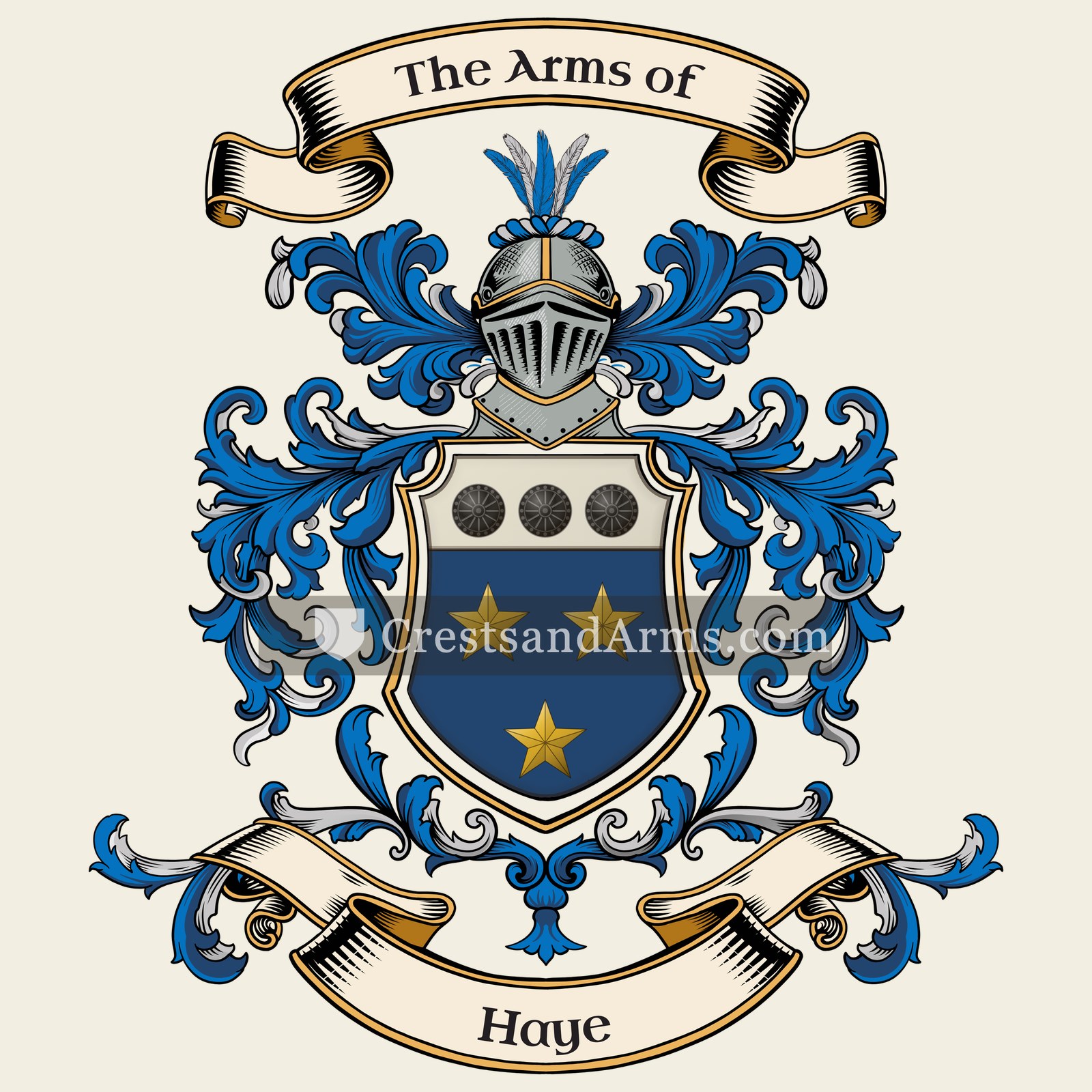
chiefAuthority, wisdom and dominion
mulletThe third son, and a divine quality from above
roundelA coin, and one who has been to the crusades
Colours
Blue (Azure)Means: Loyalty and truth
Silver (Argent)Means: Peace and sincerity
Gold (Or)Means: Generosity
Black (Sable)Means: Constancy
Historical info
Source
Sir Bernard Burke, The General Armory of England, Scotland, Ireland and Wales, London: Harrison & Sons, 1884
Blazon (the actual original written record)
“Az. three mullets or, on a chief ar. as many pellets”
SalopSalop, c. 1620
Digital archive packCoat of arms PNG, gold border print PDF, vector SVG and the certificate of authenticity. Sent to your email in minutes.
Map of England showing where the Haye arms are recorded
The Haye arms were recorded in Salop, c. 1620.
Shropshire lay on the Welsh border, and border country needed men who could fight. Families held their land in return for service, and service in arms is what a coat of arms was originally for.
This is where the arms were entered in the register. Families often moved to other parts of the country, so the same name can turn up in more than one region.
The body that granted and recorded arms in England in this period.
James VI and I
Sovereign of the period
James VI and I
1603–1625
Reigning in Belgium when the Haye arms are first recorded.
How Arms Worked in England
English heraldry allowed arms to be shared by all legitimate descendants of the original owner. These symbols were treated as personal property that moved through the generations to all children. While the eldest son kept the original design, other family members could use the same shield without needing to change it or register their own unique versions.
Granting authority
The College of Arms in London has regulated the use of coats of arms throughout England and Wales since 1484.
How they got arms
Families typically obtained their coats of arms through a formal grant from the Crown or by proving their ancient right to them.
Where arms were recorded
All official coats of arms are recorded in the registers kept at the College of Arms, which date back to the fifteenth century.
The family's standing
Recorded among the armigerous families of Salop.
Origin & History of the Haye Family in England
The surname Haye is rooted in the landscape of medieval England, originating as a topographical name for people who lived near a fenced enclosure or a hedge. In the Old English language, the word "hæg" referred to a protected piece of land or a forest clearing. Families often adopted this name to identify themselves by their specific place of residence within their local community. By the year 1620, records confirm that members of the Haye family were well-established in the county of Salop, which is also known as Shropshire. During this period, the family was likely involved in the agricultural life of the region, as the name itself remained closely tied to the management of land and boundaries. As the family grew, they became part of the local social fabric, contributing to the rural development of the West Midlands through their work and presence in the English countryside.
Related Branches & Arms
Root word
Hage
A hedge or a fenced enclosure used for protection or boundaries.
This name
HayeRefers to someone who lived near a hedge, fence, or enclosed piece of land.
also spelled
Delahaye
Hay
Haie
Hey
Hays
Related arms
de Riddersimilar arms
Saffenbergsimilar arms
van Hornesimilar arms
Haysvariant spelling
Documented Sources
J. B. Rietstap, Armorial Général, Gouda: G. B. van Goor Zonen, 1884–87
De Smet, A., Geschiedenis van Brabant, 1972
Verhulst, A., The Rise of Cities in North-West Europe, 1999
State Archives in Belgium (Rijksarchief te Brussel), Parochieregisters van Brabant
Digital archive packCoat of arms PNG, gold border print PDF, vector SVG and the certificate of authenticity. Sent to your email in minutes.


 bendDefence, and the scarf of a commander
 martletA younger son, who must win his own land
 bendDefence, and the scarf of a commander
 martletA younger son, who must win his own land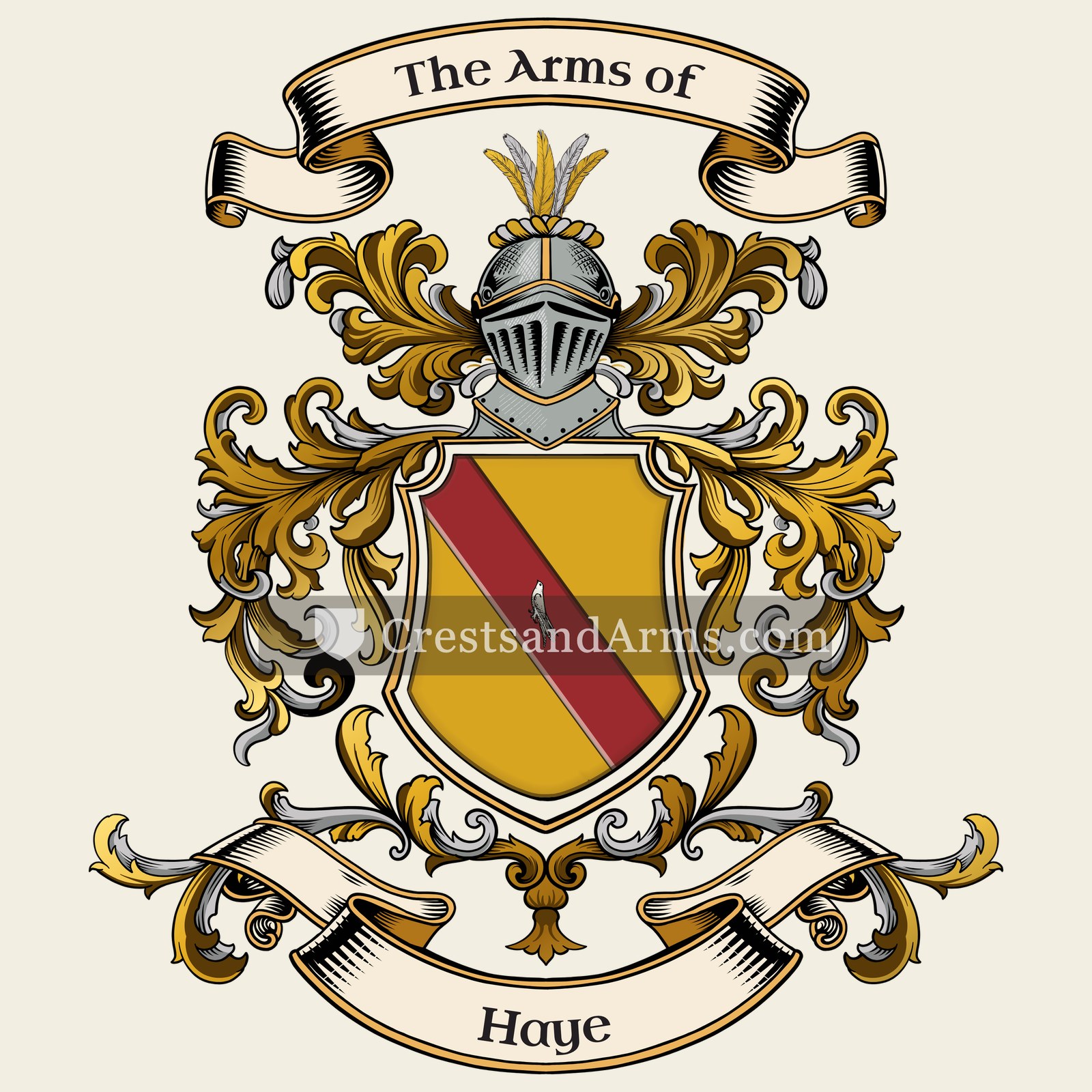


 fessThe military belt, and readiness to serve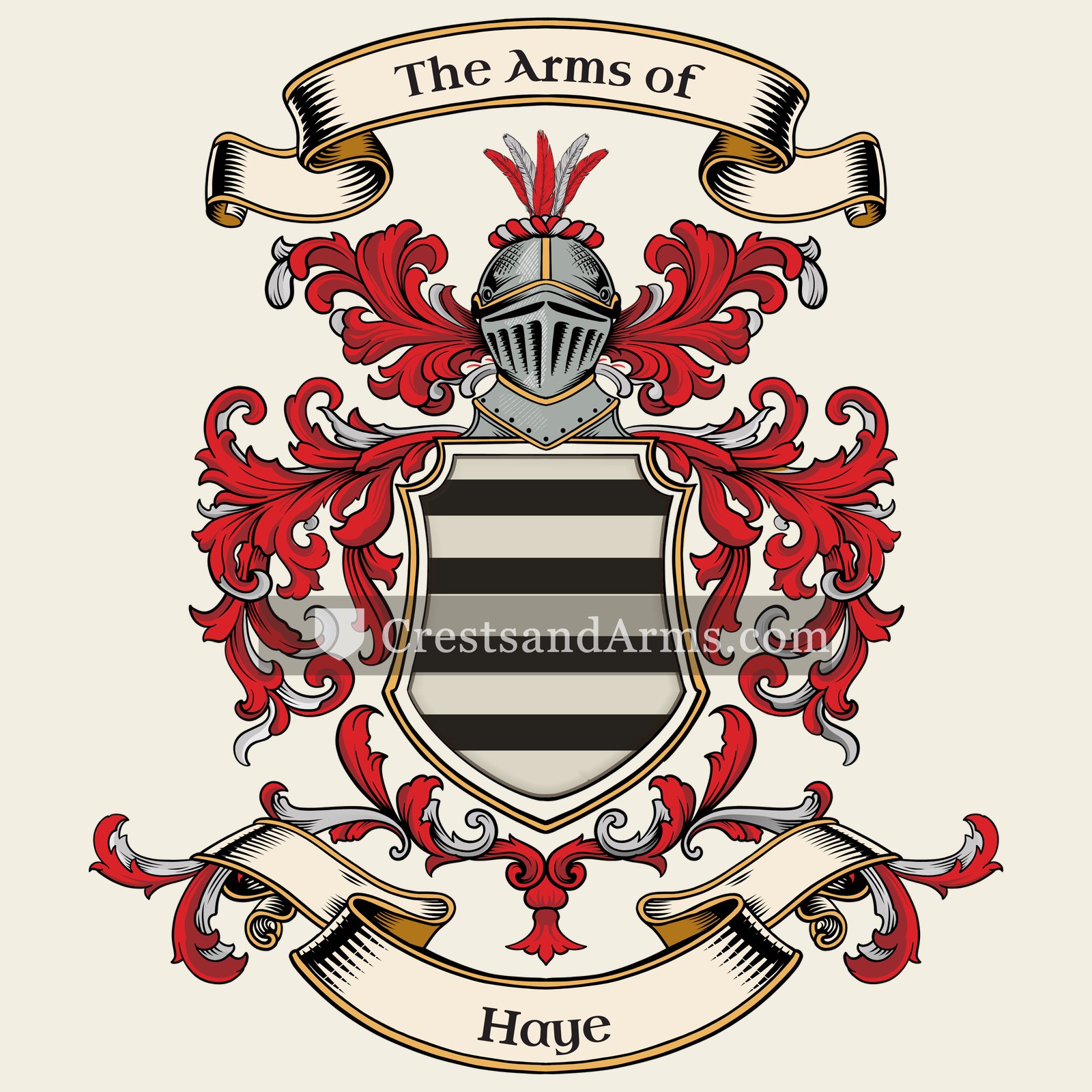


 chiefAuthority, wisdom and dominion
 mulletThe third son, and a divine quality from above
 roundelA coin, and one who has been to the crusades