A record of documented arms, meaning and origin, researched for the Hayman family lines. Documented in 2 countries.
Reg. 7940 · Dutch, G–I
Coat of Arms & Family Crest Details
Symbols on this shield
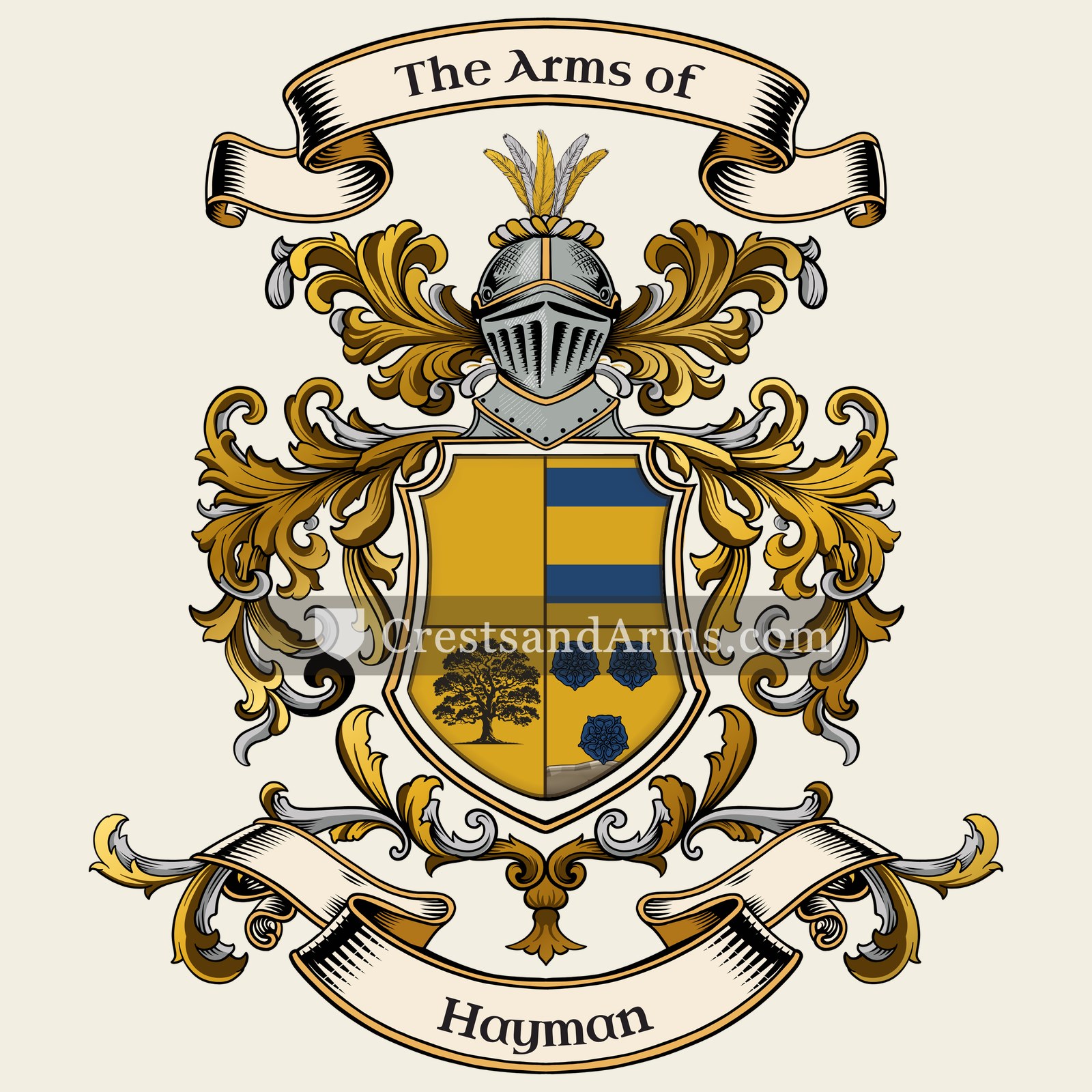
fessThe military belt, and readiness to serve
mountThe ground held, and steadfastness upon it
treeLife, endurance and deep roots
roseThe seventh son, and beauty with grace
Colours
Gold (Or)Means: Generosity
Blue (Azure)Means: Loyalty and truth
Black (Sable)Means: Constancy
Historical info
Source
J. B. Rietstap, Armorial Général, Gouda: G. B. van Goor Zonen, 1884–87
Blazon (the actual original written record)
“Ec.: au 1 d'or à un requin au nat., courbé en demi-cercle, la courbe en bas; au 2 d'or à deux fasces ondées d'azur; au 3 d'or à un arbre sec et arr. de sa.; au 4 de sin. à trois fleurs à cinq feuilles d'azur, tigées et feuillées au nat., rangées sur une terrasse au nat. C.: un requin iss., au nat.”
Netherlandsc. 1815
Digital archive packCoat of arms PNG, gold border print PDF, vector SVG and the certificate of authenticity. Sent to your email in minutes.
Map of Netherlands showing where the Hayman arms are recorded
The Hayman arms were recorded in Netherlands, c. 1815.
Arms such as these were typically recorded in Friesland.
Friesland was low, wet country on the northern coast of the Netherlands, farmed by families who had held the same land for centuries. Free landholders were unusually common there, and a free landholder could carry arms.
This is where the arms were entered in the register. Families often moved to other parts of the country, so the same name can turn up in more than one region.
Region
Friesland
First recorded
1815
Granting Authority for the Hayman Arms
Hoge Raad van Adel
Photograph made by me · CC BY-SA 3.0
The body that granted and recorded arms in Netherlands in this period.
William I of the Netherlands
Sovereign of the period
William I of the Netherlands
1815–1840
Reigning in Netherlands when the Hayman arms are first recorded.
How Arms Worked in Netherlands
In the Netherlands, coats of arms were often used by noble families and those who held specific public offices. These arms were passed down through the generations to legitimate descendants. Younger branches of a family usually kept the original design without needing to add special marks. This system ensured that the family identity remained clear and consistent over many years.
Granting authority
The Hoge Raad van Adel is the official body that regulates and manages noble titles and coats of arms in the Netherlands.
How they got arms
Families typically obtained their coats of arms through official royal grants or by proving their long-standing historical use of the symbols.
Where arms were recorded
Coats of arms are officially recorded in the registers held by the Hoge Raad van Adel, which began its work in 1814.
The family's standing
Recorded among the armigerous families of Netherlands.
Origin & History of the Hayman Family in Netherlands
The family name Hayman has deep roots in the northern region of the Netherlands known as Friesland. By the early nineteenth century, records confirm that members of the family were already established residents in this area. The name likely evolved from older Germanic or Frisian naming traditions that focused on a person’s occupation or their specific location within a village. During the Napoleonic era, the Dutch government required all citizens to register permanent surnames to improve tax collection and military conscription. This period often solidified spelling variations for families who had previously used more fluid naming styles. Because Friesland maintained a distinct cultural and linguistic identity compared to the rest of the country, the Hayman family name reflects the unique history of a region that valued independence and maritime trade. These early ancestors were part of a society that was transitioning from traditional rural life into the modern administrative structures of the nineteenth century.
Coat of Arms & Family Crest Details
Symbols on this shield
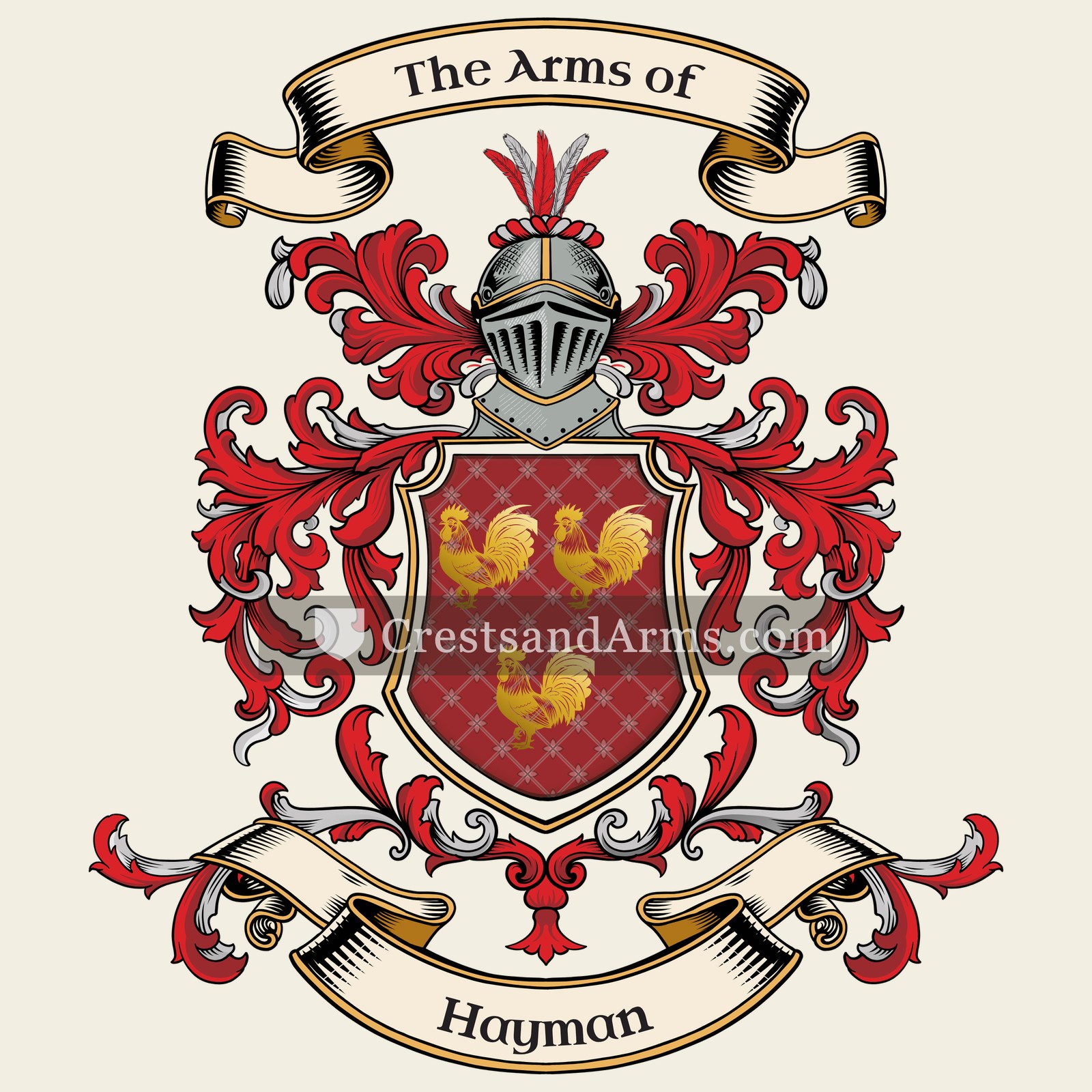
cockCourage, vigilance and readiness for battle
Colours
Red (Gules)Means: Military strength
Gold (Or)Means: Generosity
Historical info
Source
Sir Bernard Burke, The General Armory of England, Scotland, Ireland and Wales, London: Harrison & Sons, 1884
Blazon (the actual original written record)
“Gu. three cocks' heads erased or”
Englandc. 1620
Digital archive packCoat of arms PNG, gold border print PDF, vector SVG and the certificate of authenticity. Sent to your email in minutes.
Map of England showing where the Hayman arms are recorded
The Hayman arms were recorded in England, c. 1620.
Arms such as these were typically recorded in York.
Yorkshire is the largest of the English counties, and it held more gentry families than any other. Land there was split among a great many households rather than a few, so a great many of them carried arms.
This is where the arms were entered in the register. Families often moved to other parts of the country, so the same name can turn up in more than one region.
The body that granted and recorded arms in England in this period.
James VI and I
Sovereign of the period
James VI and I
1603–1625
Reigning in Netherlands when the Hayman arms are first recorded.
How Arms Worked in England
English heraldry allowed arms to be shared by all legitimate descendants of the original owner. These symbols were treated as personal property that moved through the generations to all children. While the eldest son kept the original design, other family members could use the same shield without needing to change it or register their own unique versions.
Granting authority
The College of Arms in London has regulated the use of coats of arms throughout England and Wales since 1484.
How they got arms
Families typically obtained their coats of arms through a formal grant from the Crown or by proving their ancient right to them.
Where arms were recorded
All official coats of arms are recorded in the registers kept at the College of Arms, which date back to the fifteenth century.
The family's standing
Recorded among the armigerous families of England.
Origin & History of the Hayman Family in England
The surname Hayman has deep roots in England, appearing as a descriptive occupational name long before it became a fixed family identifier. Historically, the name likely referred to a person who worked as a hayward, an official responsible for guarding fences and protecting crops from wandering livestock. By the early 17th century, the family had established a notable presence in the city of York, where records confirm their residence by 1620. During this period, York served as a vital northern hub for trade and administration, and families like the Haymans were often integrated into the local merchant or artisan classes. As the name spread across the English countryside, it evolved from a simple job title into a permanent hereditary surname, reflecting the transition of medieval society toward more structured family identities.
Hayman Meaning & Related Branches
Root word
Hagman
A person who manages or works on a hedge or enclosure.
This name
HaymanAn occupational surname for a hedge-cutter or a keeper of a fenced area.
also spelled
Heiman
Hyman
Haymon
Heyman
Haiman
Related arms
Heymanvariant spelling
Documented Sources
J. B. Rietstap, Armorial Général, Gouda: G. B. van Goor Zonen, 1884–87
AlleFriezen, Bevolkingsregister (Population Registers) of Friesland, 1811–1850
Nationaal Archief, Burgerlijke Stand (Civil Registry) of the Netherlands, 1811–1815
Meertens, P.J., De betekenis van de Nederlandse familienamen, 1964
Van Berkel, G. and Samplonius, K., Nederlandse plaatsnamen verklaard, 2018
Digital archive packCoat of arms PNG, gold border print PDF, vector SVG and the certificate of authenticity. Sent to your email in minutes.


 fessThe military belt, and readiness to serve
 mountThe ground held, and steadfastness upon it
 treeLife, endurance and deep roots
 roseThe seventh son, and beauty with grace
 fessThe military belt, and readiness to serve
 mountThe ground held, and steadfastness upon it
 treeLife, endurance and deep roots
 roseThe seventh son, and beauty with grace


 cockCourage, vigilance and readiness for battle