A record of documented arms, meaning and origin, researched for the Hayter family lines. Documented in 2 countries.
Reg. 1642 · Britain, G–I
Coat of Arms & Family Crest Details
Symbols on this shield
escallopThe pilgrim's shell, and a long journey made
bullValour and generosity
Colours
Blue (Azure)Means: Loyalty and truth
Gold (Or)Means: Generosity
Historical info
Source
J. B. Rietstap, Armorial Général, Gouda: G. B. van Goor Zonen, 1884–87
Blazon (the actual original written record)
“D'azur à une coquille d'or, acc. de trois têtes et cols de boeuf du même. C.: une tête et col de boeuf de sa., semée de coquilles d'or, percée d'une pique au nat., en barre, la pointe en haut. D.: VIA VI.”
BerkshireBerkshire, c. 1858
Digital archive packCoat of arms PNG, gold border print PDF, vector SVG and the certificate of authenticity. Sent to your email in minutes.
Map of Britain showing where the Hayter arms are recorded
The Hayter arms were recorded in Berkshire, c. 1858.
This is where the arms were entered in the register. Families often moved to other parts of the country, so the same name can turn up in more than one region.
The body that granted and recorded arms in Britain in this period.
Victoria
Sovereign of the period
Victoria
1837–1901
Reigning in Britain when the Hayter arms are first recorded.
How Arms Worked in Britain
English heraldry allowed arms to be shared by all legitimate descendants of the original owner. These symbols were treated as personal property that moved through the generations to all children. While the eldest son kept the original design, other family members could use the same shield without needing to change it or register their own unique versions.
Granting authority
The College of Arms in London has regulated the use of coats of arms throughout England and Wales since 1484.
How they got arms
Families typically obtained their coats of arms through a formal grant from the Crown or by proving their ancient right to them.
Where arms were recorded
All official coats of arms are recorded in the registers kept at the College of Arms, which date back to the fifteenth century.
The family's standing
Recorded among the armigerous families of Berkshire.
Origin & History of the Hayter Family in Britain
The surname Hayter is rooted in the landscape of medieval England, originating as a topographical name for someone who lived near a gate or a hedge. Derived from the Old English word "hæg," which refers to an enclosure or a boundary, the name likely identified families who managed or resided near these specific markers. While the name became well-established across several southern counties, the Hayter family maintained a notable presence in Berkshire by the mid-19th century. During this period, families with this name were often integrated into the local agricultural and village life that defined the region. By 1858, the Hayters in Berkshire were part of a long tradition of English families who had transitioned from rural laborers to established members of their local communities. This evolution reflects the broader history of English surnames, which often began as simple descriptions of a person’s home before becoming permanent family identifiers passed down through generations.
Coat of Arms & Family Crest Details
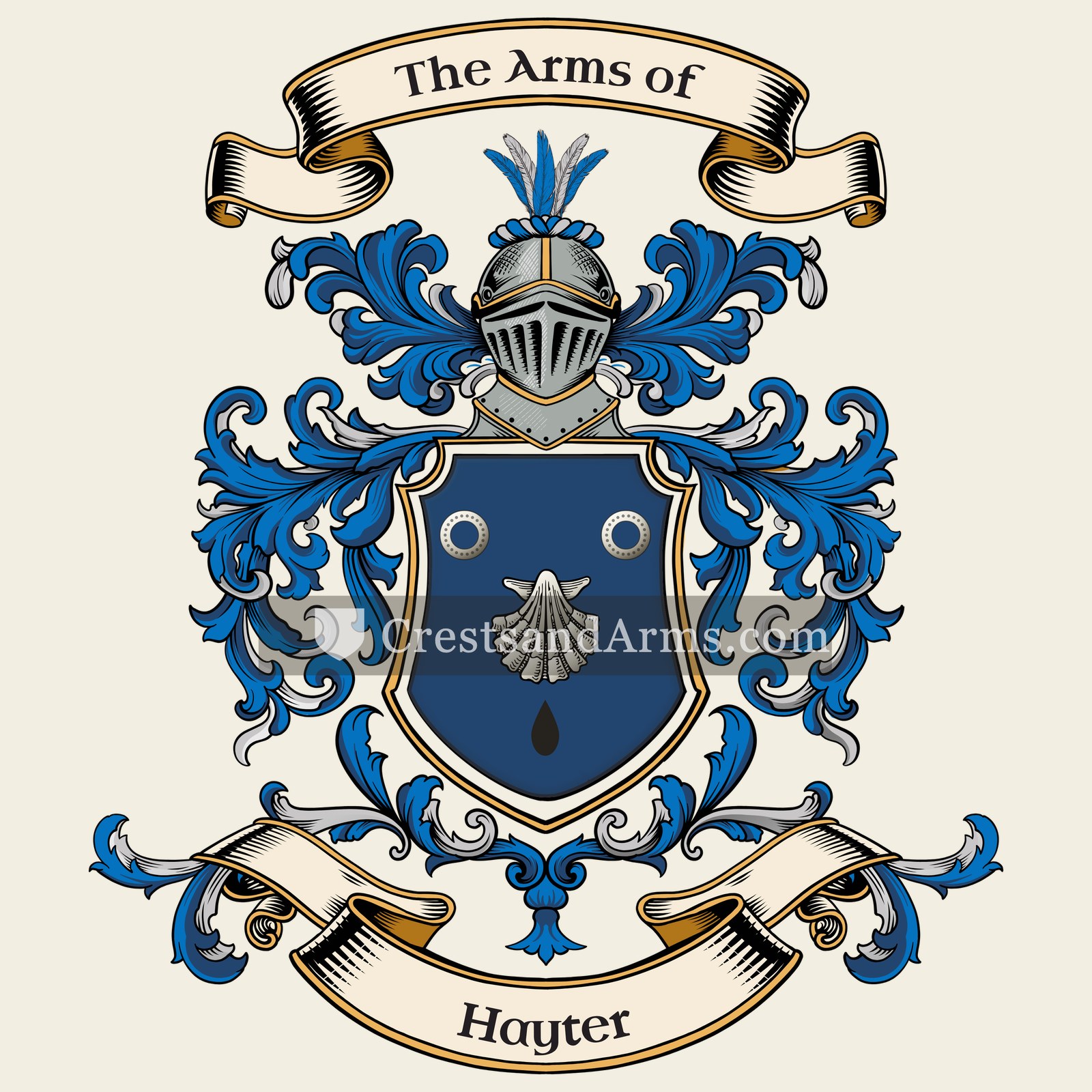
Symbols on this shield
flaunchesA reward for virtue and learning
escallopThe pilgrim's shell, and a long journey made
ringFidelity, and a promise kept
dropletsTears, and grief borne with patience
Colours
Blue (Azure)Means: Loyalty and truth
Silver (Argent)Means: Peace and sincerity
Black (Sable)Means: Constancy
Historical info
Source
Sir Bernard Burke, The General Armory of England, Scotland, Ireland and Wales, London: Harrison & Sons, 1884
Blazon (the actual original written record)
“Az. an escallop betw. two annulets ar. and as many flaunches guttée de poix”
DorsetEast Creech · Dorset, c. 1620
Digital archive packCoat of arms PNG, gold border print PDF, vector SVG and the certificate of authenticity. Sent to your email in minutes.
Map of England showing where the Hayter arms are recorded
The Hayter arms were recorded in Dorset, c. 1620.
Dorset was quiet farming and grazing country along the south coast. Its gentry were middling rather than grand, but they held their manors for a very long time, and long holding is what puts a name in the records.
This is where the arms were entered in the register. Families often moved to other parts of the country, so the same name can turn up in more than one region.
The body that granted and recorded arms in England in this period.
James VI and I
Sovereign of the period
James VI and I
1603–1625
Reigning in Britain when the Hayter arms are first recorded.
How Arms Worked in England
English heraldry allowed arms to be shared by all legitimate descendants of the original owner. These symbols were treated as personal property that moved through the generations to all children. While the eldest son kept the original design, other family members could use the same shield without needing to change it or register their own unique versions.
Granting authority
The College of Arms in London has regulated the use of coats of arms throughout England and Wales since 1484.
How they got arms
Families typically obtained their coats of arms through a formal grant from the Crown or by proving their ancient right to them.
Where arms were recorded
All official coats of arms are recorded in the registers kept at the College of Arms, which date back to the fifteenth century.
The family's standing
Recorded among the armigerous families of Dorset.
Origin & History of the Hayter Family in England
The surname Hayter is rooted in the landscape of medieval England, likely originating as a descriptive name for someone who worked with hay or lived near a hedged enclosure. By the early 17th century, the family had established a notable presence in the county of Dorset. Records from 1620 confirm that members of the Hayter family were living in this region during a time of significant social and agricultural change. As rural residents, they were deeply connected to the local economy and the seasonal rhythms of farming life. Over the following generations, the family name became firmly woven into the history of the West Country, reflecting the broader patterns of migration and settlement that defined English village life for centuries.
Related Branches & Arms
Root word
Hag
An enclosed area of land or a hedge.
This name
HayterA dweller at an enclosure or a person living near a hedge.
also spelled
Haytor
Heiter
Heyter
Haiter
Documented Sources
J. B. Rietstap, Armorial Général, Gouda: G. B. van Goor Zonen, 1884–87
Reaney, P.H. and Wilson, R.M., A Dictionary of English Surnames, 1997
The National Archives, Census Returns of England and Wales, 1851, HO 107
Digital archive packCoat of arms PNG, gold border print PDF, vector SVG and the certificate of authenticity. Sent to your email in minutes.


 escallopThe pilgrim's shell, and a long journey made
 bullValour and generosity
 escallopThe pilgrim's shell, and a long journey made
 bullValour and generosity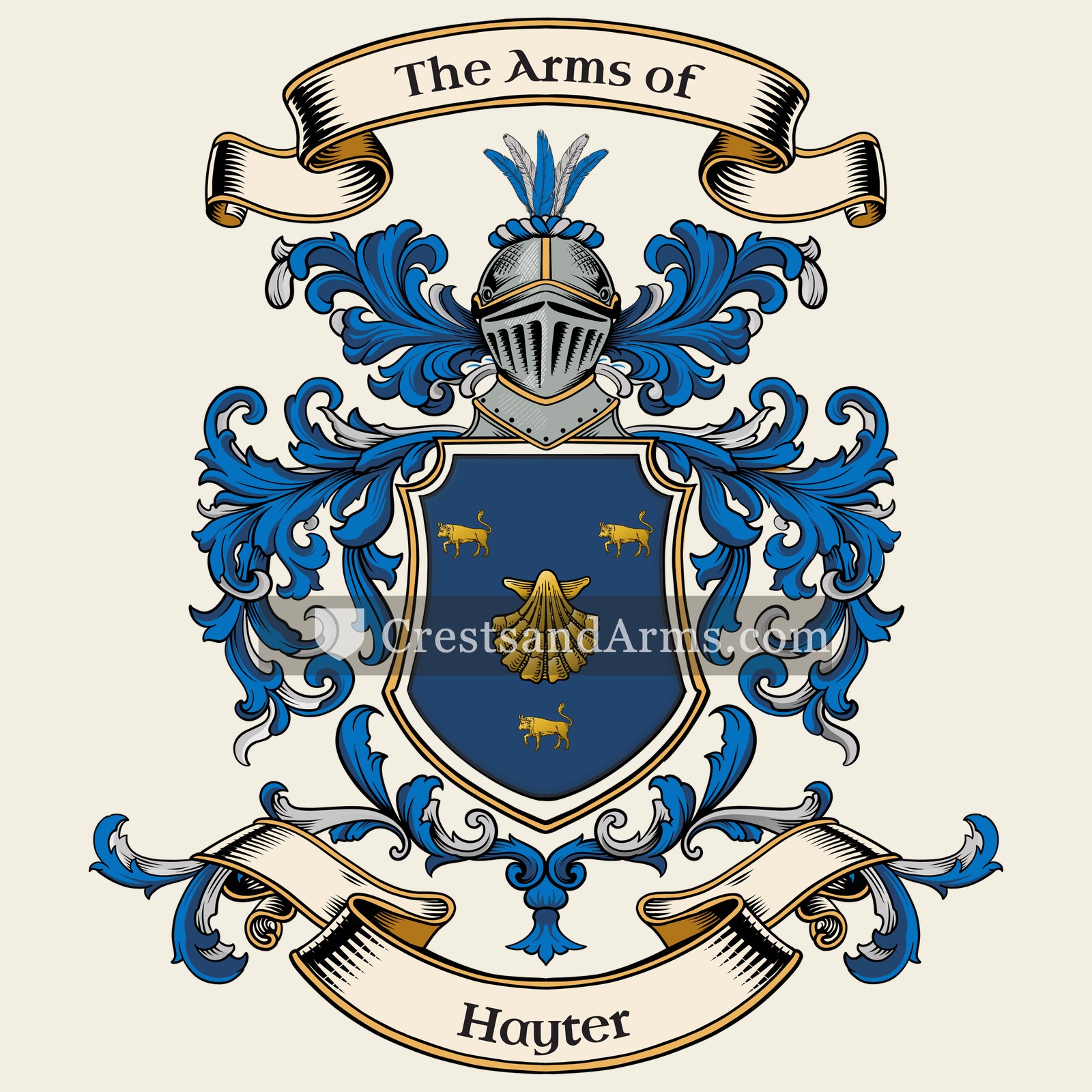


 flaunchesA reward for virtue and learning
 ringFidelity, and a promise kept
 dropletsTears, and grief borne with patience