Map of Britain showing where the Head arms are recorded
The Head arms were recorded in Kent, c. 1700.
Kent sits between London and the short crossing to Europe, and the trade passing through made it wealthy. Merchant families bought land with that money, and it was landowners who took coats of arms.
This is where the arms were entered in the register. Families often moved to other parts of the country, so the same name can turn up in more than one region.
The body that granted and recorded arms in Britain in this period.
William III of England
Sovereign of the period
William III of England
1694–1702
Reigning in Britain when the Head arms are first recorded.
How Arms Worked in Britain
English heraldry allowed arms to be shared by all legitimate descendants of the original owner. These symbols were treated as personal property that moved through the generations to all children. While the eldest son kept the original design, other family members could use the same shield without needing to change it or register their own unique versions.
Granting authority
The College of Arms in London has regulated the use of coats of arms throughout England and Wales since 1484.
How they got arms
Families typically obtained their coats of arms through a formal grant from the Crown or by proving their ancient right to them.
Where arms were recorded
All official coats of arms are recorded in the registers kept at the College of Arms, which date back to the fifteenth century.
The family's standing
Recorded among the armigerous families of Kent.
Origin & History of the Head Family in Britain
The surname Head is a locative name, meaning it was originally used to describe where a person lived or a specific feature of their local landscape. In medieval Britain, the name likely referred to someone who resided near the head of a stream, a hill, or a prominent geographic promontory. By the time the family became well-established in Kent during the early 1700s, the name had already been in use for several centuries across various English counties. Families with this name were often associated with rural communities where they worked as landowners or tradespeople. Because the name was tied to common physical landmarks, it appeared independently in different regions, reflecting the way early English surnames were adopted to help neighbors distinguish between people living in the same village. The presence of the Head family in Kent by the 18th century highlights their integration into the local agricultural and social fabric of the region during a time of significant economic growth in southern England.
Coat of Arms & Family Crest Details
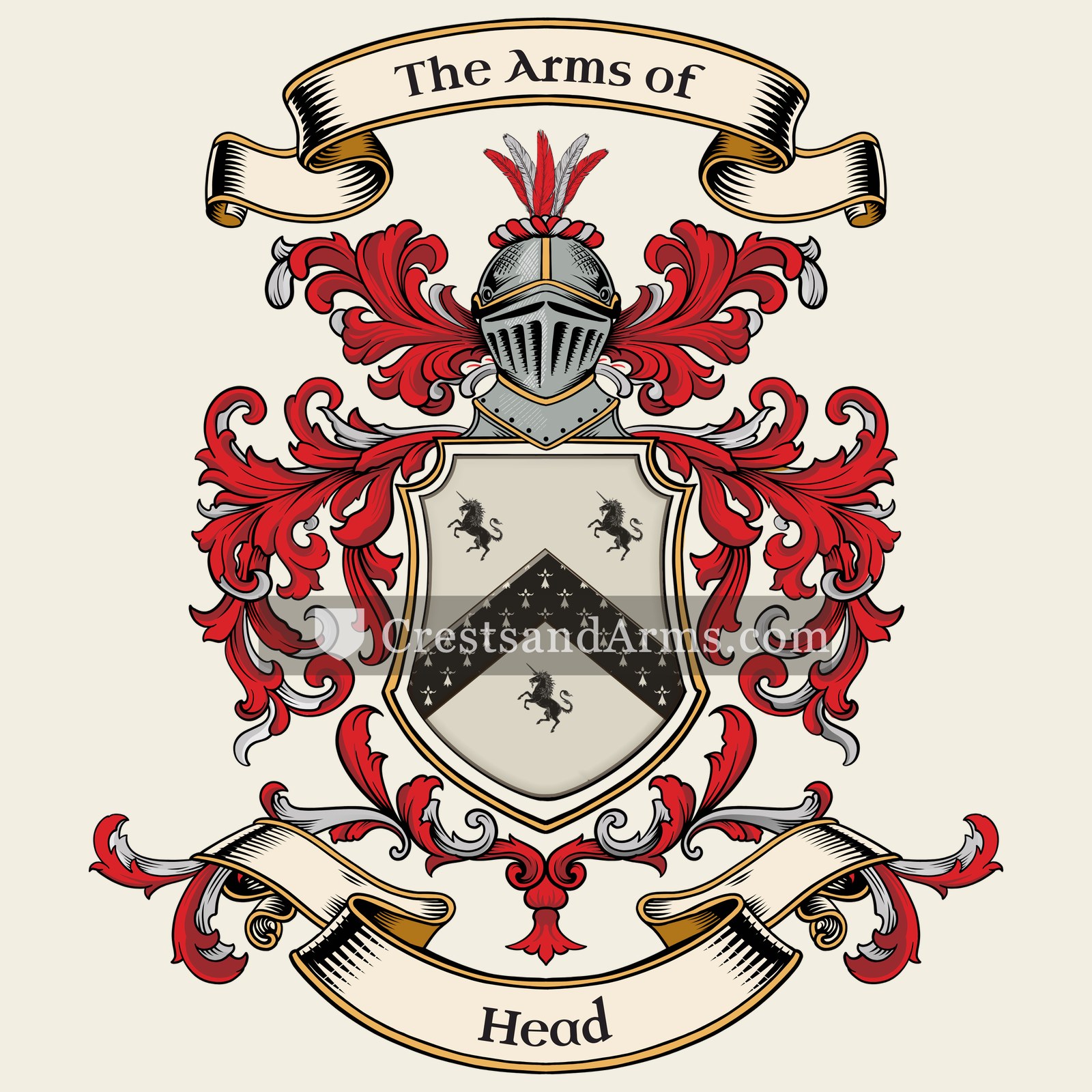
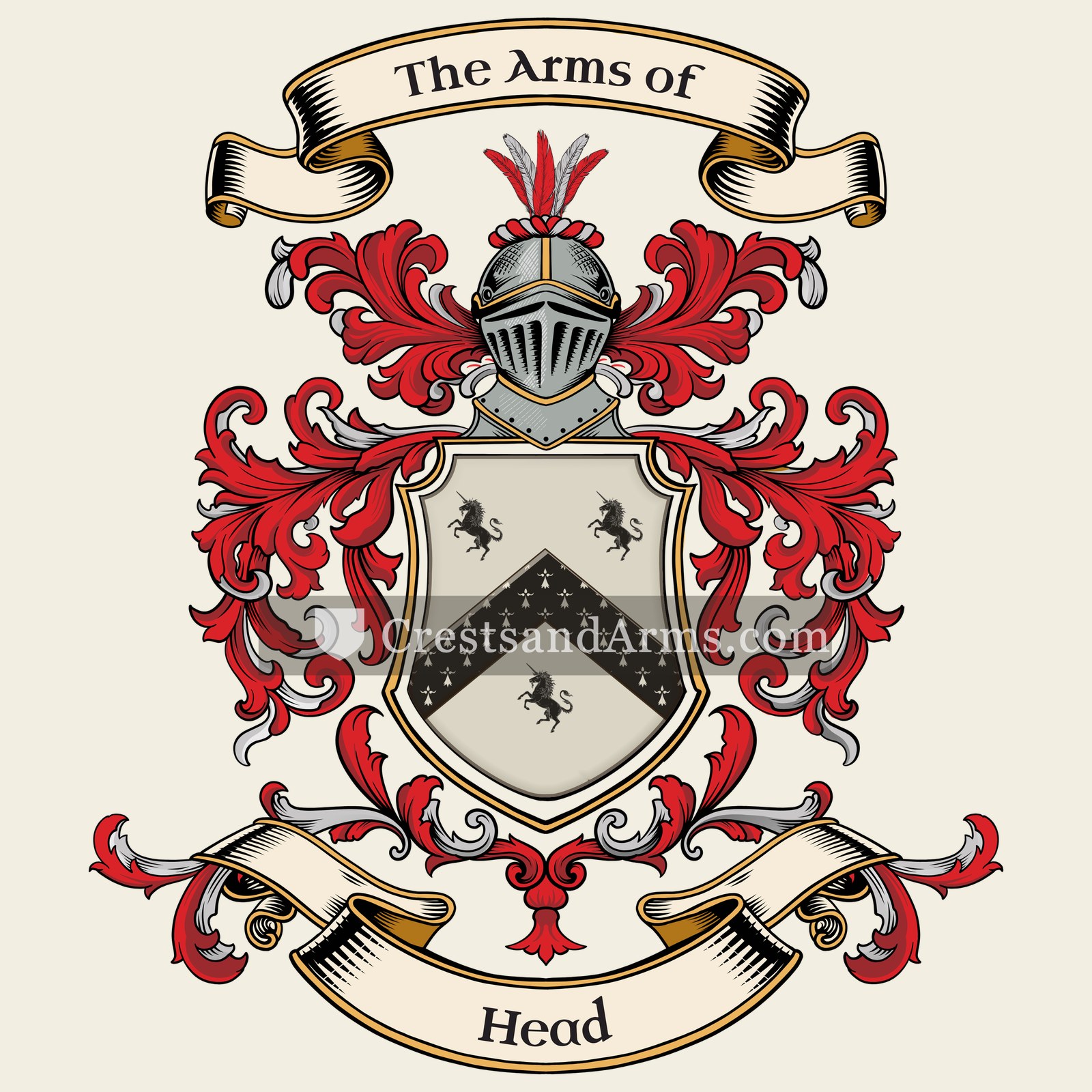
Symbols on this shield
chevronProtection, and faithful service completed
ermineDignity and rank
unicornPurity, and extreme courage in defence of honour
Colours
Silver (Argent)Means: Peace and sincerity
Counter-ermine (Ermines)Means: Dignity
Black (Sable)Means: Constancy
Historical info
Source
Sir Bernard Burke, The General Armory of England, Scotland, Ireland and Wales, London: Harrison & Sons, 1884
Blazon (the actual original written record)
“Ar. a chev. ermines betw. three unicorns' heads couped sa”
KentHermitage · Kent, c. 1620
Digital archive packCoat of arms PNG, gold border print PDF, vector SVG and the certificate of authenticity. Sent to your email in minutes.
Map of England showing where the Head arms are recorded
The Head arms were recorded in Kent, c. 1620.
Kent sits between London and the short crossing to Europe, and the trade passing through made it wealthy. Merchant families bought land with that money, and it was landowners who took coats of arms.
This is where the arms were entered in the register. Families often moved to other parts of the country, so the same name can turn up in more than one region.
The body that granted and recorded arms in England in this period.
James VI and I
Sovereign of the period
James VI and I
1603–1625
Reigning in Britain when the Head arms are first recorded.
How Arms Worked in England
English heraldry allowed arms to be shared by all legitimate descendants of the original owner. These symbols were treated as personal property that moved through the generations to all children. While the eldest son kept the original design, other family members could use the same shield without needing to change it or register their own unique versions.
Granting authority
The College of Arms in London has regulated the use of coats of arms throughout England and Wales since 1484.
How they got arms
Families typically obtained their coats of arms through a formal grant from the Crown or by proving their ancient right to them.
Where arms were recorded
All official coats of arms are recorded in the registers kept at the College of Arms, which date back to the fifteenth century.
The family's standing
Recorded among the armigerous families of Kent.
Origin & History of the Head Family in England
The surname Head emerged in England as a descriptive name, likely used to identify someone who lived at the top of a hill or held a position of leadership within a local community. By the early 17th century, the family had established a notable presence in the county of Kent. Records from 1620 confirm that members of the Head family were active in this region during a time of significant social and economic change in England. As the family settled into the landscape of Kent, they became part of the local fabric of rural life and trade. This geographical anchor suggests that the family was well-integrated into the agricultural and administrative systems of the era. Over the following generations, the name remained closely tied to the history of southeastern England, reflecting the broader patterns of migration and settlement that shaped the English countryside.
Head Meaning & Related Branches
Root word
heafod
Old English word for the top part of the body.
This name
HeadA topographic name for someone living at the top of a hill or headland.
also spelled
Heade
Hedde
Heed
Hed
Hede
Related arms
Hede, or Hedesavariant spelling
Catesbyrecorded with Head, same area
Chenyrecorded with Head, same area
Delavalrecorded with Head, same area
Documented Sources
J. B. Rietstap, Armorial Général, Gouda: G. B. van Goor Zonen, 1884–87
Bardsley, Charles Wareing, A Dictionary of English and Welsh Surnames, 1901
Reaney, Percy Hide, A Dictionary of British Surnames, 1958
The National Archives, Prerogative Court of Canterbury, Wills and Administrations, 1700–1750
Kent History and Library Centre, Parish Registers of Kent, 1700–1750
Digital archive packCoat of arms PNG, gold border print PDF, vector SVG and the certificate of authenticity. Sent to your email in minutes.


 chevronProtection, and faithful service completed
 unicornPurity, and extreme courage in defence of honour
 chevronProtection, and faithful service completed
 unicornPurity, and extreme courage in defence of honour


 ermineDignity and rank