Map of England showing where the Hearth arms are recorded
The Hearth arms were recorded in England, c. 1620.
Arms such as these were typically recorded in York.
Yorkshire is the largest of the English counties, and it held more gentry families than any other. Land there was split among a great many households rather than a few, so a great many of them carried arms.
This is where the arms were entered in the register. Families often moved to other parts of the country, so the same name can turn up in more than one region.
The body that granted and recorded arms in England in this period.
James VI and I
Sovereign of the period
James VI and I
1603–1625
Reigning in England when the Hearth arms are first recorded.
How Arms Worked in England
English heraldry allowed arms to be shared by all legitimate descendants of the original owner. These symbols were treated as personal property that moved through the generations to all children. While the eldest son kept the original design, other family members could use the same shield without needing to change it or register their own unique versions.
Granting authority
The College of Arms in London has regulated the use of coats of arms throughout England and Wales since 1484.
How they got arms
Families typically obtained their coats of arms through a formal grant from the Crown or by proving their ancient right to them.
Where arms were recorded
All official coats of arms are recorded in the registers kept at the College of Arms, which date back to the fifteenth century.
The family's standing
Recorded among the armigerous families of England.
Origin & History of the Hearth Family in England
The surname Hearth is rooted in the social and domestic life of medieval England, likely originating as a topographic name for a family that lived near a prominent communal fireplace or a house distinguished by its hearth. By the early seventeenth century, the family had established a notable presence in the historic city of York. Records from 1620 confirm that members of the Hearth family were active residents during this era, a time when York served as a vital northern hub for trade, religion, and local governance. Living in such a densely populated and ancient city suggests that these early ancestors were likely integrated into the urban economy, perhaps working as skilled tradespeople or merchants. Their presence in the city archives during this period highlights the family’s long-standing connection to the cultural and social fabric of northern England.
Related Branches & Arms
Root word
Heorth
Old English word for a fireplace or the floor of a hearth.
This name
HearthAn occupational name for someone who lived by a hearth or a maker of hearths.
also spelled
Hart
Harte
Documented Sources
Sir Bernard Burke, The General Armory of England, Scotland, Ireland and Wales, London: Harrison & Sons, 1884
Bardsley, Charles Wareing, A Dictionary of English and Welsh Surnames, 1901
York City Archives, York City Chamberlains' Accounts, 1620
Reaney, Percy Hide, A Dictionary of British Surnames, 1958
Digital archive packCoat of arms PNG, gold border print PDF, vector SVG and the certificate of authenticity. Sent to your email in minutes.


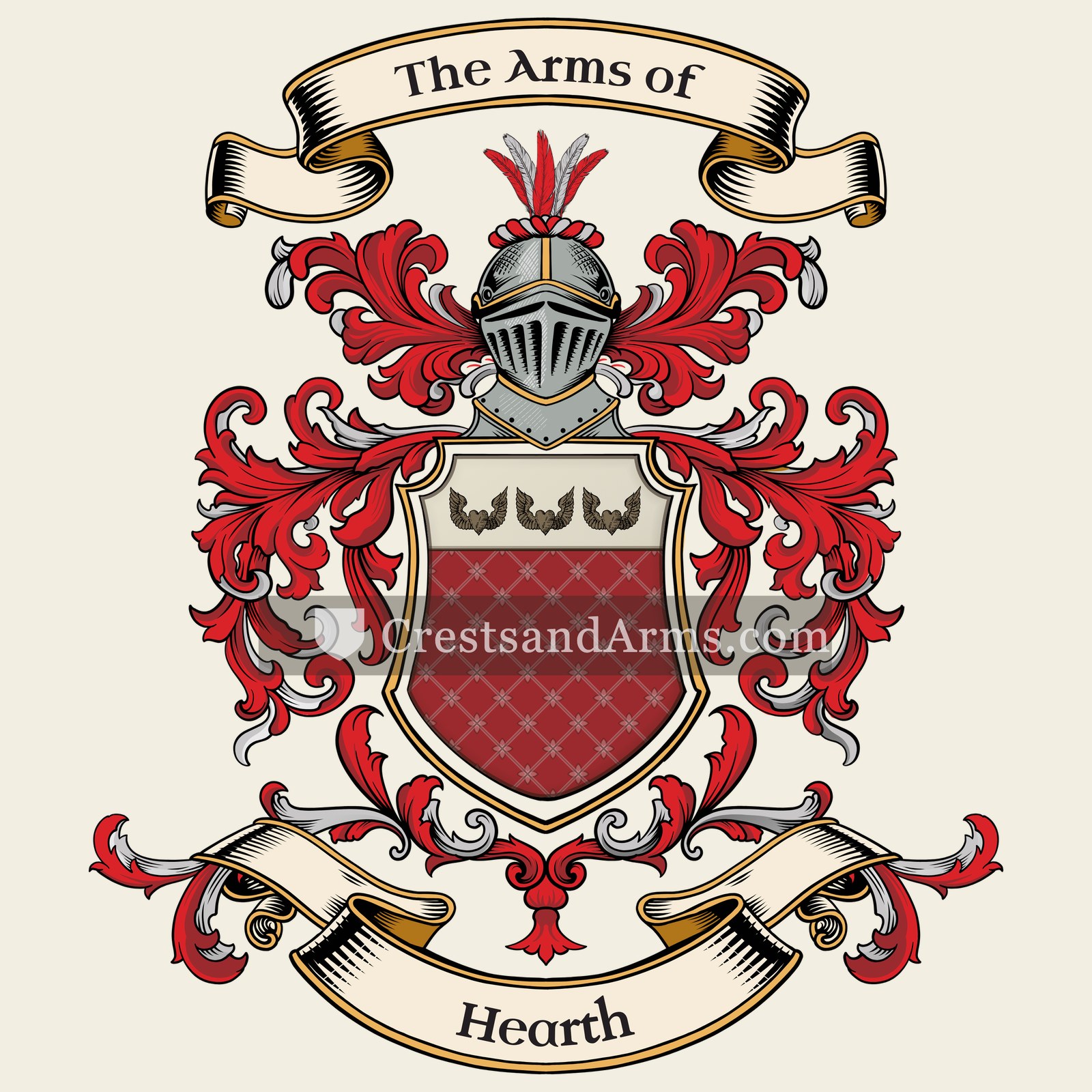
 chiefAuthority, wisdom and dominion
 heartSincerity, charity and true affection
 chiefAuthority, wisdom and dominion
 heartSincerity, charity and true affection