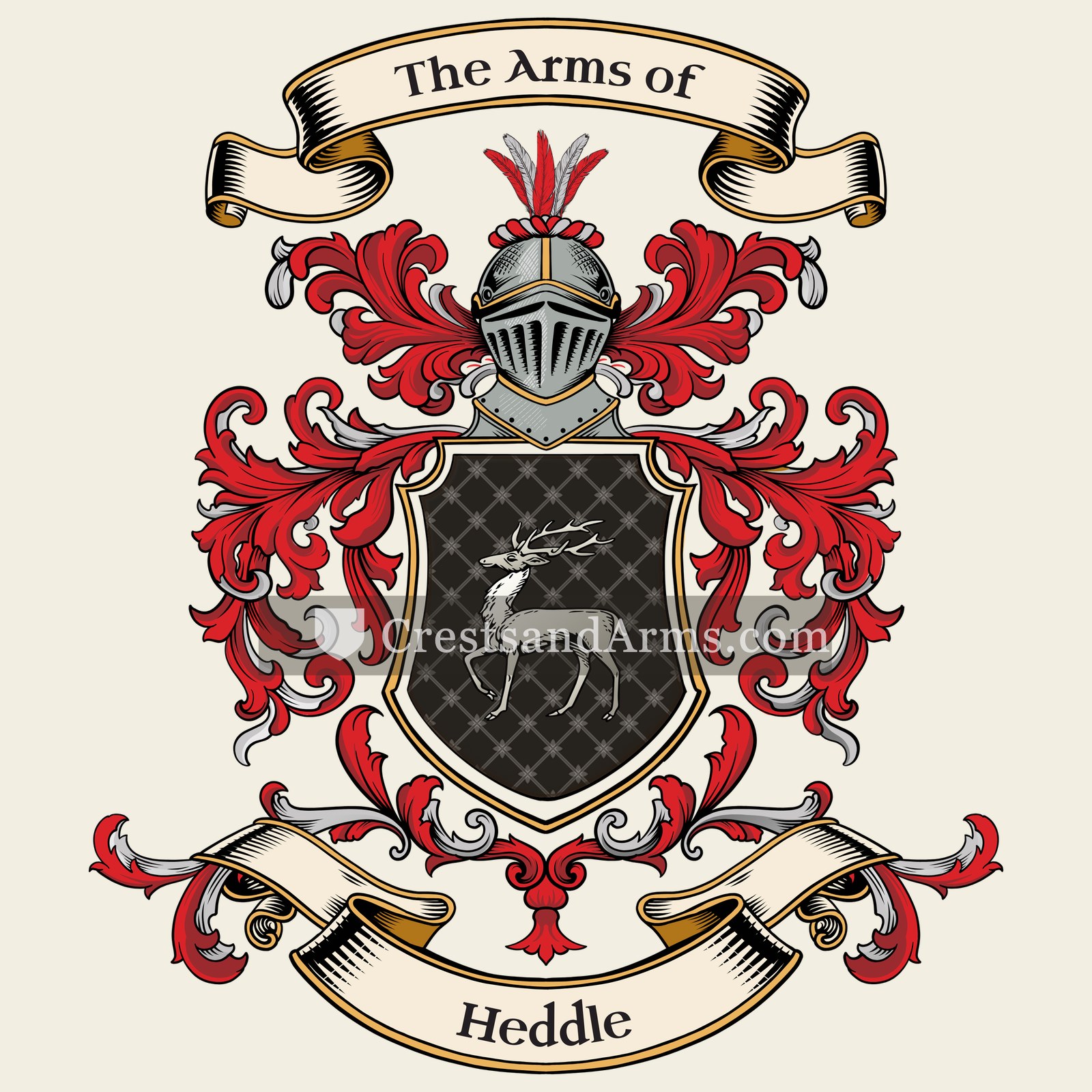
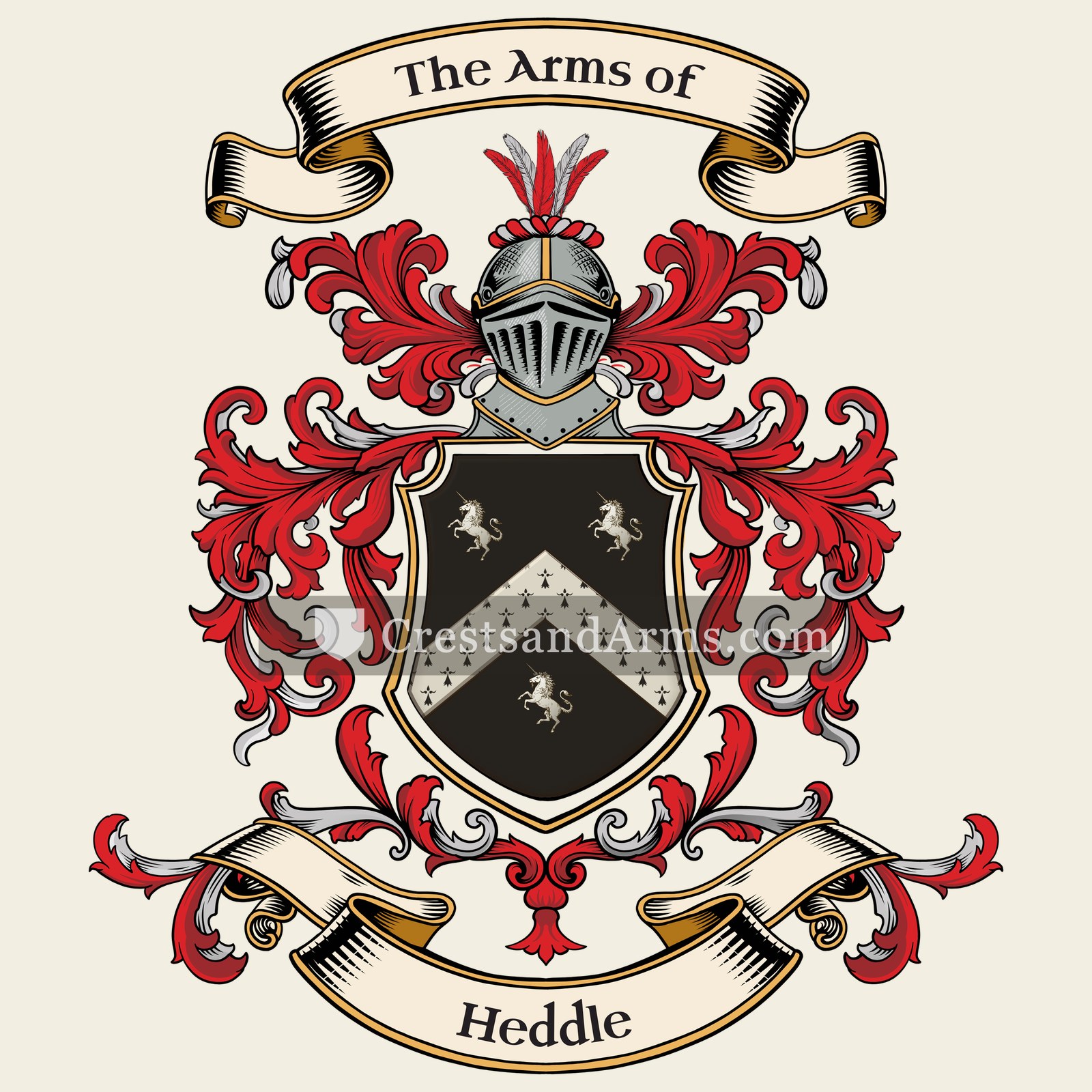
A record of documented arms, meaning and origin, researched for the Heddle family lines. Documented in 2 countries.
Reg. 3025 · Welsh, G–I
Coat of Arms & Family Crest Details
Symbols on this shield
stagPeace and harmony, and one who will not fight unprovoked
Colours
Black (Sable)Means: Constancy
Silver (Argent)Means: Peace and sincerity
Historical info
Source
Sir Bernard Burke, The General Armory of England, Scotland, Ireland and Wales, London: Harrison & Sons, 1884
Blazon (the actual original written record)
“Sa. a hart pass. ar. attired or”
DenbighUwch Aled · Denbigh, c. 1647
Where the Heddle Arms Were Recorded
Denbigh
Map of Wales showing where the Heddle arms are recorded
The Heddle arms were recorded in Denbigh, c. 1647.
Denbighshire was north Welsh country of hills and small estates. Land was held by a great many families rather than a few, and each holding brought its own claim to a coat of arms.
This is where the arms were entered in the register. Families often moved to other parts of the country, so the same name can turn up in more than one region.
The body that granted and recorded arms in Wales in this period.
Charles I of England
Sovereign of the period
Charles I of England
1625–1649
Reigning in Wales when the Heddle arms are first recorded.
How Arms Worked in Wales
English heraldry allowed arms to be shared by all legitimate descendants of the original owner. These symbols were treated as personal property that moved through the generations to all children. While the eldest son kept the original design, other family members could use the same shield without needing to change it or register their own unique versions.
Granting authority
The College of Arms in London has regulated the use of coats of arms throughout England and Wales since 1484.
How they got arms
Families typically obtained their coats of arms through a formal grant from the Crown or by proving their ancient right to them.
Where arms were recorded
All official coats of arms are recorded in the registers kept at the College of Arms, which date back to the fifteenth century.
The family's standing
Recorded among the armigerous families of Denbigh.
Origin & History of the Heddle Family in Wales
The history of the Heddle family in Wales is firmly rooted in the landscape of Denbighshire during the mid-seventeenth century. By 1647, records confirm that members of the family were established residents of the town of Denbigh, a location known for its strategic importance and its imposing medieval castle. During this era, families in the region were often deeply connected to the local agricultural economy and the shifting political climate of the Welsh Marches. The name itself likely evolved from occupational roots, as the term heddle refers to a specific component of a weaving loom used to guide warp threads. This suggests that the early Heddles may have been skilled artisans or tradespeople who played a vital role in the regional textile industry. As they settled into the community, these early ancestors helped shape the local social fabric, leaving behind a legacy that reflects the industrious nature of life in North Wales during a period of significant national change.
Coat of Arms & Family Crest Details
Symbols on this shield
chevronProtection, and faithful service completed
unicornPurity, and extreme courage in defence of honour
Colours
Black (Sable)Means: Constancy
ErmineMeans: Dignity
Silver (Argent)Means: Peace and sincerity
Historical info
Source
Sir Bernard Burke, The General Armory of England, Scotland, Ireland and Wales, London: Harrison & Sons, 1884
Blazon (the actual original written record)
“Sa. a chev. erm. betw. three unicorns' heads erased ar”
EnglandLondon, c. 1568
Where the Heddle Arms Were Recorded
London
Map of England showing where the Heddle arms are recorded
The Heddle arms were recorded in London, c. 1568.
This is where the arms were entered in the register. Families often moved to other parts of the country, so the same name can turn up in more than one region.
The body that granted and recorded arms in England in this period.
Elizabeth I of England
Sovereign of the period
Elizabeth I of England
1558–1603
Reigning in Wales when the Heddle arms are first recorded.
How Arms Worked in England
English heraldry allowed arms to be shared by all legitimate descendants of the original owner. These symbols were treated as personal property that moved through the generations to all children. While the eldest son kept the original design, other family members could use the same shield without needing to change it or register their own unique versions.
Granting authority
The College of Arms in London has regulated the use of coats of arms throughout England and Wales since 1484.
How they got arms
Families typically obtained their coats of arms through a formal grant from the Crown or by proving their ancient right to them.
Where arms were recorded
All official coats of arms are recorded in the registers kept at the College of Arms, which date back to the fifteenth century.
The family's standing
Recorded among the armigerous families of England.
Origin & History of the Heddle Family in England
The Heddle family name has deep roots in the bustling environment of sixteenth-century London. Historical records confirm that members of the family were living in the city by 1568, a time when London was rapidly expanding as a center for international trade and craftsmanship. The name itself is thought to be occupational, likely derived from the word "heddle," which refers to a specific part of a weaving loom used to guide warp threads. This suggests that the earliest ancestors of the family were likely skilled textile workers who played a vital role in the cloth industry that fueled the English economy during the Tudor period. By settling in London, these early Heddles placed themselves at the heart of a growing urban society, where their trade skills would have been highly valued as the city transformed into a global hub for commerce and industry.
Related Branches & Arms
Root word
Hedd
A Welsh word meaning peace or tranquility.
This name
HeddleDerived from a nickname for a peaceful person or a dweller near a peaceful location.
also spelled
Heddle
Heddles
Documented Sources
Sir Bernard Burke, The General Armory of England, Scotland, Ireland and Wales, London: Harrison & Sons, 1884
National Library of Wales, The Records of the Court of Great Sessions in Wales (Wales, 1647)
Davies, John, A History of Wales, 1990
Jenkins, Geraint H., The Foundations of Modern Wales: 1642–1780, 1987
Digital archive packCoat of arms PNG, gold border print PDF, vector SVG and the certificate of authenticity. Sent to your email in minutes.


 stagPeace and harmony, and one who will not fight unprovoked
 stagPeace and harmony, and one who will not fight unprovoked

 chevronProtection, and faithful service completed
 unicornPurity, and extreme courage in defence of honour