Map of England showing where the Hedges arms are recorded
The Hedges arms were recorded in Hants, c. 1620.
Hampshire had the naval dockyards at Portsmouth on one side and good farmland on the other. Sea money and land money both bought estates, and an estate was what brought a family its coat of arms.
This is where the arms were entered in the register. Families often moved to other parts of the country, so the same name can turn up in more than one region.
The body that granted and recorded arms in England in this period.
James VI and I
Sovereign of the period
James VI and I
1603–1625
Reigning in England when the Hedges arms are first recorded.
How Arms Worked in England
English heraldry allowed arms to be shared by all legitimate descendants of the original owner. These symbols were treated as personal property that moved through the generations to all children. While the eldest son kept the original design, other family members could use the same shield without needing to change it or register their own unique versions.
Granting authority
The College of Arms in London has regulated the use of coats of arms throughout England and Wales since 1484.
How they got arms
Families typically obtained their coats of arms through a formal grant from the Crown or by proving their ancient right to them.
Where arms were recorded
All official coats of arms are recorded in the registers kept at the College of Arms, which date back to the fifteenth century.
The family's standing
Recorded among the armigerous families of Hants.
Origin & History of the Hedges Family in England
The surname Hedges is a topographic name, meaning it was originally given to people who lived near a prominent hedge or a boundary marked by thickets. In medieval England, such markers were essential for defining property lines and protecting livestock from predators. By the year 1620, records confirm that members of the Hedges family were well-established in the county of Hampshire. During this era, families often took their names from the landscape features that defined their daily lives and local environment. As the family grew, they became part of the local agricultural community, contributing to the development of the rural English landscape. This connection to the land remained a central part of their identity as they moved through the seventeenth century.
Hedges Meaning & Related Branches
Root word
Haga
A Germanic term referring to an enclosure, hedge, or boundary.
This name
HedgesA topographic name for someone who lived near a boundary, fence, or enclosed piece of land.
also spelled
Hedgis
Related arms
Downtonrecorded with Hedges, same area
Frankrecorded with Hedges, same area
Gloverrecorded with Hedges, same area
Heylinrecorded with Hedges, same area
Documented Sources
Sir Bernard Burke, The General Armory of England, Scotland, Ireland and Wales, London: Harrison & Sons, 1884
Reaney, P.H., A Dictionary of English Surnames, 1991


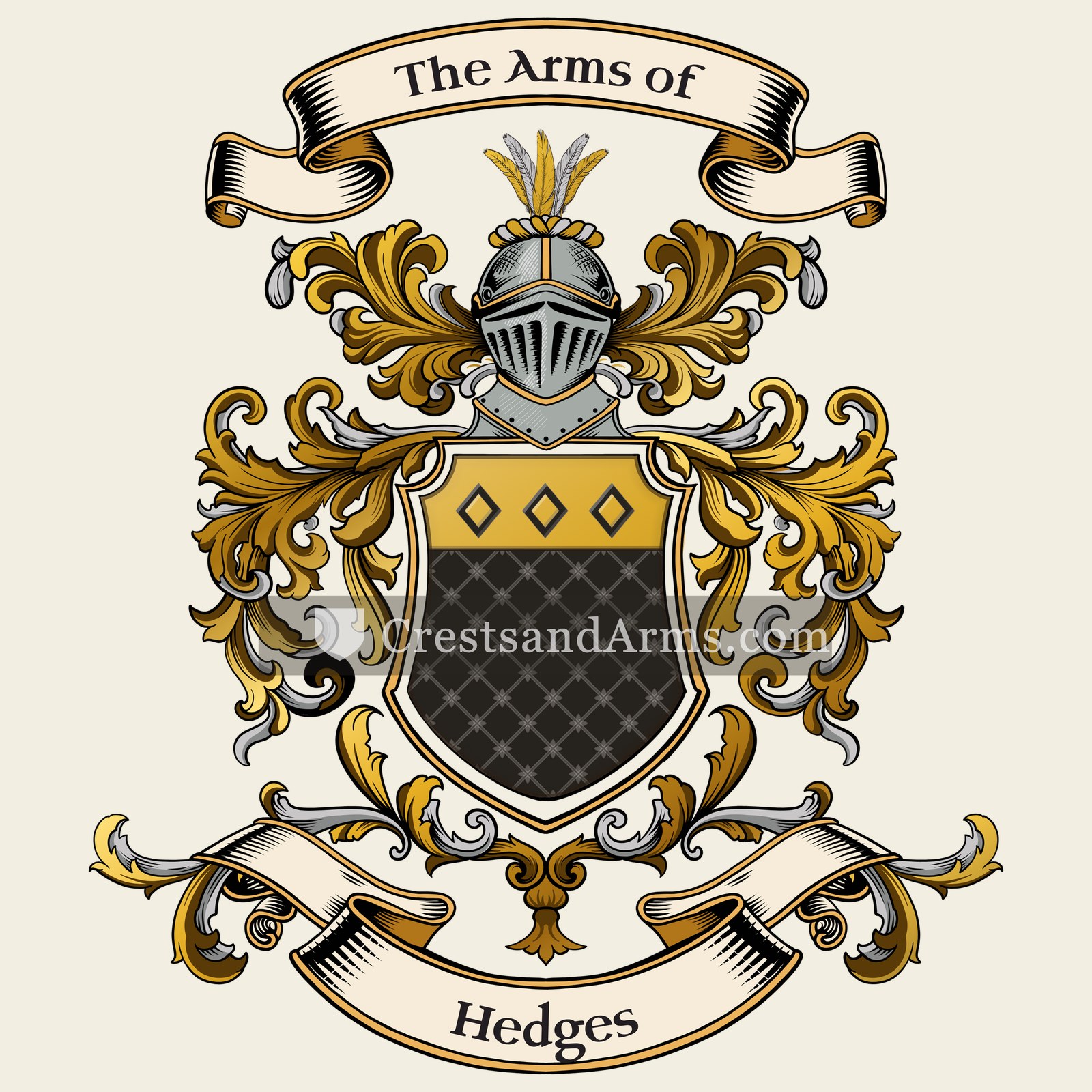
 chiefAuthority, wisdom and dominion
 masclePersuasion and the mail of a knight's coat
 chiefAuthority, wisdom and dominion
 masclePersuasion and the mail of a knight's coat