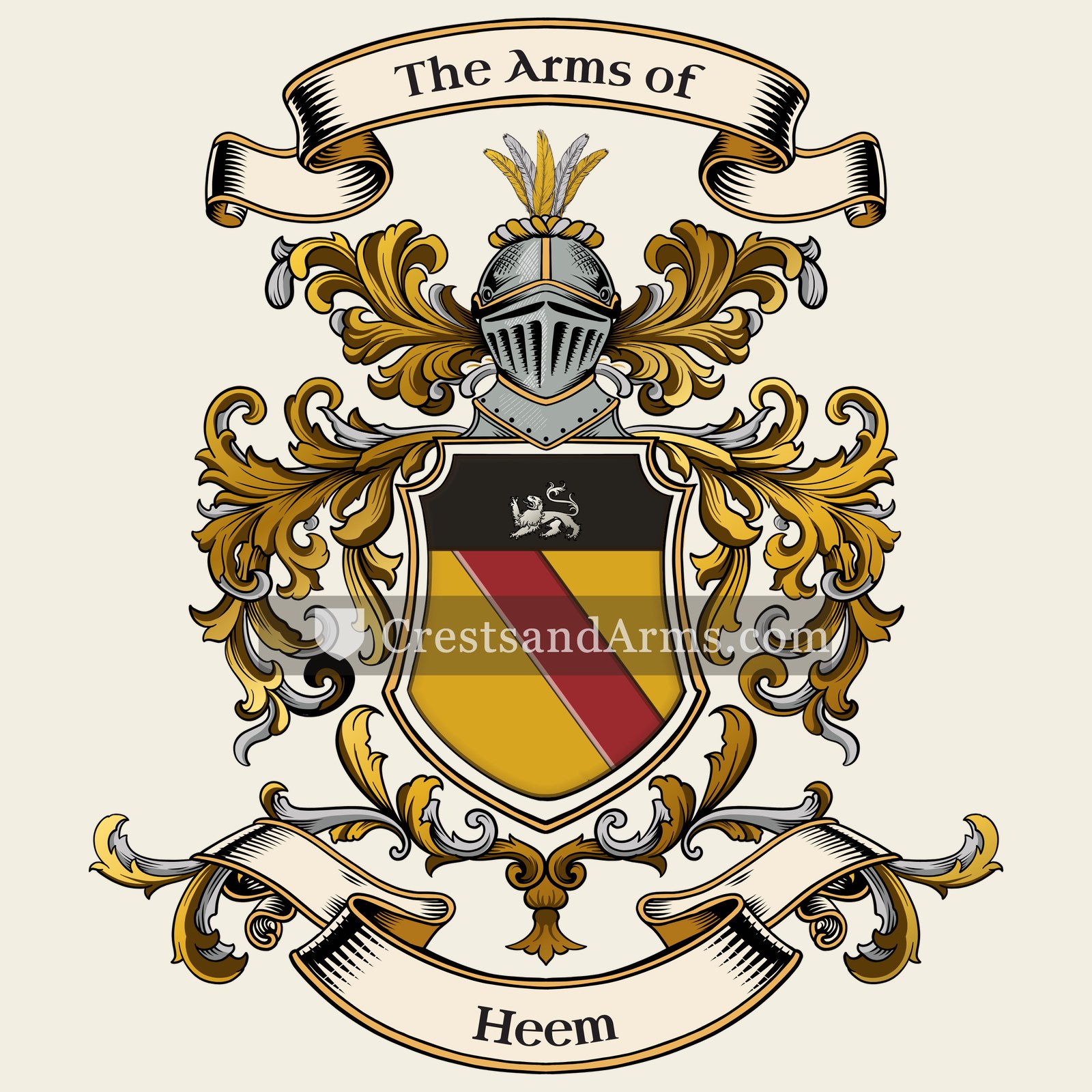
A record of documented arms, meaning and origin, researched for the Heem family of Belgium.
Reg. 0857 · Belgian, G–I
Coat of Arms & Family Crest Details
Symbols on this shield
bendDefence, and the scarf of a commander
chiefAuthority, wisdom and dominion
lionCourage, strength and royalty
Colours
Gold (Or)Means: Generosity
Red (Gules)Means: Military strength
Black (Sable)Means: Constancy
Historical info
Source
J. B. Rietstap, Armorial Général, Gouda: G. B. van Goor Zonen, 1884–87
Blazon (the actual original written record)
“D'or à quatre bandes de gu.; au chef du premier, ch. d'un lion léopardé de sa., arm. et lamp. de gu. Cq. cour. C.: le lion, iss. L.: à dextre d'or et de gu., à sen. d'or et de sa.”
BelgiumGand, c. 1706
Where the Heem Arms Were Recorded
Gand
Map of Belgium showing where the Heem arms are recorded
The Heem arms were recorded in Gand, c. 1706.
This is where the arms were entered in the register. Families often moved to other parts of the country, so the same name can turn up in more than one region.
The body that granted and recorded arms in Belgium in this period.
Philip V of Spain
Sovereign of the period
Philip V of Spain
1700–1714
Reigning in Belgium when the Heem arms are first recorded.
How Arms Worked in Belgium
In Belgium, a coat of arms is considered personal property that is passed down through the male line to legitimate descendants. Families often use the same shield design across generations to show their shared heritage. If a branch of the family wants to change the design, they must apply for an official update to their specific version of the arms.
Granting authority
The Conseil héraldique is the official body that regulates and approves all coats of arms in Belgium.
How they got arms
Families obtain their coats of arms through formal royal grants or by confirming their historical right to use existing designs.
Where arms were recorded
All approved coats of arms are officially recorded in the public registers of the Conseil héraldique since 1844.
The family's standing
Recorded among the armigerous families of Belgium.
Origin & History of the Heem Family in Belgium
The family name Heem traces its roots back to the historic city of Ghent, known as Gand in French, where members of the family were firmly established by the year 1706. During this period, Ghent was a major center for the textile trade and a hub of cultural activity within the Southern Netherlands. The name itself likely originated as a topographical descriptor, as the word "heem" is an old Germanic term for a home, a settlement, or a sheltered piece of land. Families who took this name often lived near a specific homestead or a protected enclosure, which helped neighbors identify them within the bustling urban environment of the city. By the early 18th century, the Heem family was part of the local social fabric, navigating the complex political and economic shifts that defined life in Flanders during the transition between Spanish and Austrian rule.
Related Branches & Arms
Root word
heem
A Germanic term referring to a home, dwelling, or settlement.
This name
HeemRefers to someone who lived in or originated from a specific home or village.
also spelled
Heems
Heem
de Hems
Documented Sources
J. B. Rietstap, Armorial Général, Gouda: G. B. van Goor Zonen, 1884–87
State Archives in Ghent (Rijksarchief te Gent), Parish Registers of the City of Ghent (Parochieregisters van de Stad Gent)
City Archives of Ghent (Stadsarchief Gent), Population Registers (Bevolkingsregisters)
De Flou, Karel. Woordenboek der toponymie van westelijk Vlaanderen, Vlaamsch-Zeeland, Fransch-Vlaanderen,もおlijk Vlaanderen, de provincie Antwerpen en het graafschap Loon. 1914
Pirenne, Henri. Histoire de Belgique. 1900
Digital archive packCoat of arms PNG, gold border print PDF, vector SVG and the certificate of authenticity. Sent to your email in minutes.


 bendDefence, and the scarf of a commander
 chiefAuthority, wisdom and dominion
 lionCourage, strength and royalty
 bendDefence, and the scarf of a commander
 chiefAuthority, wisdom and dominion
 lionCourage, strength and royalty