Map of Netherlands showing where the Heeringa arms are recorded
The Heeringa arms were recorded in Leeuwarden, c. 1815.
This is where the arms were entered in the register. Families often moved to other parts of the country, so the same name can turn up in more than one region.
Region
Leeuwarden
Town
Leeuwarden
First recorded
1815
Granting Authority for the Heeringa Arms
Hoge Raad van Adel
Photograph made by me · CC BY-SA 3.0
The body that granted and recorded arms in Netherlands in this period.
William I of the Netherlands
Sovereign of the period
William I of the Netherlands
1815–1840
Reigning in Netherlands when the Heeringa arms are first recorded.
How Arms Worked in Netherlands
In the Netherlands, coats of arms were often used by noble families and those who held specific public offices. These arms were passed down through the generations to legitimate descendants. Younger branches of a family usually kept the original design without needing to add special marks. This system ensured that the family identity remained clear and consistent over many years.
Granting authority
The Hoge Raad van Adel is the official body that regulates and manages noble titles and coats of arms in the Netherlands.
How they got arms
Families typically obtained their coats of arms through official royal grants or by proving their long-standing historical use of the symbols.
Where arms were recorded
Coats of arms are officially recorded in the registers held by the Hoge Raad van Adel, which began its work in 1814.
The family's standing
Recorded among the armigerous families of Netherlands.
Origin & History of the Heeringa Family in Netherlands
The family name Heeringa is deeply rooted in the province of Friesland, with clear historical records placing the family in the city of Leeuwarden by 1815. During this period, the Netherlands underwent a significant change in how citizens registered their surnames. Under the rule of Napoleon, the government required all families to adopt a formal, permanent last name for tax and military purposes. The name Heeringa follows a traditional Frisian naming pattern, as the suffix "-inga" indicates that the family originally belonged to a specific group or household associated with a person named Heer. This suggests that the family likely lived in the rural areas surrounding Leeuwarden for generations before moving into the city center as the region modernized in the early nineteenth century. By settling in Leeuwarden, the family became part of the urban growth that defined the city during the transition from the Napoleonic era to the establishment of the Kingdom of the Netherlands.
Related Branches & Arms
Root word
Heer
A Germanic term referring to a lord, master, or military leader.
This name
HeeringaA patronymic surname indicating descent from a person known as a lord or master.
also spelled
Heringe
Heringae
Heringah
Hering
Documented Sources
J. B. Rietstap, Armorial Général, Gouda: G. B. van Goor Zonen, 1884–87
Tresoar (Fries Historisch en Letterkundig Centrum), Burgerlijke Stand van Leeuwarden, Geboorteakten 1815
Tresoar (Fries Historisch en Letterkundig Centrum), Register van naamsaanneming (Akte van naamsaanneming), Leeuwarden 1811-1812
Winkler, Johan, De Nederlandsche geslachtsnamen in oorsprong, geschiedenis en beteekenis, 1885
Digital archive packCoat of arms PNG, gold border print PDF, vector SVG and the certificate of authenticity. Sent to your email in minutes.


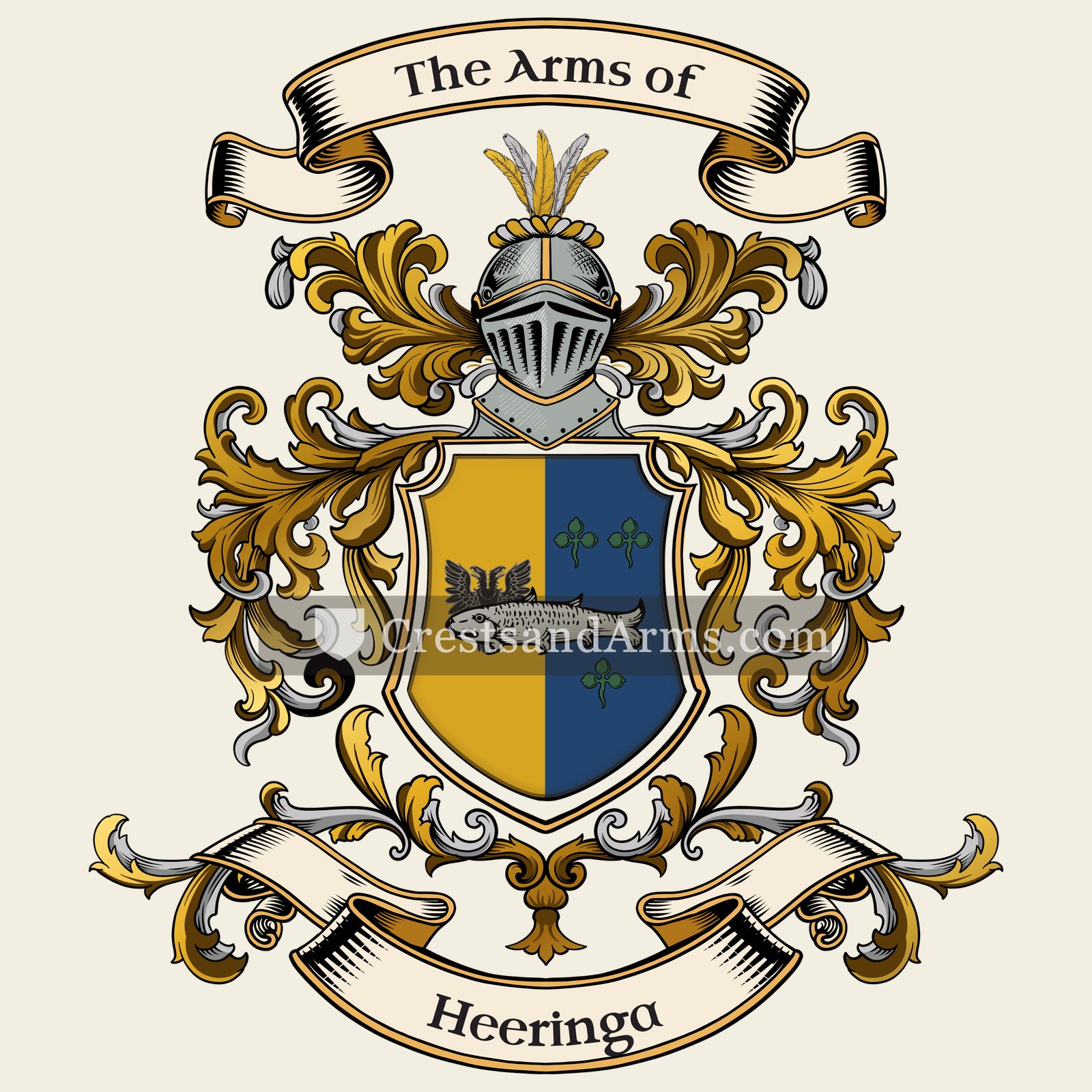
 fishA true and generous mind, and Christian faith
 eagleNobility, strength and a keen mind
 trefoilPerpetuity, and the Trinity
 fishA true and generous mind, and Christian faith
 eagleNobility, strength and a keen mind
 trefoilPerpetuity, and the Trinity