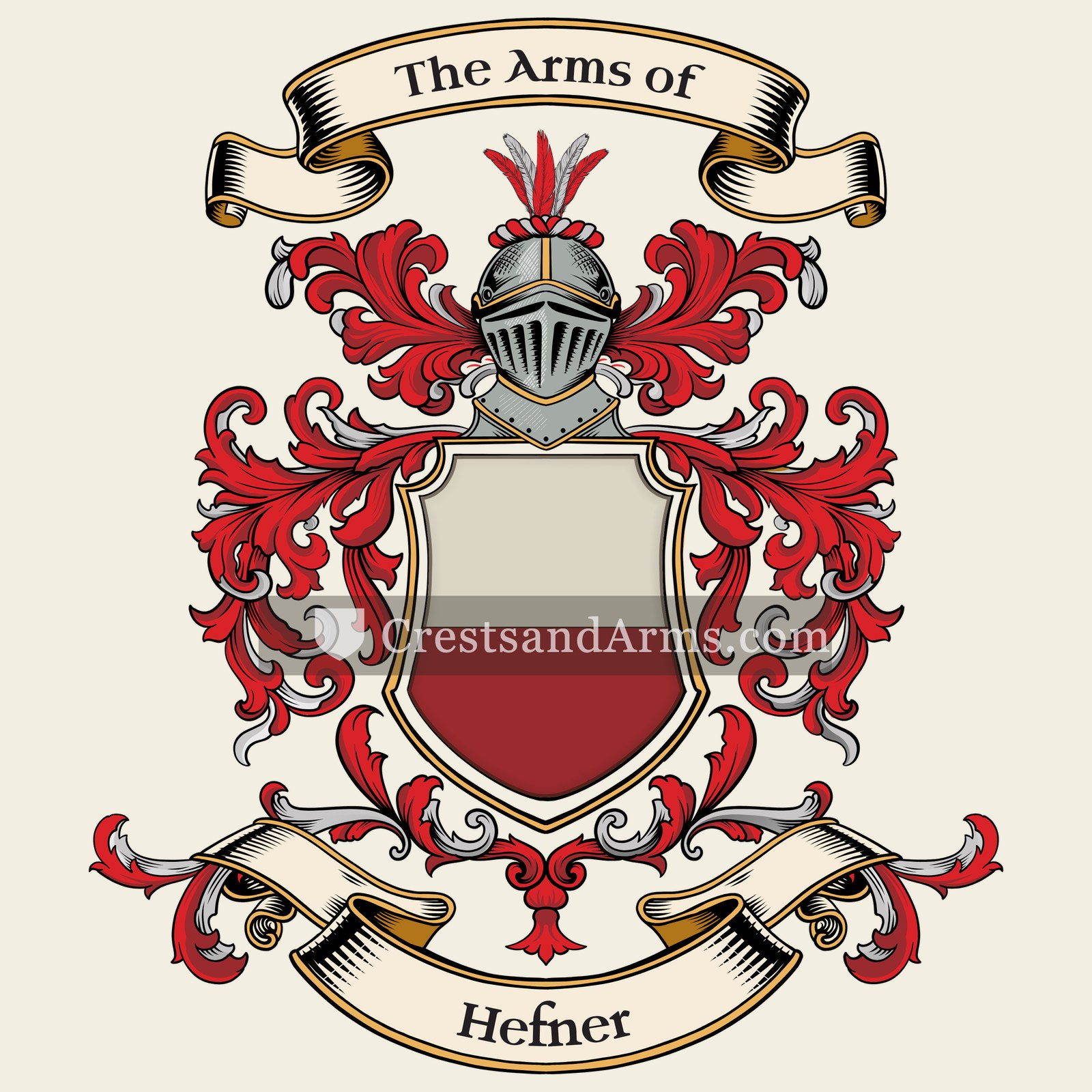
A record of documented arms, meaning and origin, researched for the Hefner family of Germany.
Reg. 7388 · German, G–I
Coat of Arms & Family Crest Details
Colours
Silver (Argent)Means: Peace and sincerity
Red (Gules)Means: Military strength
Gold (Or)Means: Generosity
Historical info
Source
J. B. Rietstap, Armorial Général, Gouda: G. B. van Goor Zonen, 1884–87
Blazon (the actual original written record)
“Coupé: au 1 d'arg. à un vigneron iss., mouv. du coupé, hab. d'or, coiffé d'un bonnet pointu du même, ceint et rebr. de gu., les bras étendus, tenant de sa main dextre une serpette et de sa sen. une grappe de raisins d'azur, pamprée de deux pièces de sin.; au 2 losangé de gu. et d'or. Cq. cour. C.: le vigneron iss. L. d'or et de gu. — (An., 30 juin 1787.) Coupé: au 1 d'arg. ch. du vigneron, à la différence qu'il tient la grappe de sa main dextre et la serpette de sa sen.; au 2 losangé d'arg. et d'or. A la fasce ondée d'azur, br. sur le coupé. Cq. cour. C.: le vigneron iss. L.: à dextre d'or et de gu., à sen. d'arg. et d'azur. D.: RECTE FACIENDO NEMINEM TIMEAS [Famille à laquelle appartenait O.-T. von H., auteur de la nouvelle édition de l'Armorial allemand de Siebmacher et de plusieurs autres travaux héraldiques.]”
BavariaBavaria, c. 1583
Digital archive packCoat of arms PNG, gold border print PDF, vector SVG and the certificate of authenticity. Sent to your email in minutes.
Map of Germany showing where the Hefner arms are recorded
The Hefner arms were recorded in Bavaria, c. 1583.
Bavaria was a country of old landed families and walled market towns. Estates passed down the same line for centuries, and both the landowners and the leading townsmen kept arms, which is why so many Bavarian names sit in the registers.
This is where the arms were entered in the register. Families often moved to other parts of the country, so the same name can turn up in more than one region.
The body that granted and recorded arms in Germany in this period.
Emperor Rudolf II
Sovereign of the period
Emperor Rudolf II
1576–1612
Reigning in Germany when the Hefner arms are first recorded.
How Arms Worked in Germany
In the Holy Roman Empire, coats of arms were often granted to individuals by the Emperor or his representatives. These arms were then passed down through the generations to all legitimate descendants of the original holder. Younger branches of a family usually kept the same shield design without needing to change it, as the arms belonged to the entire lineage.
Granting authority
The Holy Roman Emperor held the sole power to grant new coats of arms throughout his vast imperial territories.
How they got arms
Families typically obtained their coats of arms through a formal imperial grant or by proving their noble status to the authorities.
Where arms were recorded
These grants were officially recorded in the Imperial Chancery registers, which began keeping formal records of such honors during the Middle Ages.
The family's standing
Recorded among the armigerous families of Bavaria.
Origin & History of the Hefner Family in Germany
The family name Hefner originated in the German-speaking regions of Europe as a descriptive occupational surname. The name is derived from the Middle High German word *Hefener*, which referred to a potter or a maker of earthenware pots. During the late sixteenth century, the family established a notable presence in the region of Bavaria, with records confirming their residence there by 1583. At that time, individuals with this name were often integrated into the local craft guilds that dominated town life. These guilds regulated the production of household goods and ensured that potters maintained high standards for their clay wares. As the family grew, they became part of the backbone of the rural and urban economy in southern Germany, where their trade provided essential tools for daily cooking and food storage.
Hefner Meaning & Related Branches
Root word
Hafen
A pot or vessel used for cooking or storage.
This name
HefnerAn occupational surname for a potter or a maker of earthenware vessels.
also spelled
Heffner
Hefener
Related arms
Heffnervariant spelling
Documented Sources
J. B. Rietstap, Armorial Général, Gouda: G. B. van Goor Zonen, 1884–87
Bahlow, Hans, Deutsches Namenlexikon: Familien- und Vornamen nach Ursprung und Sinn erklärt, 1967
Heintze, Albert, Die deutschen Familiennamen: geschichtlich, geographisch, sprachlich, 1903