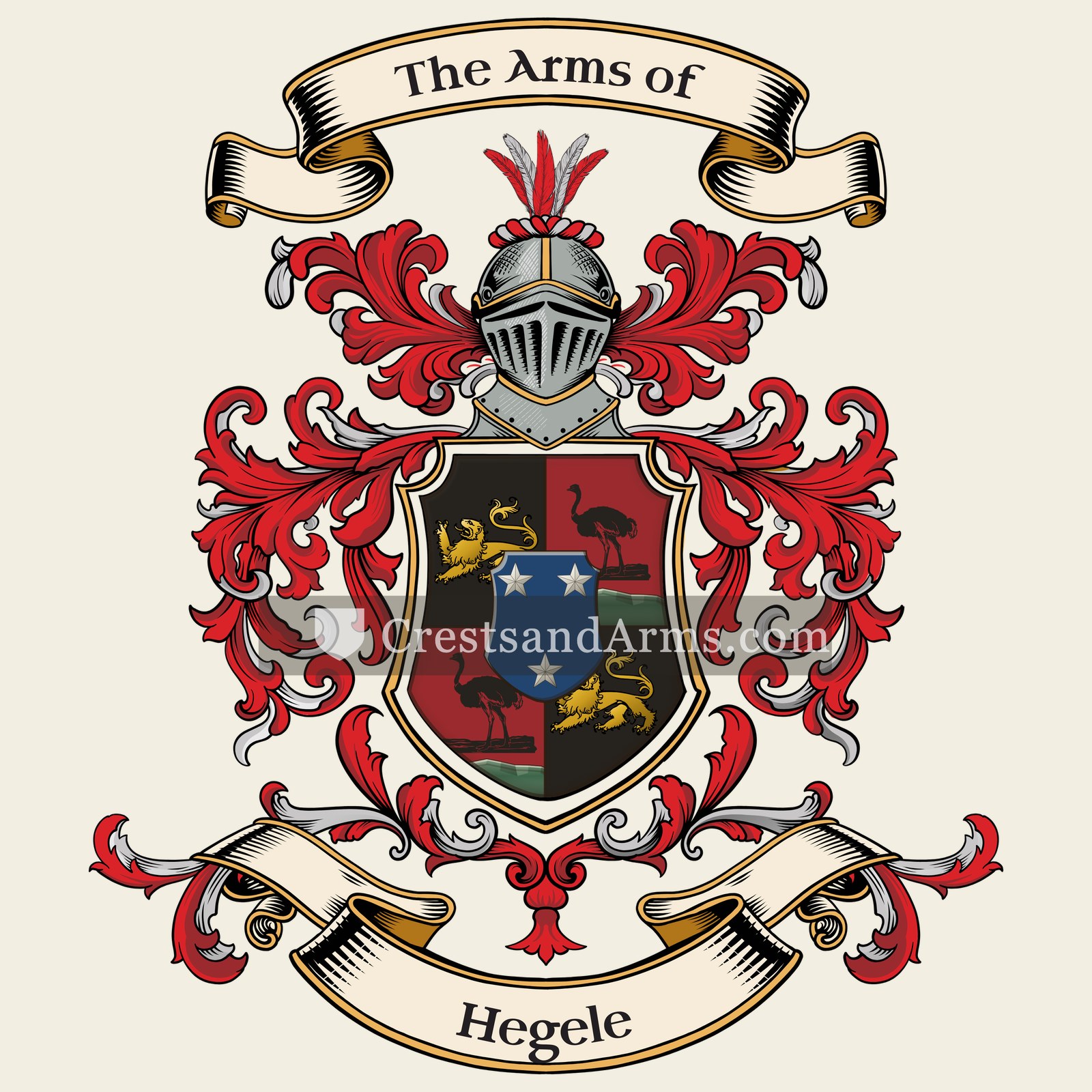
A record of documented arms, meaning and origin, researched for the Hegele family of Germany.
Reg. 5403 · German, G–I
Coat of Arms & Family Crest Details
Symbols on this shield
mountThe ground held, and steadfastness upon it
mulletThe third son, and a divine quality from above
lionCourage, strength and royalty
ostrichWilling obedience and serious thought
Colours
Black (Sable)Means: Constancy
Red (Gules)Means: Military strength
Blue (Azure)Means: Loyalty and truth
Green (Vert)Means: Hope
Silver (Argent)Means: Peace and sincerity
Gold (Or)Means: Generosity
Historical info
Source
J. B. Rietstap, Armorial Général, Gouda: G. B. van Goor Zonen, 1884–87
Blazon (the actual original written record)
“Ec.: aux 1 et 4 de sa. au lion d'or, cour. du même; aux 2 et 3 de gu. à une autruche de sa., tenant en son bec un fer-à-cheval du même et posée sur un tertre de trois coupeaux de sin. Sur le tout d'azur à trois étoiles d'arg. Deux cq. cour. C.: 1º le lion du 1, iss. et cont.; 2º l'autruche du 2. L. d'or et de gu.”
GermanyPalatinat, c. 1726
Where the Hegele Arms Were Recorded
Palatinat
Map of Germany showing where the Hegele arms are recorded
The Hegele arms were recorded in Palatinat, c. 1726.
This is where the arms were entered in the register. Families often moved to other parts of the country, so the same name can turn up in more than one region.
The body that granted and recorded arms in Germany in this period.
Charles VI, Holy Roman Emperor
Sovereign of the period
Charles VI, Holy Roman Emperor
1711–1740
Reigning in Germany when the Hegele arms are first recorded.
How Arms Worked in Germany
In the Holy Roman Empire, coats of arms were often granted to individuals by the Emperor or his representatives. These arms were then passed down through the generations to all legitimate descendants of the original holder. Younger branches of a family usually kept the same shield design without needing to change it, as the arms belonged to the entire lineage.
Granting authority
The Holy Roman Emperor held the sole power to grant new coats of arms throughout his vast imperial territories.
How they got arms
Families typically obtained their coats of arms through a formal imperial grant or by proving their noble status to the authorities.
Where arms were recorded
These grants were officially recorded in the Imperial Chancery registers, which began keeping formal records of such honors during the Middle Ages.
The family's standing
Recorded among the armigerous families of Germany.
Origin & History of the Hegele Family in Germany
The surname Hegele is deeply rooted in the southwestern regions of Germany, particularly within the historic Palatinate area. Linguists believe the name originated as a descriptive term for a person who lived near a hedge or a fenced enclosure, as the root word "Heg" relates to protective boundaries or thickets. By 1726, families carrying this name were well-established in the Palatinate, a region that faced significant social and economic shifts during the eighteenth century. Many people with this surname were likely farmers or tradespeople who worked the fertile lands along the Rhine River. Because the Palatinate was a crossroads for trade and migration, the Hegele family lived in a dynamic environment that shaped their daily lives and cultural identity long before many of their descendants eventually moved to other parts of the world.
Related Branches & Arms
Root word
Hagel
A German word referring to hail or a small enclosure.
This name
HegeleAn occupational surname for someone who lived near a fenced area or a small field.
also spelled
Hegely
Related arms
Huebingersimilar arms
Puchlersimilar arms
Documented Sources
J. B. Rietstap, Armorial Général, Gouda: G. B. van Goor Zonen, 1884–87
Bahlow, Hans, Deutsches Namenlexikon: Familien- und Vornamen nach Ursprung und Sinn erklärt, 1967
Brechenmacher, Josef Karlmann, Etymologisches Wörterbuch der deutschen Familiennamen, 1957
Landesarchiv Speyer, Kirchenbücher der Pfalz (Church records of the Palatinate), 1726
Digital archive packCoat of arms PNG, gold border print PDF, vector SVG and the certificate of authenticity. Sent to your email in minutes.


 mountThe ground held, and steadfastness upon it
 mulletThe third son, and a divine quality from above
 lionCourage, strength and royalty
 ostrichWilling obedience and serious thought
 mountThe ground held, and steadfastness upon it
 mulletThe third son, and a divine quality from above
 lionCourage, strength and royalty
 ostrichWilling obedience and serious thought