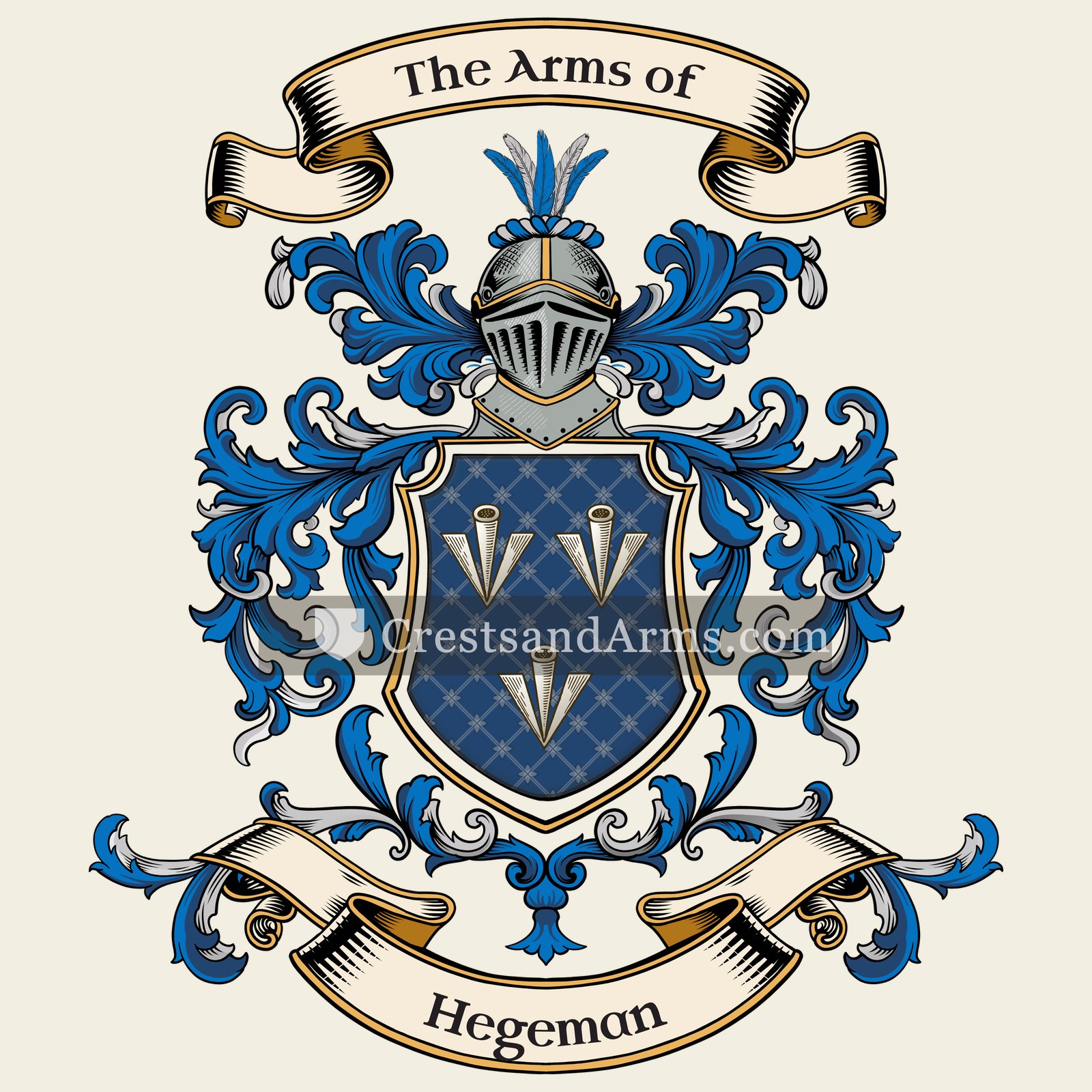
A record of documented arms, meaning and origin, researched for the Hegeman family of Netherlands.
Reg. 6489 · Dutch, G–I
Coat of Arms & Family Crest Details
Symbols on this shield
arrowReadiness for battle, and affliction endured
Colours
Blue (Azure)Means: Loyalty and truth
Silver (Argent)Means: Peace and sincerity
Historical info
Source
J. B. Rietstap, Armorial Général, Gouda: G. B. van Goor Zonen, 1884–87
Blazon (the actual original written record)
“D'azur à trois flèches accostées d'arg., ayant une pointe en haut et en bas.”
NetherlandsHarderwick Gueldre, c. 1815
Where the Hegeman Arms Were Recorded
Harderwick
Map of Netherlands showing where the Hegeman arms are recorded
The Hegeman arms were recorded in Harderwick Gueldre, c. 1815.
This is where the arms were entered in the register. Families often moved to other parts of the country, so the same name can turn up in more than one region.
Region
Harderwick
Town
Harderwick Gueldre
First recorded
1815
Granting Authority for the Hegeman Arms
Hoge Raad van Adel
Photograph made by me · CC BY-SA 3.0
The body that granted and recorded arms in Netherlands in this period.
William I of the Netherlands
Sovereign of the period
William I of the Netherlands
1815–1840
Reigning in Netherlands when the Hegeman arms are first recorded.
How Arms Worked in Netherlands
In the Netherlands, coats of arms were often used by noble families and those who held specific public offices. These arms were passed down through the generations to legitimate descendants. Younger branches of a family usually kept the original design without needing to add special marks. This system ensured that the family identity remained clear and consistent over many years.
Granting authority
The Hoge Raad van Adel is the official body that regulates and manages noble titles and coats of arms in the Netherlands.
How they got arms
Families typically obtained their coats of arms through official royal grants or by proving their long-standing historical use of the symbols.
Where arms were recorded
Coats of arms are officially recorded in the registers held by the Hoge Raad van Adel, which began its work in 1814.
The family's standing
Recorded among the armigerous families of Netherlands.
Origin & History of the Hegeman Family in Netherlands
The Hegeman family name has deep roots in the Netherlands, with historical records confirming the presence of family members in the town of Harderwijk by the year 1815. The name itself is likely derived from the Middle Dutch word "hege," which refers to a hedge or a fenced enclosure, and "man," which simply means a person. This suggests that the earliest ancestors to carry the name may have been individuals who lived near a prominent hedge or served as caretakers for a fenced property or boundary. During the early 19th century, Harderwijk was a significant fortified city and a center for trade, providing a stable environment for families to establish their roots. As the family grew, they became part of the local social fabric, contributing to the development of the region through their work and community involvement.
Related Branches & Arms
Root word
Hage
A hedge, enclosure, or fenced area of land.
This name
HegemanA person who lived near or managed a hedge or enclosed property.
Related arms
Aeltsenrecorded with Hegeman, same area
Boonenrecorded with Hegeman, same area
Brinckrecorded with Hegeman, same area
Goertzrecorded with Hegeman, same area
Documented Sources
J. B. Rietstap, Armorial Général, Gouda: G. B. van Goor Zonen, 1884–87
Gelders Archief, Burgerlijke Stand Gelderland, Harderwijk, 1815
Van der Schaar, J., Woordenboek van voornamen, 1964
Debrabandere, Frans, Woordenboek van de familienamen in België en Noord-Frankrijk, 1993
Digital archive packCoat of arms PNG, gold border print PDF, vector SVG and the certificate of authenticity. Sent to your email in minutes.


 arrowReadiness for battle, and affliction endured
 arrowReadiness for battle, and affliction endured