Map of Germany showing where the Heggen arms are recorded
The Heggen arms were recorded in Westphalia, c. 1765.
Westphalia was a land of small estates and fortified farmhouses in western Germany. Its families were numerous and not especially rich, but each held its own ground, and holding ground was what brought arms.
This is where the arms were entered in the register. Families often moved to other parts of the country, so the same name can turn up in more than one region.
The body that granted and recorded arms in Germany in this period.
Francis I, Holy Roman Emperor
Sovereign of the period
Francis I, Holy Roman Emperor
1745–1765
Reigning in Germany when the Heggen arms are first recorded.
How Arms Worked in Germany
In the Holy Roman Empire, coats of arms were often granted to individuals by the Emperor or his representatives. These arms were then passed down through the generations to all legitimate descendants of the original holder. Younger branches of a family usually kept the same shield design without needing to change it, as the arms belonged to the entire lineage.
Granting authority
The Holy Roman Emperor held the sole power to grant new coats of arms throughout his vast imperial territories.
How they got arms
Families typically obtained their coats of arms through a formal imperial grant or by proving their noble status to the authorities.
Where arms were recorded
These grants were officially recorded in the Imperial Chancery registers, which began keeping formal records of such honors during the Middle Ages.
The family's standing
Recorded among the armigerous families of Westphalia.
Origin & History of the Heggen Family in Germany
The family name Heggen originates from the Westphalia region of Germany, where historical records confirm the presence of family members as early as 1765. The name is topographical in nature, meaning it was likely derived from the landscape surrounding the family’s original home. In the local dialect, the term "Hegge" refers to a hedge, a fence, or a protected enclosure, suggesting that the first people to carry this name lived near a prominent boundary or a thicket of bushes. Over generations, the name evolved into its current form as families became more established within their local communities. By the mid-18th century, the Heggen family was well-integrated into the rural social structure of Westphalia, where they likely worked as farmers or tradespeople who relied on the land for their livelihood. This deep connection to the geography of their homeland helped define their identity and ensured that the name remained tied to the specific region for centuries.
Heggen Meaning & Related Branches
Root word
Hag
An enclosed area, hedge, or fenced piece of land.
This name
HeggenA topographic name for someone who lived near a hedge or an enclosed field.
also spelled
Heggen
Hegan
Documented Sources
J. B. Rietstap, Armorial Général, Gouda: G. B. van Goor Zonen, 1884–87
Bischöfliches Diözesanarchiv Münster, Kirchenbuchverzeichnisse des Bistums Münster, 1765
Bahlow, Hans, Deutsches Namenlexikon: Familien- und Vornamen nach Ursprung und Sinn erklärt, 1967
Gottschald, Max, Deutsche Namenkunde: Unsere Familiennamen nach ihrer Entstehung und Bedeutung, 1971
Digital archive packCoat of arms PNG, gold border print PDF, vector SVG and the certificate of authenticity. Sent to your email in minutes.


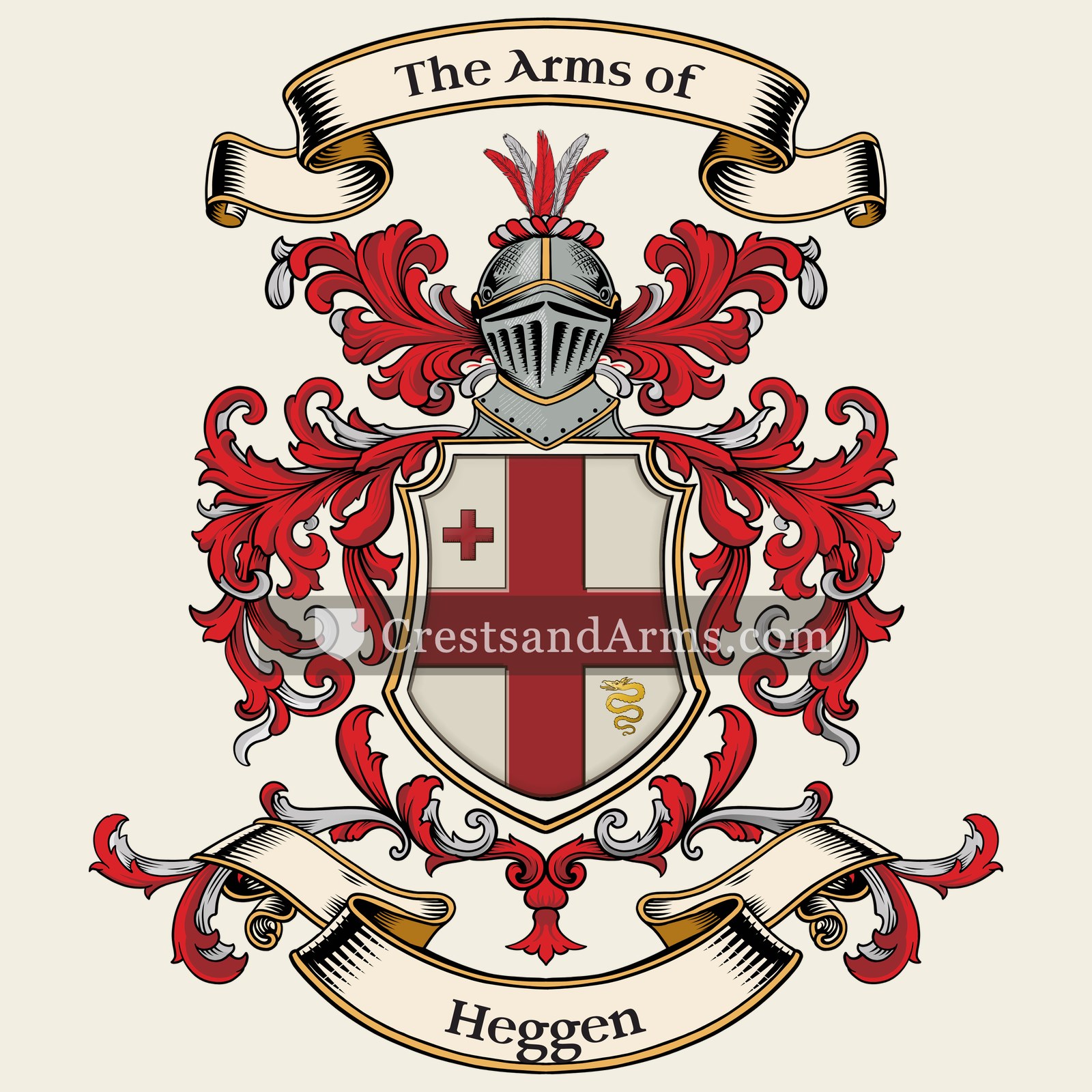
 cross symbolChristian faith and service
 serpentWisdom, healing and prudence
 cross symbolChristian faith and service
 serpentWisdom, healing and prudence