A record of documented arms, meaning and origin, researched for the Hegseth family lines. Documented in 2 countries.
Reg. 2963 · English, G–I
Coat of Arms & Family Crest Details
Symbols on this shield
bendDefence, and the scarf of a commander
chiefAuthority, wisdom and dominion
bordureA difference between branches of one family
wheatsheafPlenty, and the harvest of one's own labour
eagleNobility, strength and a keen mind
Colours
Silver (Argent)Means: Peace and sincerity
Black (Sable)Means: Constancy
Blue (Azure)Means: Loyalty and truth
ErmineMeans: Dignity
Gold (Or)Means: Generosity
Historical info
Source
Sir Bernard Burke, The General Armory of England, Scotland, Ireland and Wales, London: Harrison & Sons, 1884
Blazon (the actual original written record)
“Ar. on a bend sa. three garbs or, a chief az. thereon an eagle with two heads displ. ppr. all within a bordure erminois, quartering FLEETWOOD and BOLD”
LancasterNorth Meols · Lancaster, c. 1620
Digital archive packCoat of arms PNG, gold border print PDF, vector SVG and the certificate of authenticity. Sent to your email in minutes.
Map of England showing where the Hegseth arms are recorded
The Hegseth arms were recorded in Lancaster, c. 1620.
Lancashire was divided among a great many small landed families, more than most northern counties. Estates were passed down whole rather than split up, so the same names hold the same ground for centuries in the records.
This is where the arms were entered in the register. Families often moved to other parts of the country, so the same name can turn up in more than one region.
The body that granted and recorded arms in England in this period.
James VI and I
Sovereign of the period
James VI and I
1603–1625
Reigning in England when the Hegseth arms are first recorded.
How Arms Worked in England
English heraldry allowed arms to be shared by all legitimate descendants of the original owner. These symbols were treated as personal property that moved through the generations to all children. While the eldest son kept the original design, other family members could use the same shield without needing to change it or register their own unique versions.
Granting authority
The College of Arms in London has regulated the use of coats of arms throughout England and Wales since 1484.
How they got arms
Families typically obtained their coats of arms through a formal grant from the Crown or by proving their ancient right to them.
Where arms were recorded
All official coats of arms are recorded in the registers kept at the College of Arms, which date back to the fifteenth century.
The family's standing
Recorded among the armigerous families of Lancaster.
Origin & History of the Hegseth Family in England
The history of the Hegseth name in England is deeply rooted in the social landscape of the early seventeenth century. Records indicate that members of the family were established in the county of Lancaster by 1620, a period defined by significant religious and political shifts. During this time, families in the Lancashire region often lived in close-knit rural communities where they worked in agriculture or local trade. The name itself reflects a connection to the geography of the North, as many surnames from this era were derived from specific landmarks or homesteads. As the family settled into life in Lancaster, they became part of the local fabric that helped shape the region’s development during the transition into the Stuart period. Their presence in these early parish records highlights how families of that era maintained stability and community ties despite the broader national changes occurring across England.
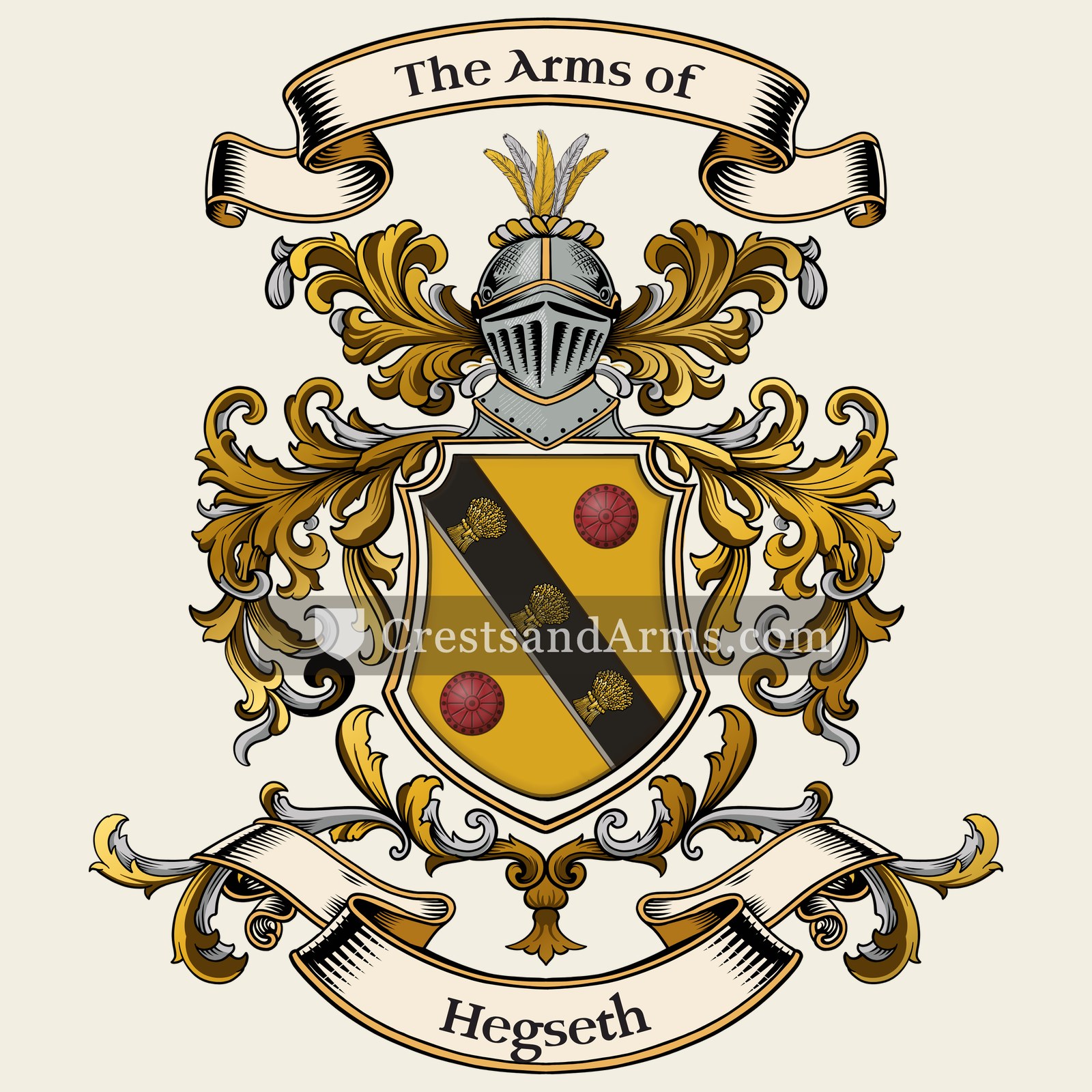
Coat of Arms & Family Crest Details
Symbols on this shield
bendDefence, and the scarf of a commander
roundelA coin, and one who has been to the crusades
wheatsheafPlenty, and the harvest of one's own labour
Colours
Gold (Or)Means: Generosity
Black (Sable)Means: Constancy
Red (Gules)Means: Military strength
Historical info
Source
Sir Bernard Burke, The General Armory of England, Scotland, Ireland and Wales, London: Harrison & Sons, 1884
Blazon (the actual original written record)
“Or, on a bend sa. betw. two torteaux three garbs of the field, quartering BAMFORD and LLOYD”
DenbighGwyrch Castle · Denbigh, c. 1647
Digital archive packCoat of arms PNG, gold border print PDF, vector SVG and the certificate of authenticity. Sent to your email in minutes.
Map of Wales showing where the Hegseth arms are recorded
The Hegseth arms were recorded in Denbigh, c. 1647.
Denbighshire was north Welsh country of hills and small estates. Land was held by a great many families rather than a few, and each holding brought its own claim to a coat of arms.
This is where the arms were entered in the register. Families often moved to other parts of the country, so the same name can turn up in more than one region.
The body that granted and recorded arms in Wales in this period.
Charles I of England
Sovereign of the period
Charles I of England
1625–1649
Reigning in England when the Hegseth arms are first recorded.
How Arms Worked in Wales
English heraldry allowed arms to be shared by all legitimate descendants of the original owner. These symbols were treated as personal property that moved through the generations to all children. While the eldest son kept the original design, other family members could use the same shield without needing to change it or register their own unique versions.
Granting authority
The College of Arms in London has regulated the use of coats of arms throughout England and Wales since 1484.
How they got arms
Families typically obtained their coats of arms through a formal grant from the Crown or by proving their ancient right to them.
Where arms were recorded
All official coats of arms are recorded in the registers kept at the College of Arms, which date back to the fifteenth century.
The family's standing
Recorded among the armigerous families of Denbigh.
Origin & History of the Hegseth Family in Wales
The history of the Hegseth name in Wales is deeply rooted in the social landscape of the seventeenth century. By 1647, records confirm that members of the family were established in the town of Denbigh. During this period, Denbigh was a significant administrative and market hub in North Wales, serving as a crossroads for local trade and legal affairs. Families living in this area often navigated the complex transition between traditional Welsh customs and the growing influence of English governance. As residents of a prominent town, the early Hegseth family likely participated in the local economy and the civic life of the region. Their presence in Denbigh suggests they were part of a stable community that weathered the political instability of the mid-1600s. This early foothold provides a clear starting point for understanding how the family integrated into the historic fabric of Welsh society.
Related Branches & Arms
Root word
Hegset
A farmstead located on a hillside or slope.
This name
HegsethDerived from a Norwegian topographic name referring to a person living on a hillside farm.
also spelled
Heskett
Hesketh-Fleetwood
Documented Sources
Sir Bernard Burke, The General Armory of England, Scotland, Ireland and Wales, London: Harrison & Sons, 1884
Lancashire Archives, Bishop’s Transcripts of Parish Registers for the Diocese of Chester, 1620


 bendDefence, and the scarf of a commander
 chiefAuthority, wisdom and dominion
 bordureA difference between branches of one family
 wheatsheafPlenty, and the harvest of one's own labour
 eagleNobility, strength and a keen mind
 bendDefence, and the scarf of a commander
 chiefAuthority, wisdom and dominion
 bordureA difference between branches of one family
 wheatsheafPlenty, and the harvest of one's own labour
 eagleNobility, strength and a keen mind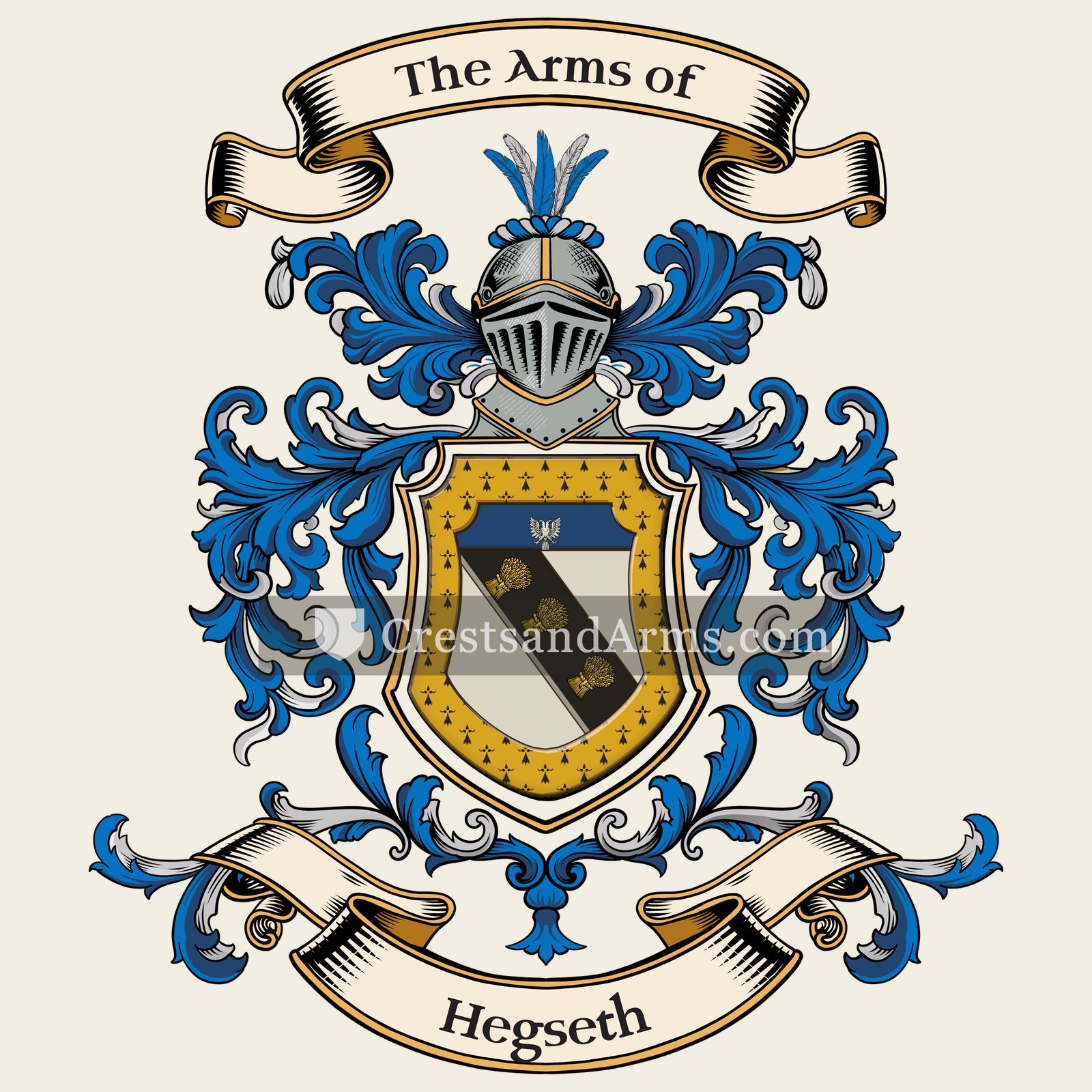


 roundelA coin, and one who has been to the crusades