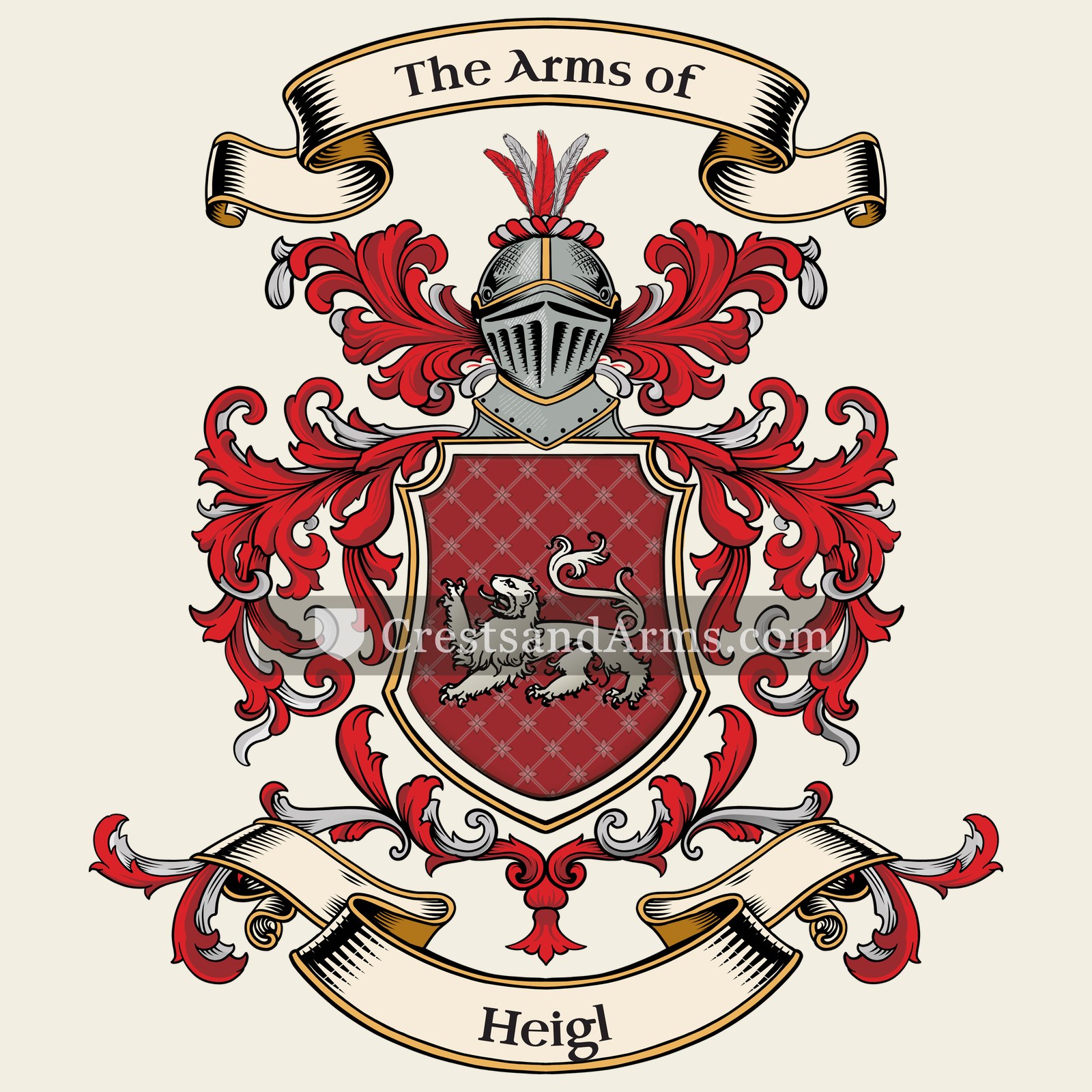
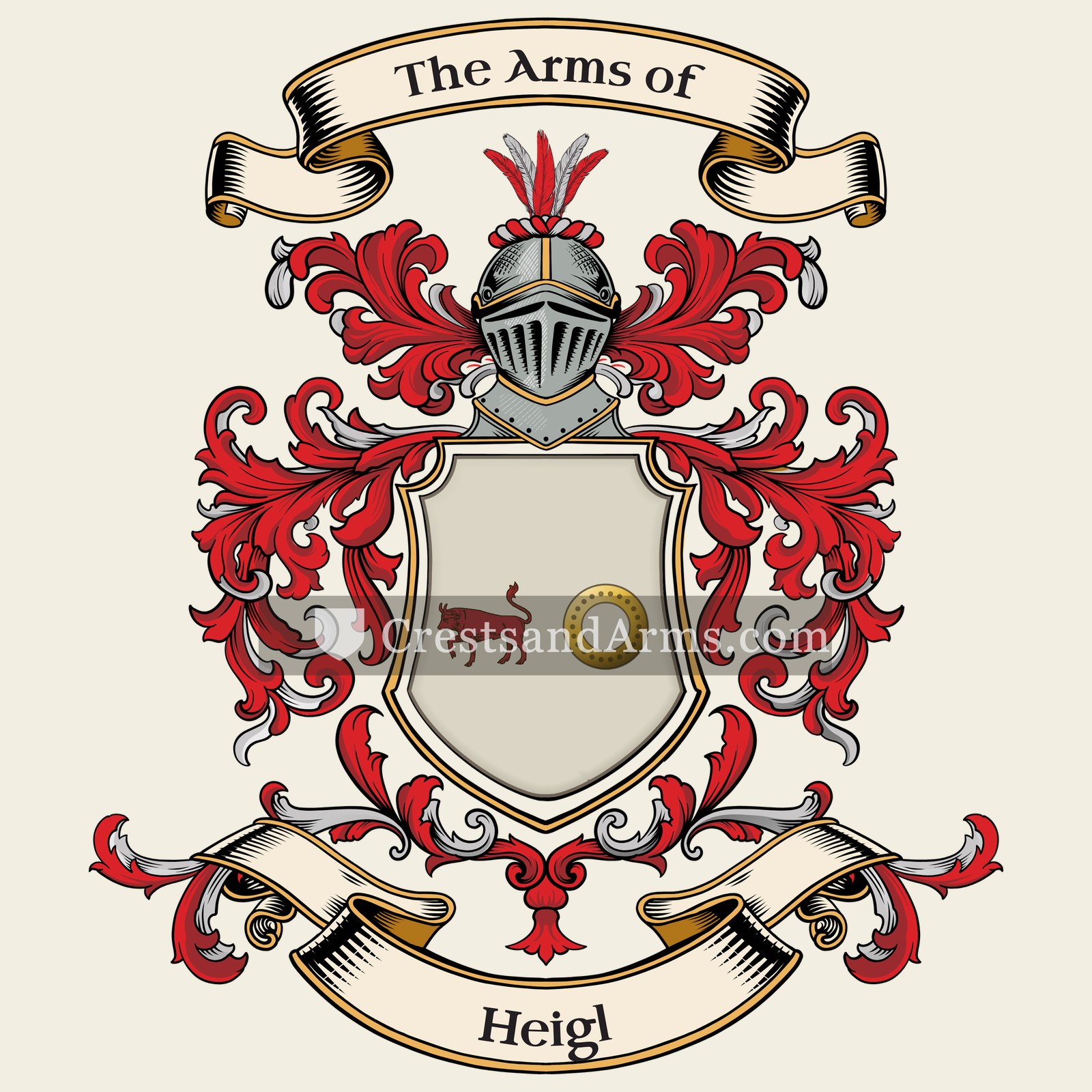
A record of documented arms, meaning and origin, researched for the Heigl family lines. Documented in 2 countries.
Reg. 0585 · German, G–I
Coat of Arms & Family Crest Details
Symbols on this shield
lionCourage, strength and royalty
Colours
Red (Gules)Means: Military strength
Silver (Argent)Means: Peace and sincerity
Historical info
Source
J. B. Rietstap, Armorial Général, Gouda: G. B. van Goor Zonen, 1884–87
Blazon (the actual original written record)
“De gu. à une haie d'osiers d'arg. en p, de laquelle sort une chatte ramp. du sec., ayant un visage de femme de carn., coiffée d'un bonnet d'or. C.: la figure de l'écu, moins la haie. L. d'arg. et de gu.”
GermanyDachau Bav, c. 1765
Where the Heigl Arms Were Recorded
Dachau
Map of Germany showing where the Heigl arms are recorded
The Heigl arms were recorded in Dachau Bav, c. 1765.
This is where the arms were entered in the register. Families often moved to other parts of the country, so the same name can turn up in more than one region.
The body that granted and recorded arms in Germany in this period.
Francis I, Holy Roman Emperor
Sovereign of the period
Francis I, Holy Roman Emperor
1745–1765
Reigning in Germany when the Heigl arms are first recorded.
How Arms Worked in Germany
In the Holy Roman Empire, coats of arms were often granted to individuals by the Emperor or his representatives. These arms were then passed down through the generations to all legitimate descendants of the original holder. Younger branches of a family usually kept the same shield design without needing to change it, as the arms belonged to the entire lineage.
Granting authority
The Holy Roman Emperor held the sole power to grant new coats of arms throughout his vast imperial territories.
How they got arms
Families typically obtained their coats of arms through a formal imperial grant or by proving their noble status to the authorities.
Where arms were recorded
These grants were officially recorded in the Imperial Chancery registers, which began keeping formal records of such honors during the Middle Ages.
The family's standing
Recorded among the armigerous families of Germany.
Origin & History of the Heigl Family in Germany
The family name Heigl originates from the southern regions of Germany, particularly within the state of Bavaria. Linguistically, the name is a diminutive form of the name Hugo, which was a popular choice in the Middle Ages. Over time, the name evolved through local dialects to become Heigl, serving as a way to identify individuals in small rural communities. By the mid-eighteenth century, records confirm that families bearing this name were well-established in the town of Dachau. During this period, the region was characterized by agricultural life and trade guilds, where families like the Heigls played a role in the local social structure. Because surnames were often tied to specific geographic areas, the presence of the Heigl name in Dachau by 1765 suggests that the family had likely been rooted in the Bavarian landscape for several generations prior to that date.
Coat of Arms & Family Crest Details
Symbols on this shield
bullValour and generosity
ringFidelity, and a promise kept
Colours
Silver (Argent)Means: Peace and sincerity
Red (Gules)Means: Military strength
Gold (Or)Means: Generosity
Historical info
Source
J. B. Rietstap, Armorial Général, Gouda: G. B. van Goor Zonen, 1884–87
Blazon (the actual original written record)
“D'Arg. à un rencontre de buffle de gu., accorné d'or, bouclé du même. C.: une tête de buffle de gu., accornée et bouclée d'or, posée de profil.”
Austriac. 1772
Where the Heigl Arms Were Recorded
Tyrol
Map of Austria showing where the Heigl arms are recorded
The Heigl arms were recorded in Austria, c. 1772.
Arms such as these were typically recorded in Tyrol.
Tyrol was mountain country in western Austria, where the valleys were held by families who had been there a very long time. Old tenure counted for more than money, and old families carried arms.
This is where the arms were entered in the register. Families often moved to other parts of the country, so the same name can turn up in more than one region.
Region
Tyrol
First recorded
1772
Granting Authority for the Heigl Arms
Imperial and Royal chancery
Sodacan · CC BY-SA 3.0
The body that granted and recorded arms in Austria in this period.
Joseph II, Holy Roman Emperor
Sovereign of the period
Joseph II, Holy Roman Emperor
1765–1790
Reigning in Germany when the Heigl arms are first recorded.
How Arms Worked in Austria
Austrian coats of arms were often linked directly to noble titles granted by the Emperor. These symbols belonged to the entire family line rather than just one individual. When a family grew, new branches kept the original design without needing to change it. This system allowed all members of a noble house to share the same identity across many generations.
Granting authority
The Imperial and Royal chancery managed all heraldic matters and controlled the official granting of arms throughout the Austrian lands.
How they got arms
Families typically received their arms through a formal imperial decree that often accompanied the elevation of a person to noble status.
Where arms were recorded
Official records of these grants were kept in the Imperial Register of Nobility which began its formal documentation process in 1453.
The family's standing
Recorded among the armigerous families of Austria.
Origin & History of the Heigl Family in Austria
The family name Heigl originates from the mountainous landscapes of the Austrian Tyrol, where it emerged as a descriptive surname rooted in the local German dialect. During the eighteenth century, the name was closely tied to the rugged terrain of the Alps, as the term often functioned as a diminutive form of the name Hugo or referred to someone living on a steep, grassy hillside. By 1772, records confirm that families bearing this name were well-established members of the Tyrolean community, living as independent farmers and craftsmen in the high valleys. These early ancestors played a vital role in the regional economy, navigating the challenges of alpine agriculture and maintaining the small, isolated settlements that defined life in western Austria. Because the family remained in these tight-knit mountain villages for generations, the name became a permanent fixture of the local culture and historical identity of the region.
Related Branches & Arms
Root word
Hugo
A Germanic name derived from the word for mind, heart, or spirit.
This name
HeiglA diminutive form of the name Hugo, historically used as a nickname for someone named Hugh.
also spelled
Heigel
Haigel
Related arms
Heigelvariant spelling
Documented Sources
J. B. Rietstap, Armorial Général, Gouda: G. B. van Goor Zonen, 1884–87


 lionCourage, strength and royalty
 lionCourage, strength and royalty

 bullValour and generosity
 ringFidelity, and a promise kept