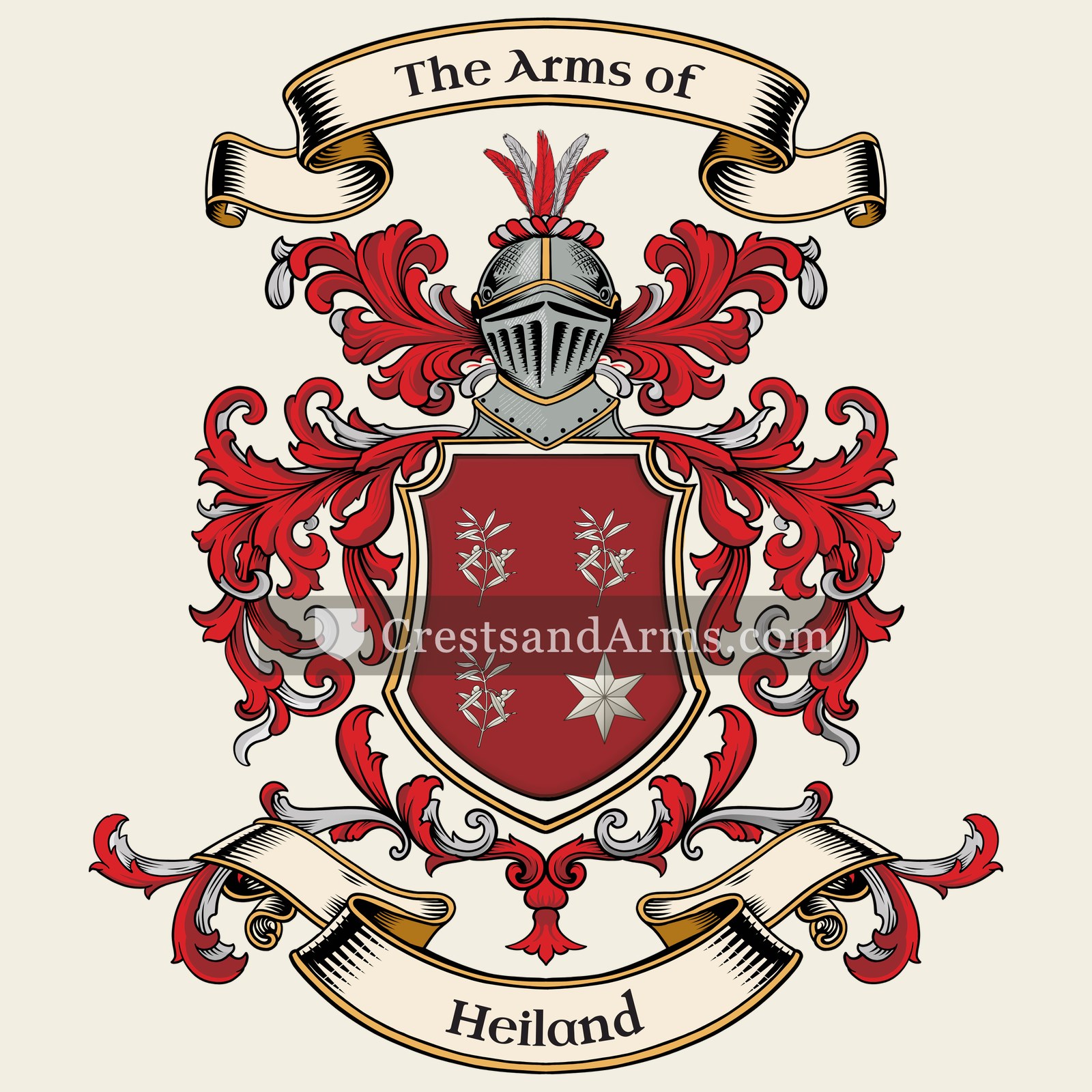
A record of documented arms, meaning and origin, researched for the Heiland family of Germany.
Reg. 8496 · German, G–I
Coat of Arms & Family Crest Details
Symbols on this shield
bendDefence, and the scarf of a commander
branchPeace, and new growth
starThe celestial goddess, and nobility
Colours
Red (Gules)Means: Military strength
Silver (Argent)Means: Peace and sincerity
Historical info
Source
J. B. Rietstap, Armorial Général, Gouda: G. B. van Goor Zonen, 1884–87
Blazon (the actual original written record)
“De gu. à trois chicots d'arg., les deux du chef posés à dextre en bande et à sen. en barre, et le troisième en p. posé en fasce; le tout acc. au point du chef d'une étoile d'arg. C.: une étoile d'arg.; entre un vol du même, l'aile dextre ch. d'une barre et l'aile sen. d'une bande de gu., surch. chacune de trois étoiles d'arg.”
GermanyMisnie, c. 1725
Where the Heiland Arms Were Recorded
Misnie
Map of Germany showing where the Heiland arms are recorded
The Heiland arms were recorded in Misnie, c. 1725.
This is where the arms were entered in the register. Families often moved to other parts of the country, so the same name can turn up in more than one region.
The body that granted and recorded arms in Germany in this period.
Charles VI, Holy Roman Emperor
Sovereign of the period
Charles VI, Holy Roman Emperor
1711–1740
Reigning in Germany when the Heiland arms are first recorded.
How Arms Worked in Germany
In the Holy Roman Empire, coats of arms were often granted to individuals by the Emperor or his representatives. These arms were then passed down through the generations to all legitimate descendants of the original holder. Younger branches of a family usually kept the same shield design without needing to change it, as the arms belonged to the entire lineage.
Granting authority
The Holy Roman Emperor held the sole power to grant new coats of arms throughout his vast imperial territories.
How they got arms
Families typically obtained their coats of arms through a formal imperial grant or by proving their noble status to the authorities.
Where arms were recorded
These grants were officially recorded in the Imperial Chancery registers, which began keeping formal records of such honors during the Middle Ages.
The family's standing
Recorded among the armigerous families of Germany.
Origin & History of the Heiland Family in Germany
The surname Heiland is deeply rooted in the German language and carries a meaning tied to salvation or the concept of a savior. Historically, the name often functioned as a descriptive term for individuals who were seen as helpful or perhaps those who lived near lands associated with religious foundations. By the early 18th century, records confirm that members of the Heiland family were established in the region of Misnie, which is known today as the Meissen area in Saxony. During this period, the family likely participated in the agricultural and craft-based economy that defined the region. As residents of Misnie, they were part of a territory famous for its long history of trade and its role in the development of European porcelain. The family name persisted through generations as these early ancestors navigated the social and economic shifts of the 1700s in central Germany.
Related Branches & Arms
Root word
Heil
Old High German term for health, prosperity, or salvation.
This name
HeilandA topographic or occupational name referring to a savior or a person from a place of healing.
also spelled
Heiland
Heylant
Hayland
Hyland
Documented Sources
J. B. Rietstap, Armorial Général, Gouda: G. B. van Goor Zonen, 1884–87
Bahlow, Hans, Deutsches Namenlexikon: Familien- und Vornamen nach Ursprung und Sinn erklärt, 1972
Sächsisches Staatsarchiv, Kirchenbücher der Parochie Meißen, 1725
Gottschald, Max, Deutsche Namenkunde: Unsere Familiennamen, 1982
Digital archive packCoat of arms PNG, gold border print PDF, vector SVG and the certificate of authenticity. Sent to your email in minutes.


 bendDefence, and the scarf of a commander
 branchPeace, and new growth
 starThe celestial goddess, and nobility
 bendDefence, and the scarf of a commander
 branchPeace, and new growth
 starThe celestial goddess, and nobility