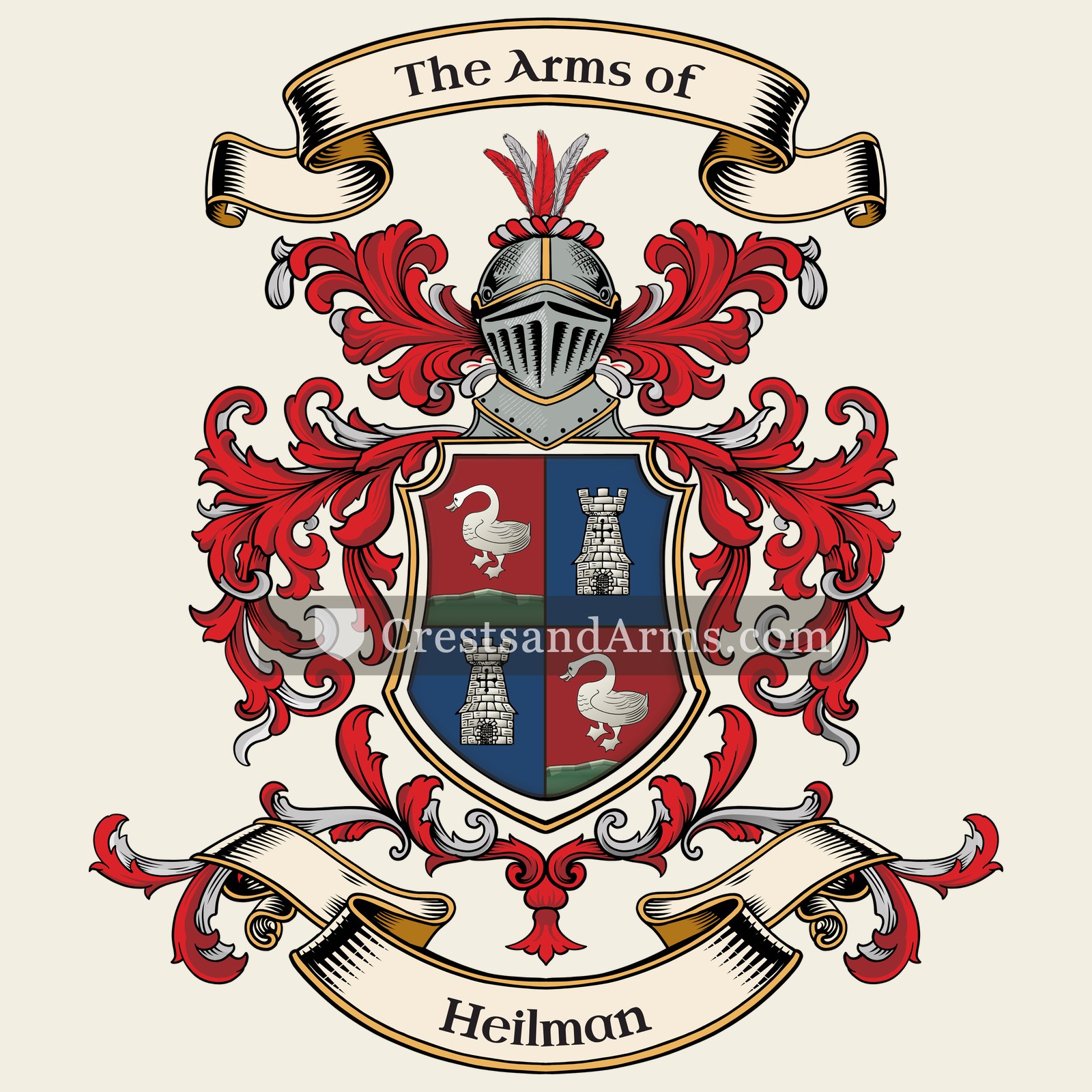
A record of documented arms, meaning and origin, researched for the Heilman family of Germany.
Reg. 7093 · German, G–I
Coat of Arms & Family Crest Details
Symbols on this shield
mountThe ground held, and steadfastness upon it
swanGrace, light and the poet's art
towerGrandeur and solidity, and a stronghold defended
Colours
Red (Gules)Means: Military strength
Blue (Azure)Means: Loyalty and truth
Green (Vert)Means: Hope
Silver (Argent)Means: Peace and sincerity
Historical info
Source
J. B. Rietstap, Armorial Général, Gouda: G. B. van Goor Zonen, 1884–87
Blazon (the actual original written record)
“Ec.: aux 1 et 4 de gu. à un cygne d'arg., se becquetant la poitrine, posé sur un tertre de sin., le cygne du 1 cont.; aux 2 et 3 d'azur à une tour d'arg., ouv. et aj. de sa. Cq. cour. C.: un homme iss., hab. de gu., ceint de deux rubans flottants d'arg. et de gu., coiffé d'un bonnet albanais de gu., retr. d'azur, tenant un fer de flèche en pal. L. d'arg., de gu. et d'azur.”
Germanyc. 1765
Where the Heilman Arms Were Recorded
Bavaria
Map of Germany showing where the Heilman arms are recorded
The Heilman arms were recorded in Germany, c. 1765.
Arms such as these were typically recorded in Bavaria.
Bavaria was a country of old landed families and walled market towns. Estates passed down the same line for centuries, and both the landowners and the leading townsmen kept arms, which is why so many Bavarian names sit in the registers.
This is where the arms were entered in the register. Families often moved to other parts of the country, so the same name can turn up in more than one region.
The body that granted and recorded arms in Germany in this period.
Francis I, Holy Roman Emperor
Sovereign of the period
Francis I, Holy Roman Emperor
1745–1765
Reigning in Germany when the Heilman arms are first recorded.
How Arms Worked in Germany
In the Holy Roman Empire, coats of arms were often granted to individuals by the Emperor or his representatives. These arms were then passed down through the generations to all legitimate descendants of the original holder. Younger branches of a family usually kept the same shield design without needing to change it, as the arms belonged to the entire lineage.
Granting authority
The Holy Roman Emperor held the sole power to grant new coats of arms throughout his vast imperial territories.
How they got arms
Families typically obtained their coats of arms through a formal imperial grant or by proving their noble status to the authorities.
Where arms were recorded
These grants were officially recorded in the Imperial Chancery registers, which began keeping formal records of such honors during the Middle Ages.
The family's standing
Recorded among the armigerous families of Germany.
Origin & History of the Heilman Family in Germany
The surname Heilman is rooted in the Germanic linguistic tradition, where it functioned as a descriptive name for a person of good character. Derived from the Middle High German word "heil," which translates to healthy, sound, or fortunate, the name was originally bestowed upon individuals who were seen as wholesome or spiritually blessed. By the time members of the family were documented in Bavaria in 1765, the name had become a stable hereditary surname passed down through generations of farmers, craftsmen, and local tradespeople. During this era, the Bavarian region was characterized by tight-knit village communities where family names served as essential markers of identity within parish registers and land records. These early ancestors lived through a period of significant social transition in the Holy Roman Empire, where the stability of a family name helped maintain social standing and legal recognition within their local townships.
Related Branches & Arms
Root word
Heil
Derived from the Middle High German word for health or salvation.
This name
HeilmanA person who is healthy, whole, or a man of salvation.
also spelled
Heilmann
Heylman
Heilmanne
Hylman
Documented Sources
J. B. Rietstap, Armorial Général, Gouda: G. B. van Goor Zonen, 1884–87
Bahlow, Hans, Deutsches Namenlexikon: Familien- und Vornamen nach Ursprung und Sinn erklärt, 1967
Heintze, Albert, Die deutschen Familien-Namen: geschichtlich, geographisch, sprachlich, 1903
Bayerisches Hauptstaatsarchiv, Kurbayern Hofkammer: Steuer- und Katasterwesen, 1765
Digital archive packCoat of arms PNG, gold border print PDF, vector SVG and the certificate of authenticity. Sent to your email in minutes.


 mountThe ground held, and steadfastness upon it
 swanGrace, light and the poet's art
 towerGrandeur and solidity, and a stronghold defended
 mountThe ground held, and steadfastness upon it
 swanGrace, light and the poet's art
 towerGrandeur and solidity, and a stronghold defended