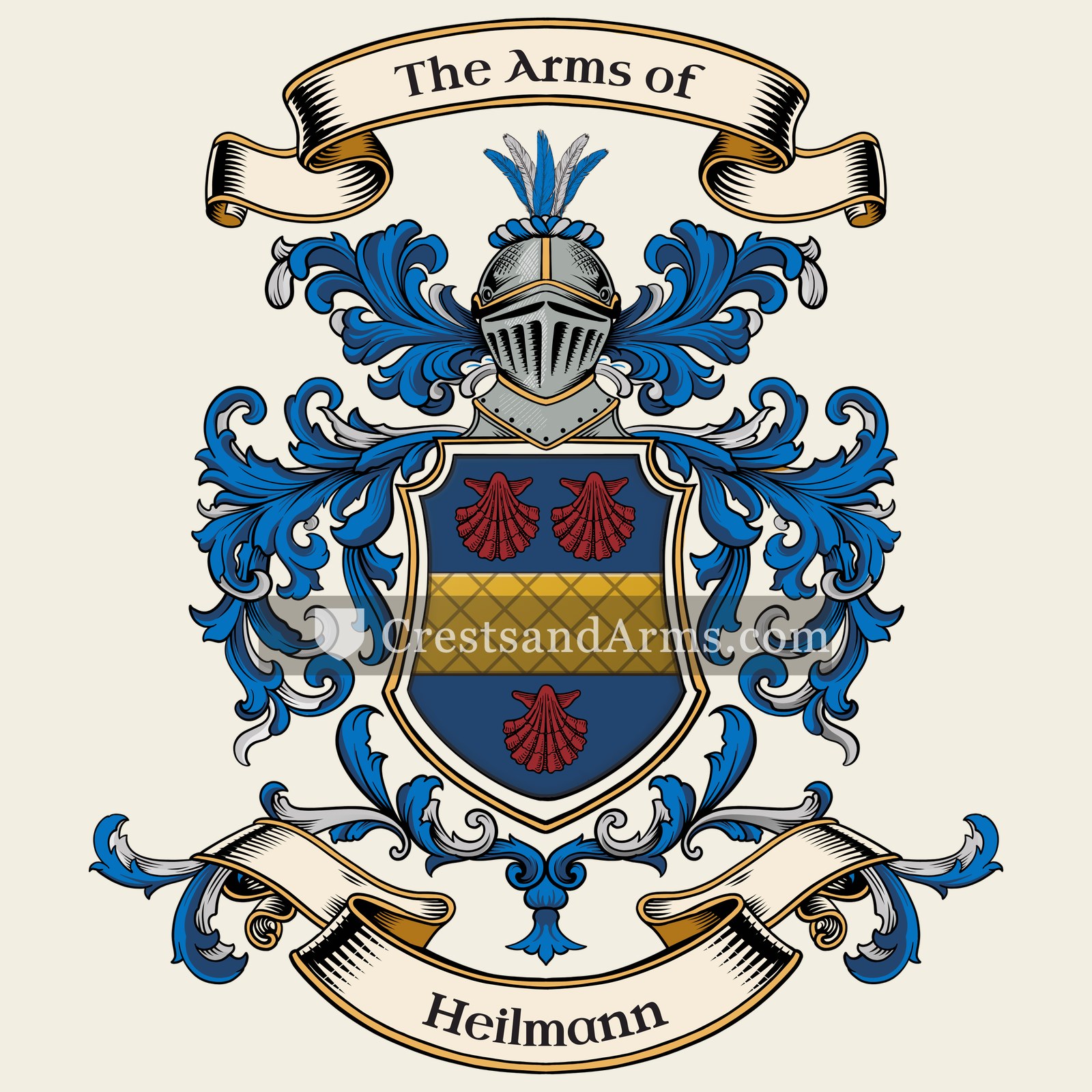
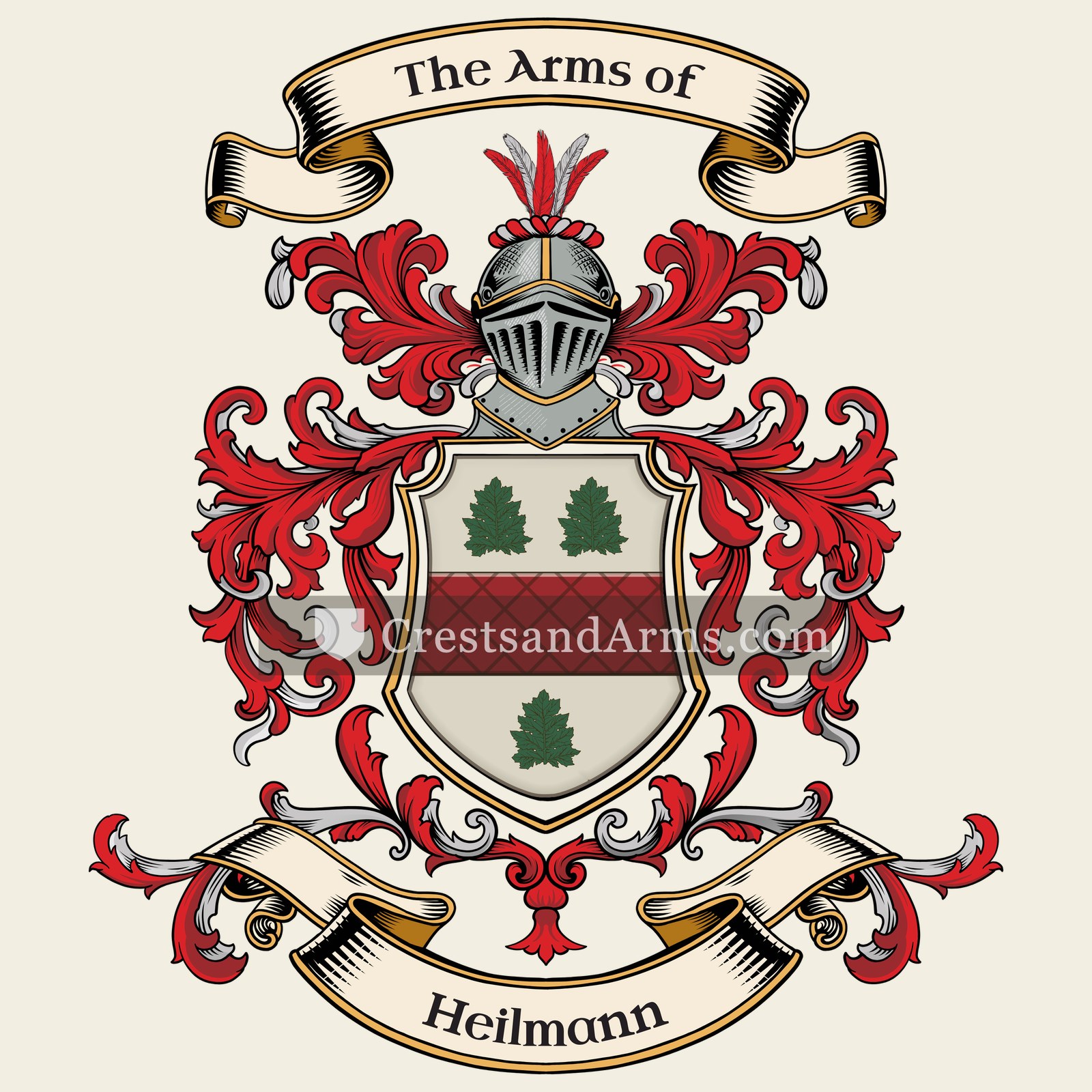
A record of documented arms, meaning and origin, researched for the Heilmann family lines. Documented in 2 countries.
Reg. 4840 · French, G–I
Coat of Arms & Family Crest Details
Symbols on this shield
fessThe military belt, and readiness to serve
escallopThe pilgrim's shell, and a long journey made
Colours
Blue (Azure)Means: Loyalty and truth
Gold (Or)Means: Generosity
Red (Gules)Means: Military strength
Historical info
Source
J. B. Rietstap, Armorial Général, Gouda: G. B. van Goor Zonen, 1884–87
Blazon (the actual original written record)
“D'azur à la fasce d'or, acc. de trois coquilles parties de gu. et d'or.”
FranceStrasbourg, c. 1663
Where the Heilmann Arms Were Recorded
Strasbourg
Map of France showing where the Heilmann arms are recorded
The Heilmann arms were recorded in Strasbourg, c. 1663.
This is where the arms were entered in the register. Families often moved to other parts of the country, so the same name can turn up in more than one region.
The body that granted and recorded arms in France in this period.
Louis XIV of France
Sovereign of the period
Louis XIV of France
1643–1715
Reigning in France when the Heilmann arms are first recorded.
How Arms Worked in France
In France, a coat of arms was a mark of honor that passed down through the male line to all legitimate descendants. Families often used the same shield without changes to show their shared heritage. If a branch wanted to stand out, they could add a small mark to their shield to show their specific place in the family tree.
Granting authority
The Juge d'armes de France acted as the official authority that regulated and verified coats of arms across the country.
How they got arms
Families typically inherited their arms from ancestors, though they could also receive them through royal grants or by proving their noble status.
Where arms were recorded
Coats of arms were officially recorded in the Armorial Général de France, which began its main collection in the year 1696.
The family's standing
Recorded among the armigerous families of France.
Origin & History of the Heilmann Family in France
The family name Heilmann has deep roots in the Alsace region, a territory that has shifted between French and German cultural influences for centuries. By 1663, records confirm that members of the Heilmann family were well-established residents of Strasbourg. During this era, the city was a crossroads for trade and intellectual exchange, allowing families like the Heilmanns to integrate into the local urban economy. The name itself is derived from the Germanic words for "healthy" or "whole" and "man," suggesting it was originally a descriptive nickname for a person of good character or physical strength. As the family grew within the city, they became part of the complex social fabric of Strasbourg, navigating the unique legal and linguistic traditions that defined the borderland between France and the Holy Roman Empire. Their presence in the city during the seventeenth century highlights the family's long-standing role in the development of this historic French region.
Coat of Arms & Family Crest Details
Symbols on this shield
fessThe military belt, and readiness to serve
leafHappiness and abundance
Colours
Silver (Argent)Means: Peace and sincerity
Red (Gules)Means: Military strength
Green (Vert)Means: Hope
Historical info
Source
J. B. Rietstap, Armorial Général, Gouda: G. B. van Goor Zonen, 1884–87
Blazon (the actual original written record)
“D'arg. à la fasce de gu., acc. de trois feuilles de tilleul de sin., les tiges en bas.”
SwitzerlandFribourg, c. 1745
Where the Heilmann Arms Were Recorded
Fribourg
Map of Switzerland showing where the Heilmann arms are recorded
The Heilmann arms were recorded in Fribourg, c. 1745.
This is where the arms were entered in the register. Families often moved to other parts of the country, so the same name can turn up in more than one region.
The body that granted and recorded arms in Switzerland in this period.
How Arms Worked in Switzerland
In Switzerland, coats of arms were not restricted to the nobility and were often adopted by common citizens and families. These symbols were passed down through generations to show family identity. When branches of a family grew, they often changed small details of the design to distinguish their own line from the original group.
Granting authority
Cantonal and civic authorities managed the use of coats of arms within their specific regions and local jurisdictions.
How they got arms
Families typically assumed their own coats of arms based on local custom rather than receiving them from a central monarch.
Where arms were recorded
Arms were recorded in various cantonal and civic registers starting from the fourteenth century throughout the Swiss region.
The family's standing
Recorded among the armigerous families of Switzerland.
Origin & History of the Heilmann Family in Switzerland
The surname Heilmann has deep roots in the German-speaking regions of Europe, where it originally functioned as a descriptive name meaning a healthy or fortunate man. By the mid-eighteenth century, branches of the family had established a notable presence in the Swiss canton of Fribourg. Records confirm that members of the Heilmann family were living in this region by 1745, likely working within the local agricultural or trade sectors that defined the Swiss economy at the time. Because Fribourg served as a bridge between the French and German cultural spheres of Switzerland, families like the Heilmanns often navigated a bilingual environment while maintaining their distinct Germanic heritage. Over the following decades, these early residents became integrated into the social fabric of the canton, contributing to the steady growth of the local population during a period of significant regional development.
Related Branches & Arms
Root word
Heil
Derived from the Germanic word for health, prosperity, or salvation.
This name
HeilmannA topographic or occupational name referring to a healthy or prosperous man.
also spelled
Heilman
Hylman
Related arms
Hetzel de Lindnachsimilar arms
Lindnocksimilar arms
Tuckingsimilar arms
Heilmanvariant spelling
Documented Sources
J. B. Rietstap, Armorial Général, Gouda: G. B. van Goor Zonen, 1884–87
Archives de la ville et de l'Eurométropole de Strasbourg, Registres paroissiaux de Strasbourg (1663)
Himly, François-Jacques, Chronologie de la Basse-Alsace, 1972
Livet, Georges, L'intendance d'Alsace sous Louis XIV, 1956
Digital archive packCoat of arms PNG, gold border print PDF, vector SVG and the certificate of authenticity. Sent to your email in minutes.


 fessThe military belt, and readiness to serve
 escallopThe pilgrim's shell, and a long journey made
 fessThe military belt, and readiness to serve
 escallopThe pilgrim's shell, and a long journey made

 leafHappiness and abundance