A record of documented arms, meaning and origin, researched for the Heintz family lines. Documented in 2 countries.
Reg. 7181 · Danish, G–I
Coat of Arms & Family Crest Details
Symbols on this shield
mountThe ground held, and steadfastness upon it
bearStrength, cunning and protection of kin
knightChivalry and service in arms
Colours
Silver (Argent)Means: Peace and sincerity
Gold (Or)Means: Generosity
Green (Vert)Means: Hope
Black (Sable)Means: Constancy
Historical info
Source
J. B. Rietstap, Armorial Général, Gouda: G. B. van Goor Zonen, 1884–87
Blazon (the actual original written record)
“Ec.: aux 1 et 4 d'arg. à une tête et col d'ours de sa., cour. d'or; aux 2 et 3 d'or à un sauvage de carn., ceint et cour. de lierre, posé de front, tenant une massue abaissée, le tout soutenu d'une terrasse de sin. C.: le sauvage iss.”
Denmarkc. 1702
Digital archive packCoat of arms PNG, gold border print PDF, vector SVG and the certificate of authenticity. Sent to your email in minutes.
Map of Denmark showing where the Heintz arms are recorded
The Heintz arms were recorded in Denmark, c. 1702.
Arms such as these were typically recorded in Sjaælland.
Zealand held the Danish court, the crown's offices and Copenhagen itself. Families who served the king kept estates within reach of it, and royal service was the ordinary route to a coat of arms.
This is where the arms were entered in the register. Families often moved to other parts of the country, so the same name can turn up in more than one region.
The body that granted and recorded arms in Denmark in this period.
Frederik IV of Denmark
Sovereign of the period
Frederik IV of Denmark
1699–1730
Reigning in Denmark when the Heintz arms are first recorded.
How Arms Worked in Denmark
Danish heraldry during this period was closely tied to noble status and royal favor rather than being open to all citizens. Arms were typically granted by the monarch to individuals, and these symbols were then shared by all members of the noble house. If a family line died out, the right to use those specific arms ended with them.
Granting authority
The Danish royal chancery held the power to issue and regulate official coats of arms for the kingdom.
How they got arms
Families usually received their arms through a formal royal grant that confirmed their noble status and rights.
Where arms were recorded
These grants were officially recorded in the Danish Royal Chancery records starting in the sixteenth century.
The family's standing
Recorded among the armigerous families of Denmark.
Origin & History of the Heintz Family in Denmark
The family name Heintz has deep roots in the history of Sjælland, where records confirm members of the family were living as early as 1702. The name itself is a German variant of the name Heinrich, which became popular across Northern Europe during the Middle Ages. As trade and travel routes expanded between the German states and the Danish islands, families with this name moved into the region to work in various trades or as skilled laborers. By the time the 1702 records appear, the Heintz family had already integrated into the local Danish community. They lived during a period when Denmark was transitioning toward more formal record-keeping, which helps historians track their presence in local parish registers. These early ancestors were likely part of the growing urban or rural middle class that helped shape the social structure of Sjælland during the eighteenth century.
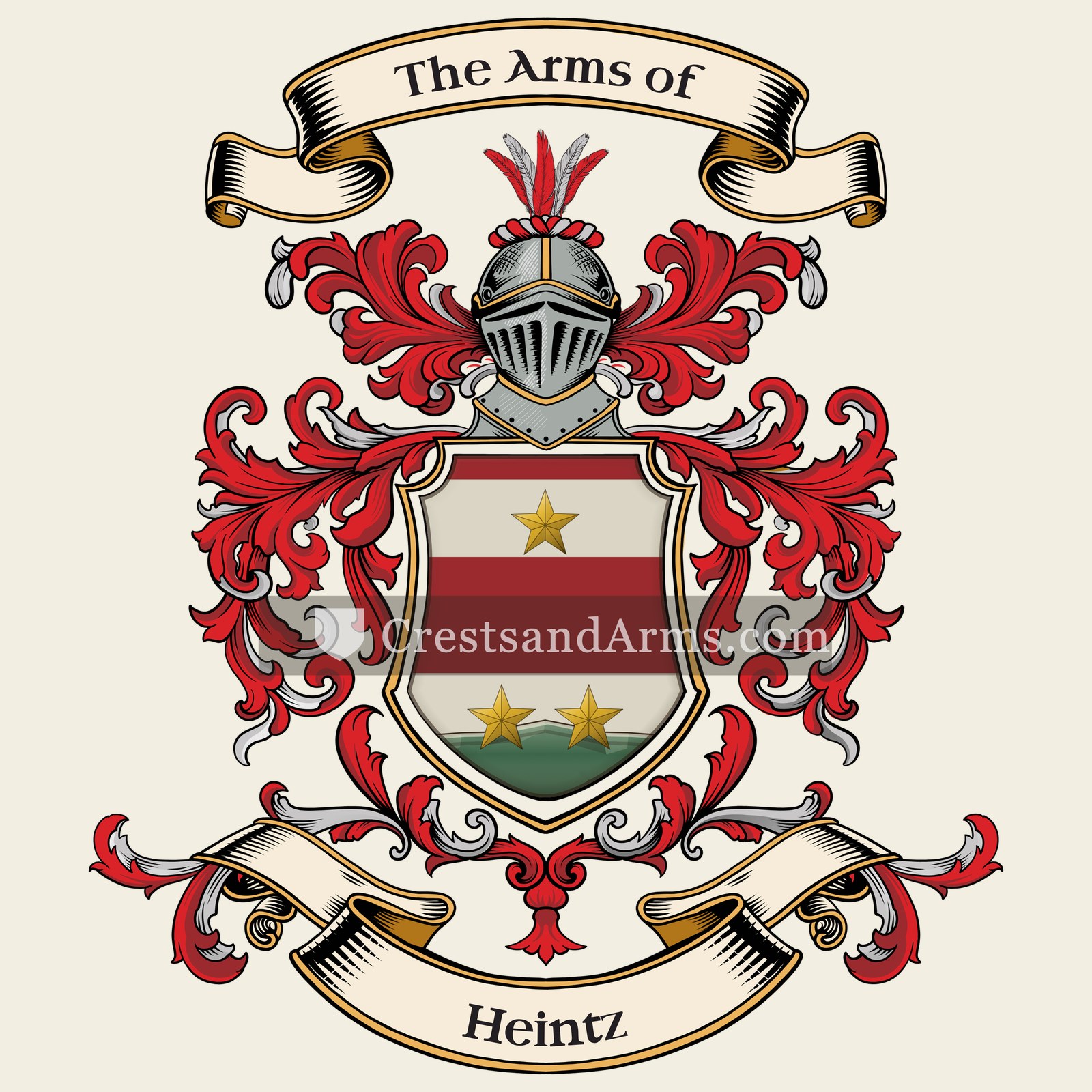
Coat of Arms & Family Crest Details
Symbols on this shield
mountThe ground held, and steadfastness upon it
mulletThe third son, and a divine quality from above
Colours
Red (Gules)Means: Military strength
Silver (Argent)Means: Peace and sincerity
Green (Vert)Means: Hope
Gold (Or)Means: Generosity
Historical info
Source
J. B. Rietstap, Armorial Général, Gouda: G. B. van Goor Zonen, 1884–87
Blazon (the actual original written record)
“De gu. à deux barreaux de fer courbés d'arg., acc. de trois étoiles d'or, 1 en chef et 2 en flancs, et d'un rasoir au nat., emm. de sa., ouv. et posé en chev.; à un tertre de sin., mouv. de la p. C.: un jeune homme iss., hab. de gu., tenant le rasoir de l'écu, en chev. renv.”
SwitzerlandBerne, c. 1745
Digital archive packCoat of arms PNG, gold border print PDF, vector SVG and the certificate of authenticity. Sent to your email in minutes.
Map of Switzerland showing where the Heintz arms are recorded
The Heintz arms were recorded in Berne, c. 1745.
This is where the arms were entered in the register. Families often moved to other parts of the country, so the same name can turn up in more than one region.
The body that granted and recorded arms in Switzerland in this period.
How Arms Worked in Switzerland
In Switzerland, coats of arms were not restricted to the nobility and were often adopted by common citizens and families. These symbols were passed down through generations to show family identity. When branches of a family grew, they often changed small details of the design to distinguish their own line from the original group.
Granting authority
Cantonal and civic authorities managed the use of coats of arms within their specific regions and local jurisdictions.
How they got arms
Families typically assumed their own coats of arms based on local custom rather than receiving them from a central monarch.
Where arms were recorded
Arms were recorded in various cantonal and civic registers starting from the fourteenth century throughout the Swiss region.
The family's standing
Recorded among the armigerous families of Switzerland.
Origin & History of the Heintz Family in Switzerland
The family name Heintz has deep roots in the German-speaking regions of Switzerland, where it emerged as a variation of the personal name Heinrich. By the middle of the eighteenth century, the Heintz family was well-established in the city of Berne, with records confirming their presence there by 1745. During this era, families with this surname were often involved in the skilled trades and local governance that defined the Swiss urban middle class. As the name spread across the cantons, it became associated with the industrious nature of the local citizenry who helped shape the political and social landscape of the Swiss Confederation. The history of the name reflects the broader migration patterns of families moving between rural alpine communities and the growing administrative centers of the Swiss state.
Heintz Meaning & Related Branches
Root word
Heinrich
Derived from Germanic elements meaning home ruler or ruler of the enclosure.
This name
HeintzA patronymic form indicating a descendant of someone named Henry or Heinrich.
also spelled
Heyntz
Heintze
Heintzs
Hints
Related arms
Haintzvariant spelling
Documented Sources
J. B. Rietstap, Armorial Général, Gouda: G. B. van Goor Zonen, 1884–87
Rigsarkivet, Kirkebøger for Sjællands Stift (Parish registers for the Diocese of Sjælland)
Rigsarkivet, Folketællinger (Census records)
Nielsen, O., Kjøbenhavns Diplomatarium, 1872
Steenstrup, Johannes, Danmarks Riges Historie, 1896
Digital archive packCoat of arms PNG, gold border print PDF, vector SVG and the certificate of authenticity. Sent to your email in minutes.


 mountThe ground held, and steadfastness upon it
 bearStrength, cunning and protection of kin
 knightChivalry and service in arms
 mountThe ground held, and steadfastness upon it
 bearStrength, cunning and protection of kin
 knightChivalry and service in arms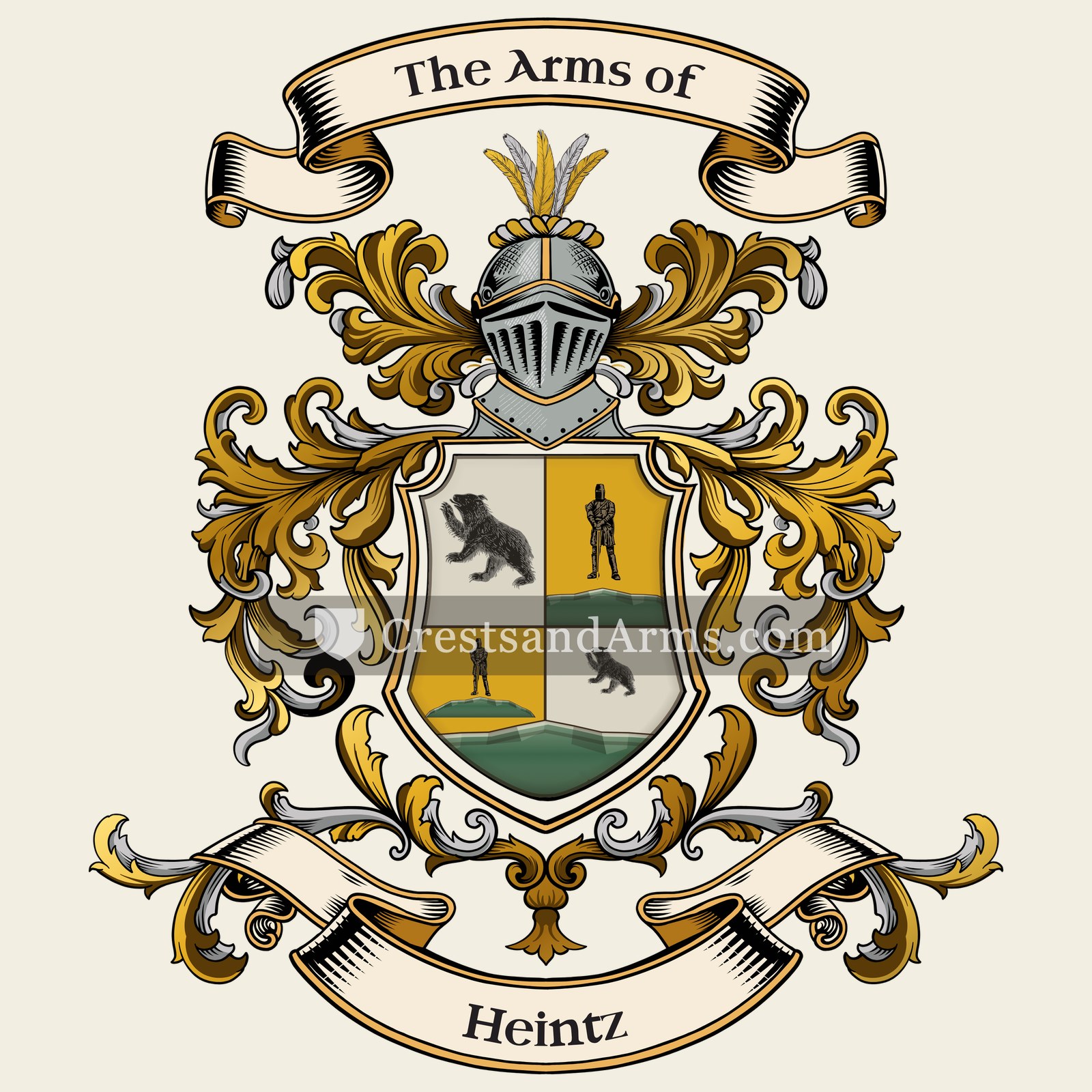


 mulletThe third son, and a divine quality from above