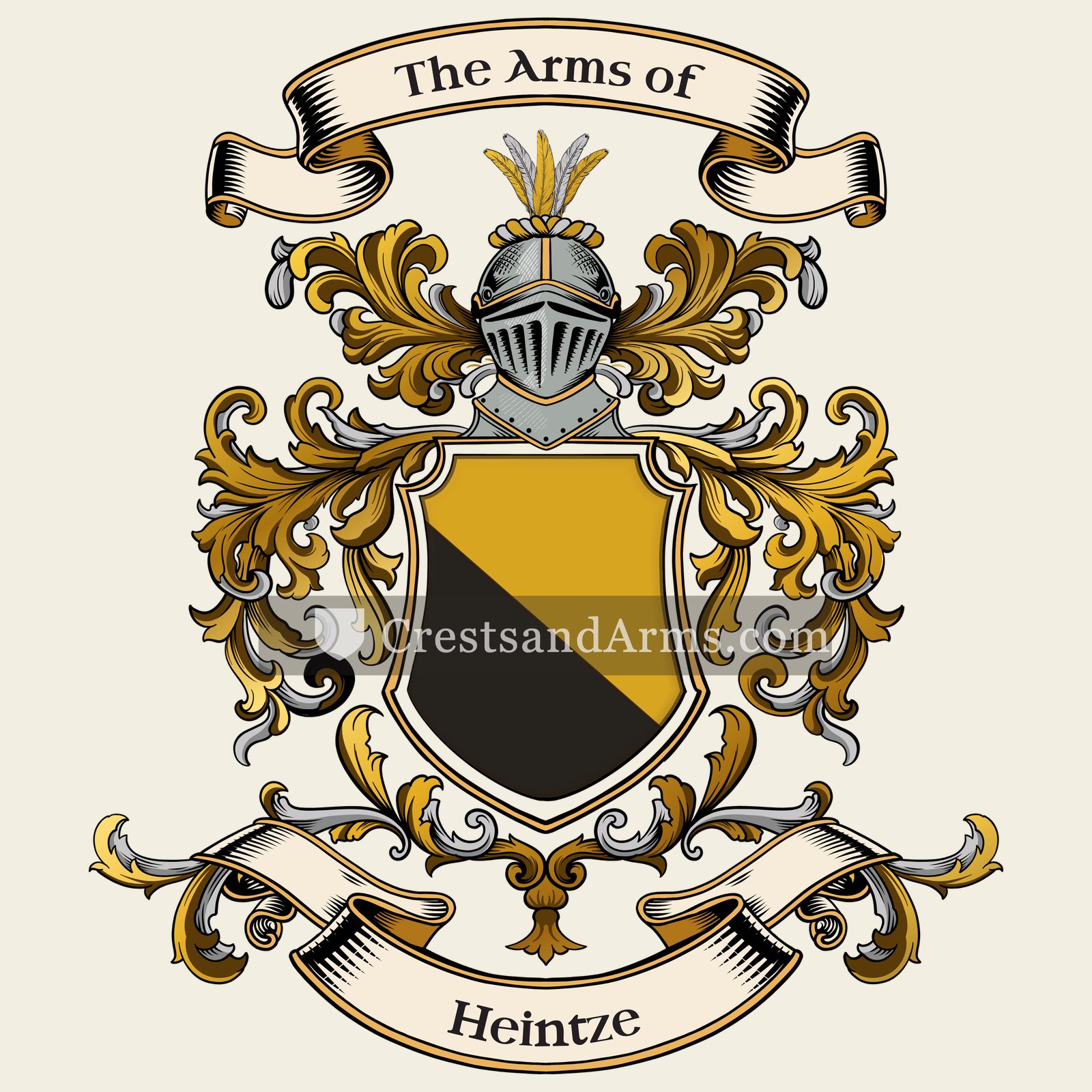
A record of documented arms, meaning and origin, researched for the Heintze family of Germany.
Reg. 3041 · German, G–I
Coat of Arms & Family Crest Details
Colours
Black (Sable)Means: Constancy
Gold (Or)Means: Generosity
Historical info
Source
J. B. Rietstap, Armorial Général, Gouda: G. B. van Goor Zonen, 1884–87
Blazon (the actual original written record)
“Tranché: au 1 de sa. à un cerf courant au nat., tenant entre ses dents une petite branche feuillée de sin.; au 2 d'or à un chapeau de sa., retr. de gu. C.: un homme iss., hab. de gu., rebr. et ceint de sa., coiffé du chapeau du 2, tenant de sa main dextre la jambe d'un cerf. L.: à dextre de gu. et de sa., à sen. de gu. et d'or.”
GermanyGörlitz Silésie, c. 1608
Digital archive packCoat of arms PNG, gold border print PDF, vector SVG and the certificate of authenticity. Sent to your email in minutes.
Map of Germany showing where the Heintze arms are recorded
The Heintze arms were recorded in Görlitz Silésie, c. 1608.
This is where the arms were entered in the register. Families often moved to other parts of the country, so the same name can turn up in more than one region.
The body that granted and recorded arms in Germany in this period.
Emperor Rudolf II
Sovereign of the period
Emperor Rudolf II
1576–1612
Reigning in Germany when the Heintze arms are first recorded.
How Arms Worked in Germany
In the Holy Roman Empire, coats of arms were often granted to individuals by the Emperor or his representatives. These arms were then passed down through the generations to all legitimate descendants of the original holder. Younger branches of a family usually kept the same shield design without needing to change it, as the arms belonged to the entire lineage.
Granting authority
The Holy Roman Emperor held the sole power to grant new coats of arms throughout his vast imperial territories.
How they got arms
Families typically obtained their coats of arms through a formal imperial grant or by proving their noble status to the authorities.
Where arms were recorded
These grants were officially recorded in the Imperial Chancery registers, which began keeping formal records of such honors during the Middle Ages.
The family's standing
Recorded among the armigerous families of Germany.
Origin & History of the Heintze Family in Germany
The surname Heintze is a German patronymic name, which means it originated as a shortened form of the name Heinrich. During the Middle Ages, it was common for people to identify themselves by their father’s first name, and over time, these names became permanent family surnames. By the early 17th century, the Heintze family had established a notable presence in the city of Görlitz, located in the historic region of Silesia. In 1608, records indicate that members of the family were active participants in the social and civic life of this prosperous trade hub. Because Görlitz sat at the crossroads of major European merchant routes, the Heintze family likely benefited from the city’s status as a center for commerce and craftsmanship. Their presence in this region during such a transformative period suggests that they were part of the growing urban middle class that helped shape the cultural identity of Silesia before the disruptions of the Thirty Years' War.
Related Branches & Arms
Root word
Heinrich
Derived from Germanic elements meaning home and ruler.
This name
HeintzeA diminutive form indicating a descendant or follower of the home ruler.
also spelled
Heyntze
Heintzee
Heintz
Hintsa
Related arms
Heintzvariant spelling
Brucknerrecorded with Heintze, same area
Büttnerrecorded with Heintze, same area
Diettrichrecorded with Heintze, same area
Documented Sources
J. B. Rietstap, Armorial Général, Gouda: G. B. van Goor Zonen, 1884–87
Bahlow, Hans, Deutsches Namenlexikon: Familien- und Vornamen nach Ursprung und Sinn erklärt, 1967
Jecht, Richard, Geschichte der Stadt Görlitz, 1926
Stadtarchiv Görlitz, Bürgerbuch der Stadt Görlitz, 1600–1650
Digital archive packCoat of arms PNG, gold border print PDF, vector SVG and the certificate of authenticity. Sent to your email in minutes.