Map of France showing where the Held arms are recorded
The Held arms were recorded in Strasbourg, c. 1663.
This is where the arms were entered in the register. Families often moved to other parts of the country, so the same name can turn up in more than one region.
The body that granted and recorded arms in France in this period.
Louis XIV of France
Sovereign of the period
Louis XIV of France
1643–1715
Reigning in France when the Held arms are first recorded.
How Arms Worked in France
In France, a coat of arms was a mark of honor that passed down through the male line to all legitimate descendants. Families often used the same shield without changes to show their shared heritage. If a branch wanted to stand out, they could add a small mark to their shield to show their specific place in the family tree.
Granting authority
The Juge d'armes de France acted as the official authority that regulated and verified coats of arms across the country.
How they got arms
Families typically inherited their arms from ancestors, though they could also receive them through royal grants or by proving their noble status.
Where arms were recorded
Coats of arms were officially recorded in the Armorial Général de France, which began its main collection in the year 1696.
The family's standing
Recorded among the armigerous families of France.
Origin & History of the Held Family in France
The history of the Held family in France is deeply rooted in the unique cultural landscape of Alsace, specifically within the city of Strasbourg. By the year 1663, the family was well-established in this region, which served as a crossroads between French and Germanic influences. During this period, the name Held functioned as a descriptive identifier, likely originating from Middle High German terms that denoted a hero or a bold individual. Because Strasbourg was a center for trade and intellectual exchange, families like the Helds often integrated into the local burgher class, participating in the city’s complex guild systems and civic governance. Their presence in the city during the mid-17th century suggests they were part of the stable population that navigated the transition of Alsace from the Holy Roman Empire to the Kingdom of France. This era required families to adapt to shifting political loyalties while maintaining their professional standing in the local urban community.
Coat of Arms & Family Crest Details
Symbols on this shield
saltireResolution, and St Andrew's cross
legStrength and swiftness
Colours
Gold (Or)Means: Generosity
Black (Sable)Means: Constancy
Historical info
Source
J. B. Rietstap, Armorial Général, Gouda: G. B. van Goor Zonen, 1884–87
Blazon (the actual original written record)
“D'or à deux membres d'aigle de sa., passés en saut.”
Germanyc. 1765
Digital archive packCoat of arms PNG, gold border print PDF, vector SVG and the certificate of authenticity. Sent to your email in minutes.
Map of Germany showing where the Held arms are recorded
The Held arms were recorded in Germany, c. 1765.
Arms such as these were typically recorded in Bavaria.
Bavaria was a country of old landed families and walled market towns. Estates passed down the same line for centuries, and both the landowners and the leading townsmen kept arms, which is why so many Bavarian names sit in the registers.
This is where the arms were entered in the register. Families often moved to other parts of the country, so the same name can turn up in more than one region.
The body that granted and recorded arms in Germany in this period.
Francis I, Holy Roman Emperor
Sovereign of the period
Francis I, Holy Roman Emperor
1745–1765
Reigning in France when the Held arms are first recorded.
How Arms Worked in Germany
In the Holy Roman Empire, coats of arms were often granted to individuals by the Emperor or his representatives. These arms were then passed down through the generations to all legitimate descendants of the original holder. Younger branches of a family usually kept the same shield design without needing to change it, as the arms belonged to the entire lineage.
Granting authority
The Holy Roman Emperor held the sole power to grant new coats of arms throughout his vast imperial territories.
How they got arms
Families typically obtained their coats of arms through a formal imperial grant or by proving their noble status to the authorities.
Where arms were recorded
These grants were officially recorded in the Imperial Chancery registers, which began keeping formal records of such honors during the Middle Ages.
The family's standing
Recorded among the armigerous families of Germany.
Origin & History of the Held Family in Germany
The surname Held has deep roots in the German language, originating as a descriptive nickname for a person who displayed great courage or strength. In the Middle Ages, the term was often used to describe a bold warrior or a hero in local folklore, and it eventually became a formal family name as populations grew and surnames became necessary for tax and census records. By the time the family was documented in Bavaria in 1765, the name was well-established among the local population. During this era, families with this name were often involved in agricultural life or skilled trades within the rural communities of southern Germany. Because the name was tied to a common personality trait, it appeared independently in various regions, reflecting the values of strength and bravery that were highly respected in German society at the time.
Coat of Arms & Family Crest Details
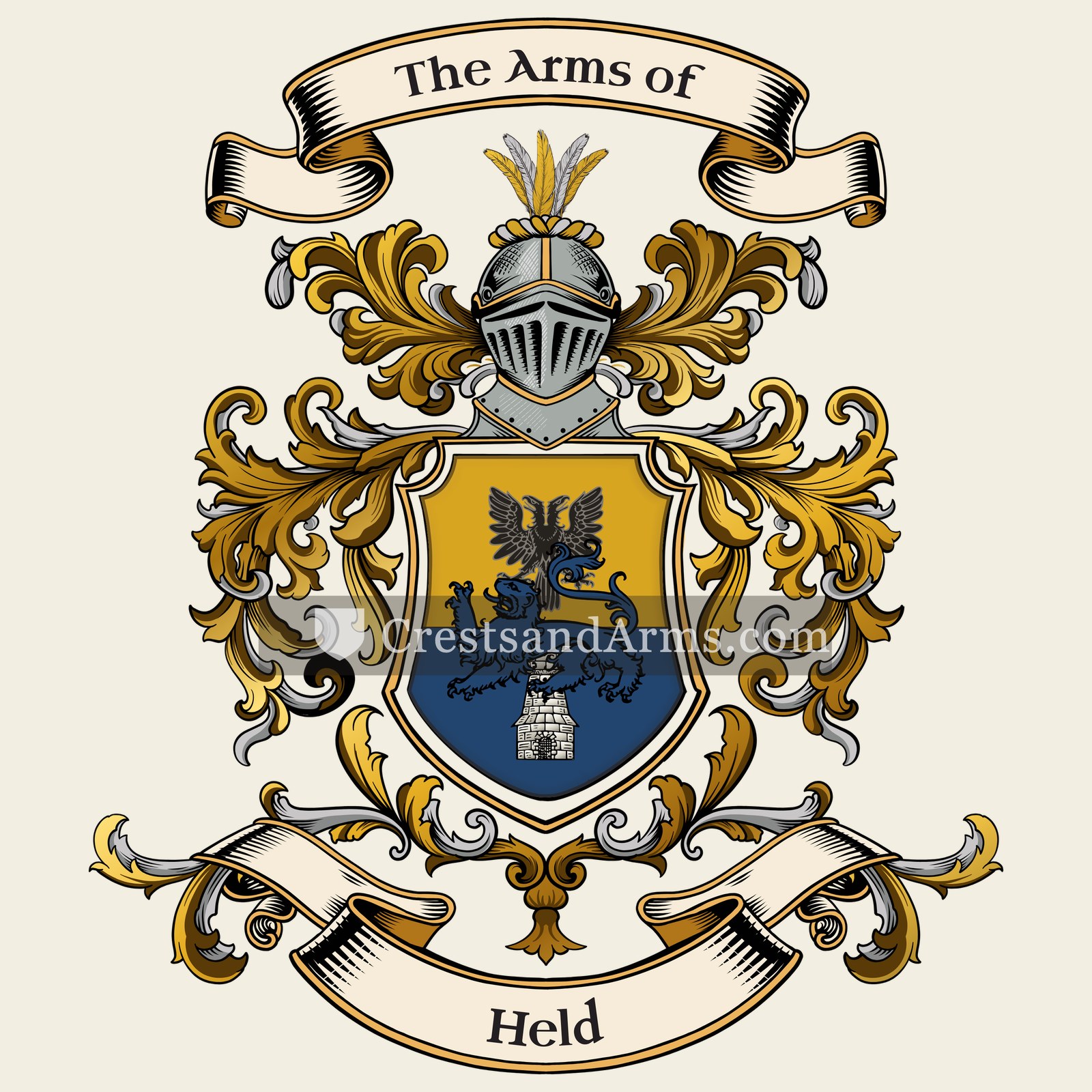
Symbols on this shield
towerGrandeur and solidity, and a stronghold defended
lionCourage, strength and royalty
eagleNobility, strength and a keen mind
Colours
Gold (Or)Means: Generosity
Blue (Azure)Means: Loyalty and truth
Silver (Argent)Means: Peace and sincerity
Black (Sable)Means: Constancy
Historical info
Source
J. B. Rietstap, Armorial Général, Gouda: G. B. van Goor Zonen, 1884–87
Blazon (the actual original written record)
“Coupé: au 1 d'or à l'aigle de sa.; au 2 tiercé en pal: a. et c. d'azur à une tour d'arg.; b. d'arg. au lion d'azur. Deux cq. cour. C.: 1º une aigle iss. et cont. de sa., cour. d'or; 1. d'or et de sa.; 2º trois pl d'aut., une d'arg. entre deux d'azur; l. d'arg. et d'azur.”
Austriac. 1795
Digital archive packCoat of arms PNG, gold border print PDF, vector SVG and the certificate of authenticity. Sent to your email in minutes.
Map of Austria showing where the Held arms are recorded
The Held arms were recorded in Austria, c. 1795.
Arms such as these were typically recorded in Tyrol.
Tyrol was mountain country in western Austria, where the valleys were held by families who had been there a very long time. Old tenure counted for more than money, and old families carried arms.
This is where the arms were entered in the register. Families often moved to other parts of the country, so the same name can turn up in more than one region.
Region
Tyrol
First recorded
1795
Granting Authority for the Held Arms
Imperial and Royal chancery
Sodacan · CC BY-SA 3.0
The body that granted and recorded arms in Austria in this period.
Francis II, Holy Roman Emperor
Sovereign of the period
Francis II, Holy Roman Emperor
1792–1806
Reigning in France when the Held arms are first recorded.
How Arms Worked in Austria
Austrian coats of arms were often linked directly to noble titles granted by the Emperor. These symbols belonged to the entire family line rather than just one individual. When a family grew, new branches kept the original design without needing to change it. This system allowed all members of a noble house to share the same identity across many generations.
Granting authority
The Imperial and Royal chancery managed all heraldic matters and controlled the official granting of arms throughout the Austrian lands.
How they got arms
Families typically received their arms through a formal imperial decree that often accompanied the elevation of a person to noble status.
Where arms were recorded
Official records of these grants were kept in the Imperial Register of Nobility which began its formal documentation process in 1453.
The family's standing
Recorded among the armigerous families of Austria.
Origin & History of the Held Family in Austria
The surname Held has deep roots in the mountainous landscape of Tyrol, where families bearing this name were well established by the late eighteenth century. In the German language, the word *Held* translates to hero or champion, a term that likely originated as a descriptive nickname for a person known for their physical strength or bravery in local community life. By 1795, records show that the Held family was integrated into the social and economic fabric of the Austrian Alps, likely working as farmers, craftsmen, or tradespeople who navigated the challenging terrain of the region. As the family grew, they became part of the distinct cultural identity of Tyrol, a province defined by its rugged independence and strong traditions. Over generations, the name served as a link to these early ancestors who built their lives in the high valleys and mountain passes of the Austrian Empire.
Related Branches & Arms
Root word
Held
Derived from the Germanic word for hero or warrior.
This name
HeldAn occupational or descriptive name referring to a brave person or a hero.
also spelled
Helld
Helde
Heldd
Related arms
Heltvariant spelling
Prenningerrecorded with Held, same area
Documented Sources
J. B. Rietstap, Armorial Général, Gouda: G. B. van Goor Zonen, 1884–87
Archives de la ville et de l'Eurométropole de Strasbourg, Registres paroissiaux et d'état civil, 1663
Livet, Georges, L'intendance d'Alsace sous Louis XIV, 1648-1715, 1956
Rapp, Francis, Le Strasbourg des grandes heures, 1300-1530, 1996
Digital archive packCoat of arms PNG, gold border print PDF, vector SVG and the certificate of authenticity. Sent to your email in minutes.


 knightChivalry and service in arms
 knightChivalry and service in arms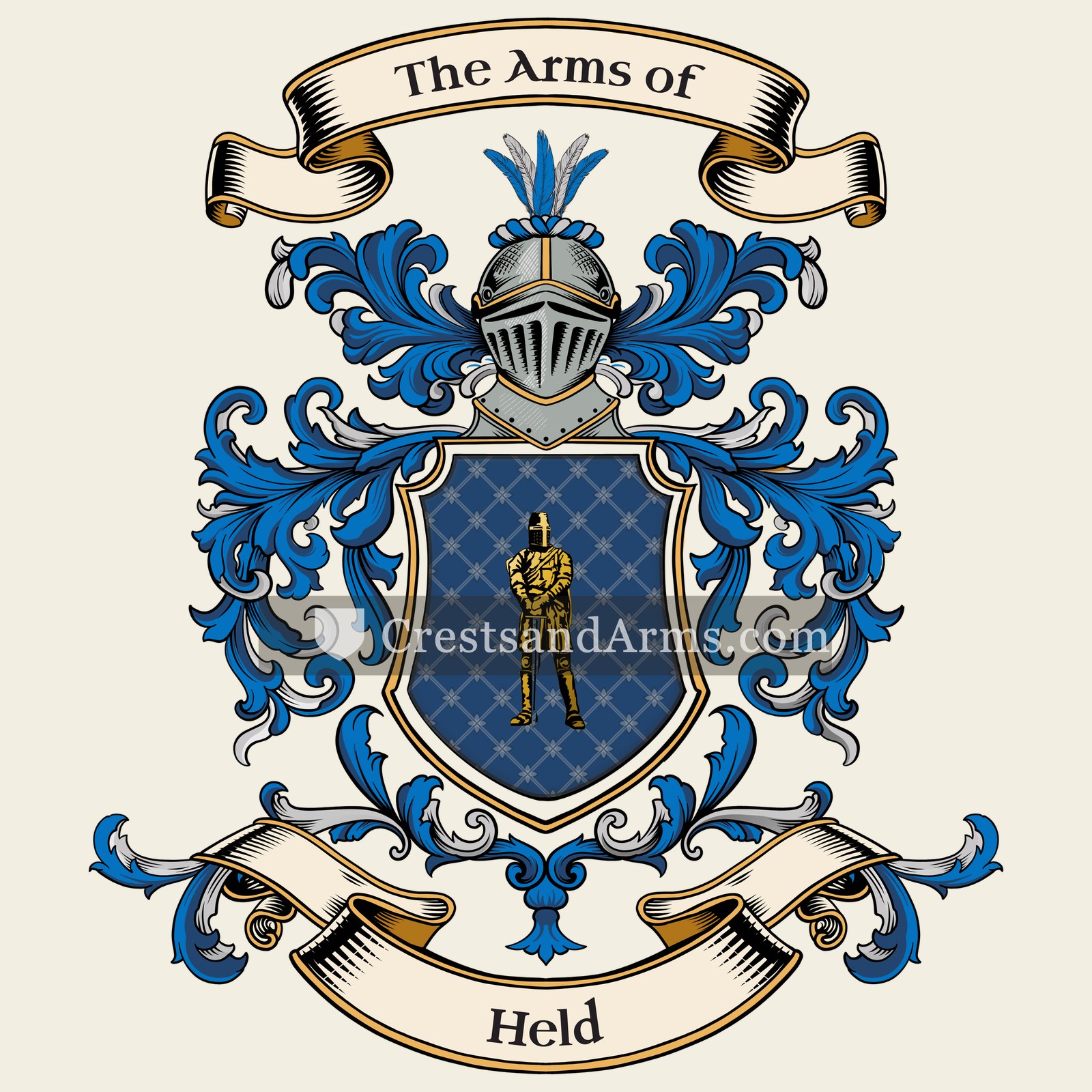


 saltireResolution, and St Andrew's cross
 legStrength and swiftness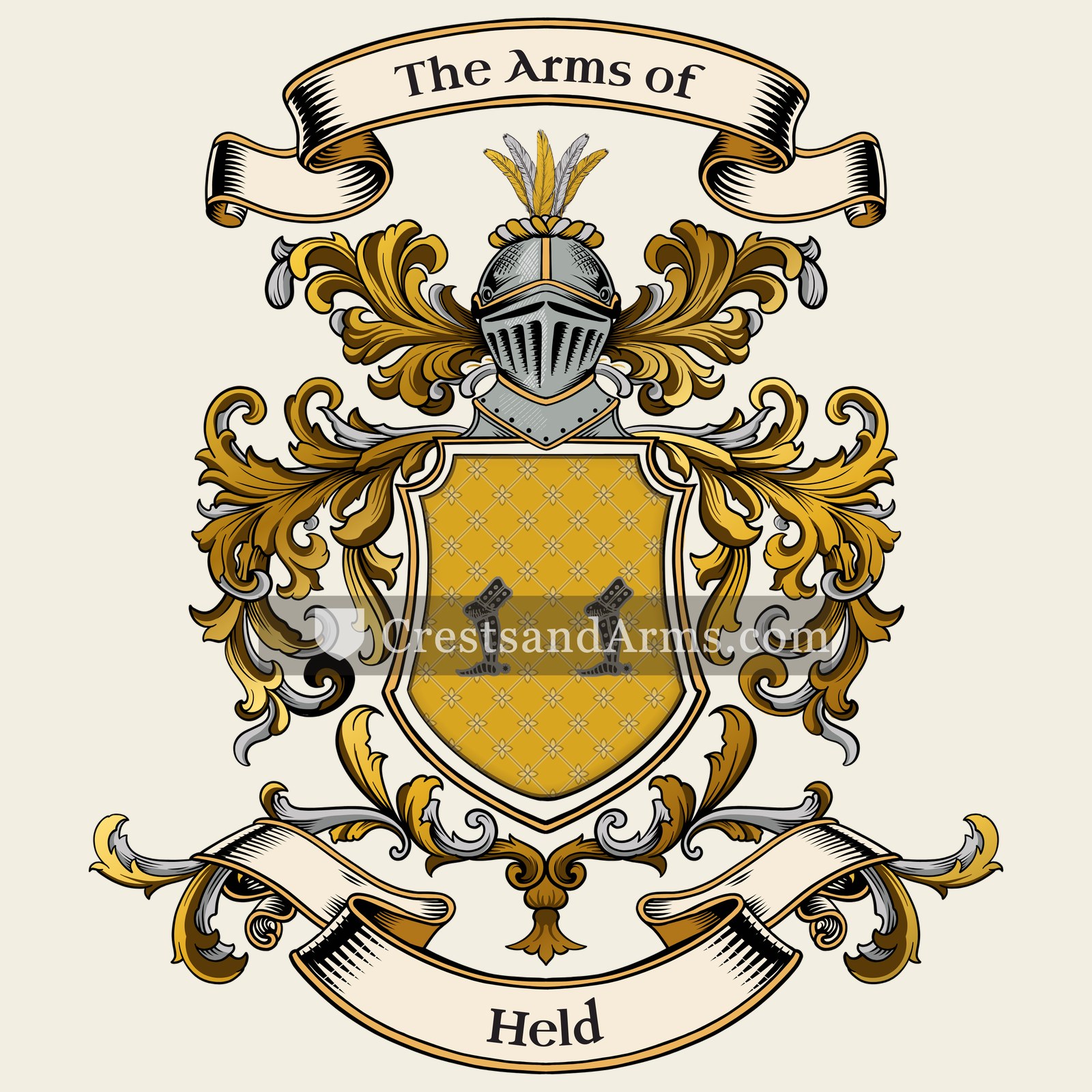


 towerGrandeur and solidity, and a stronghold defended
 lionCourage, strength and royalty
 eagleNobility, strength and a keen mind