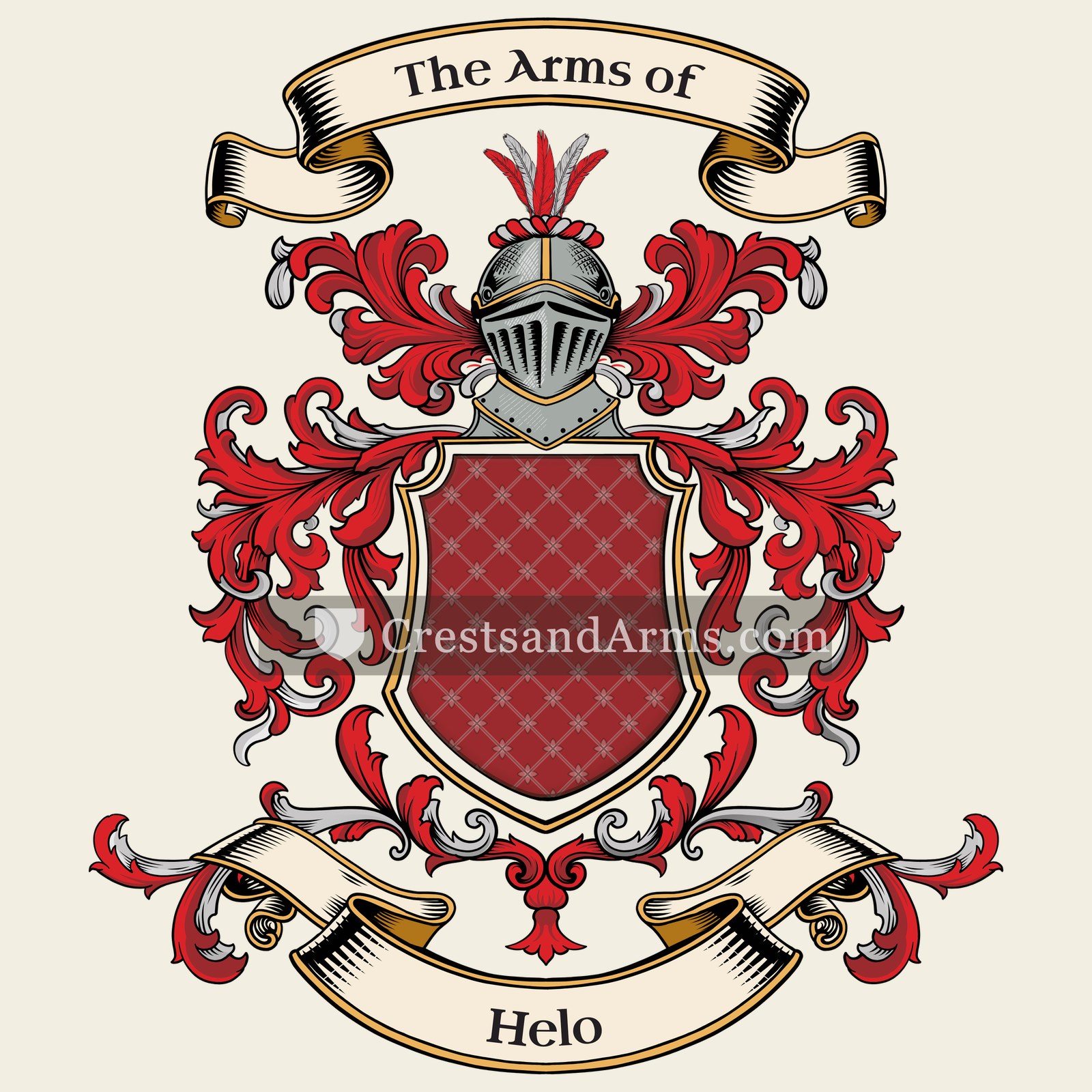
A record of documented arms, meaning and origin, researched for the Helo family of France.
Reg. 5837 · French, G–I
Coat of Arms & Family Crest Details
Colours
Red (Gules)Means: Military strength
Historical info
Source
J. B. Rietstap, Armorial Général, Gouda: G. B. van Goor Zonen, 1884–87
Blazon (the actual original written record)
“De gu. à trois bustes humains de carn., chevelés d'or, hab. du même, la poitrine couverte d'azur, posés de face. C.: un buste de l'écu. L. de gu. et d'or [V. Elout.]”
FlandreFlandre, c. 1663
Digital archive packCoat of arms PNG, gold border print PDF, vector SVG and the certificate of authenticity. Sent to your email in minutes.
Map of France showing where the Helo arms are recorded
The Helo arms were recorded in Flandre, c. 1663.
Flandre grew rich on cloth, and its towns were among the busiest in Europe. Merchant families bought land with their profits and took arms to go with it, so trade put as many names in the registers here as land did.
This is where the arms were entered in the register. Families often moved to other parts of the country, so the same name can turn up in more than one region.
The body that granted and recorded arms in France in this period.
Louis XIV of France
Sovereign of the period
Louis XIV of France
1643–1715
Reigning in France when the Helo arms are first recorded.
How Arms Worked in France
In France, a coat of arms was a mark of honor that passed down through the male line to all legitimate descendants. Families often used the same shield without changes to show their shared heritage. If a branch wanted to stand out, they could add a small mark to their shield to show their specific place in the family tree.
Granting authority
The Juge d'armes de France acted as the official authority that regulated and verified coats of arms across the country.
How they got arms
Families typically inherited their arms from ancestors, though they could also receive them through royal grants or by proving their noble status.
Where arms were recorded
Coats of arms were officially recorded in the Armorial Général de France, which began its main collection in the year 1696.
The family's standing
Recorded among the armigerous families of Flandre.
Origin & History of the Helo Family in France
The family name Helo traces its roots to the historical region of Flanders, where members of the family were documented as early as 1663. During the seventeenth century, this area was a bustling center of trade and agriculture, placing the Helo family within a society defined by strong local traditions and a complex mix of French and Dutch cultural influences. The name itself likely evolved from regional dialects common in the Low Countries, reflecting the linguistic shifts occurring in Flandre at the time. As residents of this strategically important territory, early members of the family were likely involved in the local economy, which relied heavily on textile production and maritime commerce. By settling in this region, the family became part of a long history of resilience and adaptation that defined the people of Flanders throughout the early modern period.
Related Branches & Arms
Root word
Hel
A Germanic root meaning sun or light.
This name
HeloDerived from a diminutive form of names starting with Hel, signifying a bright or shining person.
also spelled
Hellaut
Helautt
Helau
Helo
Documented Sources
J. B. Rietstap, Armorial Général, Gouda: G. B. van Goor Zonen, 1884–87
Rijksarchief te Gent, Parochieregisters van het Bisdom Gent
Archives de l'État à Lille, Série G: Clergé séculier et régulier
Blok, D.P., Algemene Geschiedenis der Nederlanden, 1977
Pirenne, Henri, Histoire de Belgique, 1900
Digital archive packCoat of arms PNG, gold border print PDF, vector SVG and the certificate of authenticity. Sent to your email in minutes.