A record of documented arms, meaning and origin, researched for the Helphenstein family lines. Documented in 2 countries.
Reg. 8282 · German, G–I
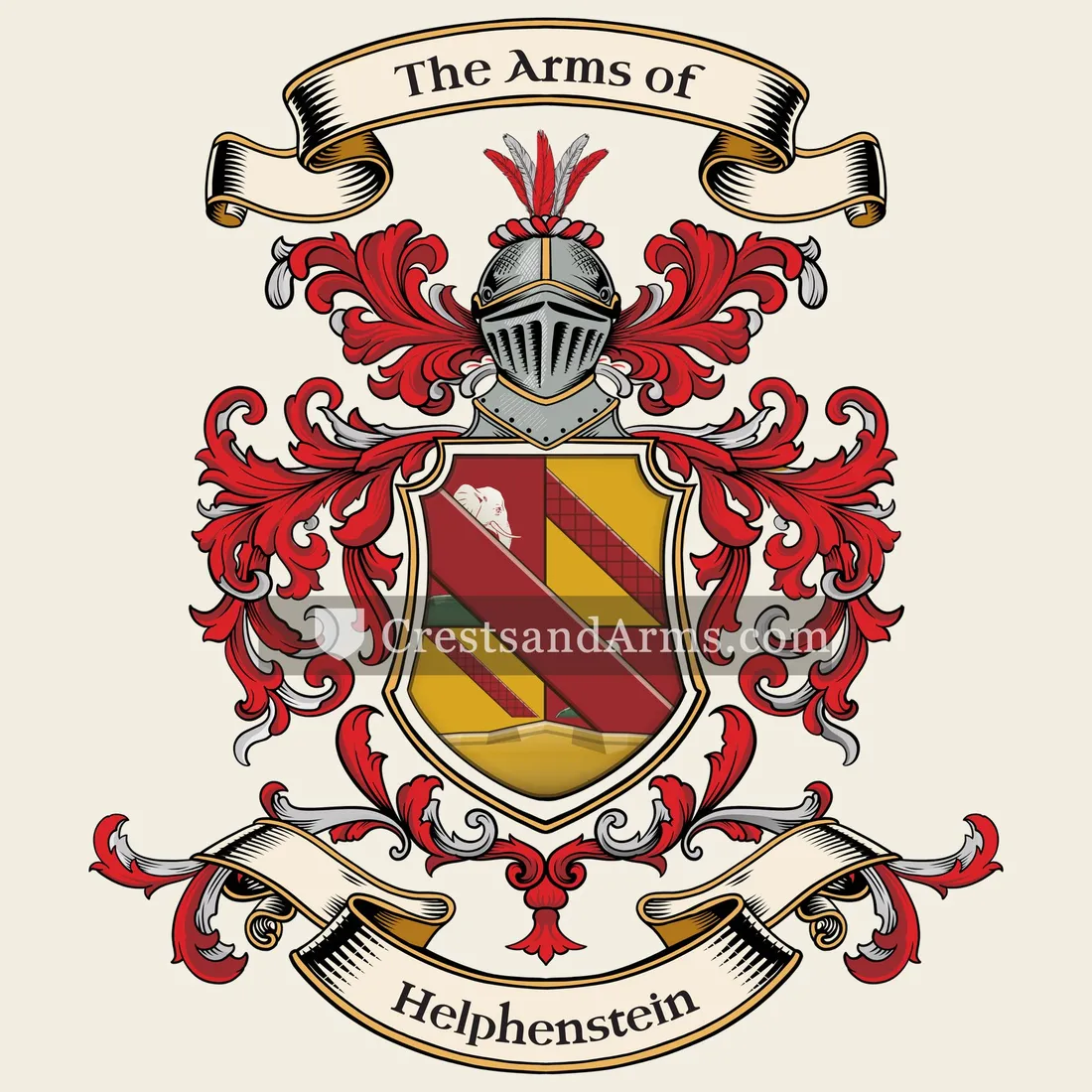
Meaning of the Helphenstein family crest colors & symbols
Symbols on this shield
mountThe ground held, and steadfastness upon it
bendDefence, and the scarf of a commander
elephantGreat strength, wit and ambition
Colours
Red (Gules)Means: Military strength
Gold (Or)Means: Generosity
Green (Vert)Means: Hope
Silver (Argent)Means: Peace and sincerity
Historical info
Source
J. B. Rietstap, Armorial Général, Gouda: G. B. van Goor Zonen, 1884–87
Blazon (the actual original written record)
“Ec.: aux 1 et 4 de gu. à un éléphant d'arg., pass. sur un tertre d'or (Helfenstein); aux 2 et 3 d'or à la bande vivrée de gu. (Gundelfingen). C.: 1º la tête de l'éléphant, cont.; I. d'arg. et de gu.; 2º une tête et col de cygne d'or, bq. de gu., traversée d'un joug de gu., les extrémités sommées de plumes de sa.; l. d'or et de gu.”
SwabiaSwabia, c. 1627
Digital archive packCoat of arms PNG, gold border print PDF, vector SVG and the certificate of authenticity. Sent to your email in minutes.
Map of Germany showing where the Helphenstein arms are recorded
The Helphenstein arms were recorded in Swabia, c. 1627.
Swabia was broken into a great many small territories in southern Germany, and each had its own landowners and its own leading townsmen. That fragmentation produced an unusual number of families with arms.
This is where the arms were entered in the register. Families often moved to other parts of the country, so the same name can turn up in more than one region.
The body that granted and recorded arms in Germany in this period.
Ferdinand II, Holy Roman Emperor
Sovereign of the period
Ferdinand II, Holy Roman Emperor
1619–1637
Reigning in Germany when the Helphenstein arms are first recorded.
How Arms Worked in Germany
In the Holy Roman Empire, coats of arms were often granted to individuals by the Emperor or his representatives. These arms were then passed down through the generations to all legitimate descendants of the original holder. Younger branches of a family usually kept the same shield design without needing to change it, as the arms belonged to the entire lineage.
Granting authority
The Holy Roman Emperor held the sole power to grant new coats of arms throughout his vast imperial territories.
How they got arms
Families typically obtained their coats of arms through a formal imperial grant or by proving their noble status to the authorities.
Where arms were recorded
These grants were officially recorded in the Imperial Chancery registers, which began keeping formal records of such honors during the Middle Ages.
The family's standing
Recorded among the armigerous families of Swabia.
Origin & History of the Helphenstein Family in Germany
The Helphenstein family name finds its historical roots in the region of Swabia, a territory in southwestern Germany known for its complex social structure and deep ties to the Holy Roman Empire. By 1627, the family was already established in this area during a time of great upheaval caused by the Thirty Years' War. The name itself likely evolved from a combination of local linguistic roots, possibly referencing a specific geographic feature or a landmark near their early homesteads. Living in Swabia meant that the family was part of a culture that valued trade, craftsmanship, and local governance, which helped them maintain their presence through centuries of regional conflict. As the family grew, they became integrated into the fabric of Swabian village life, often appearing in local parish records that tracked births, marriages, and deaths. These early generations helped define the family identity long before the modern era, leaving a legacy rooted in the fertile lands and historic towns of the German southwest.
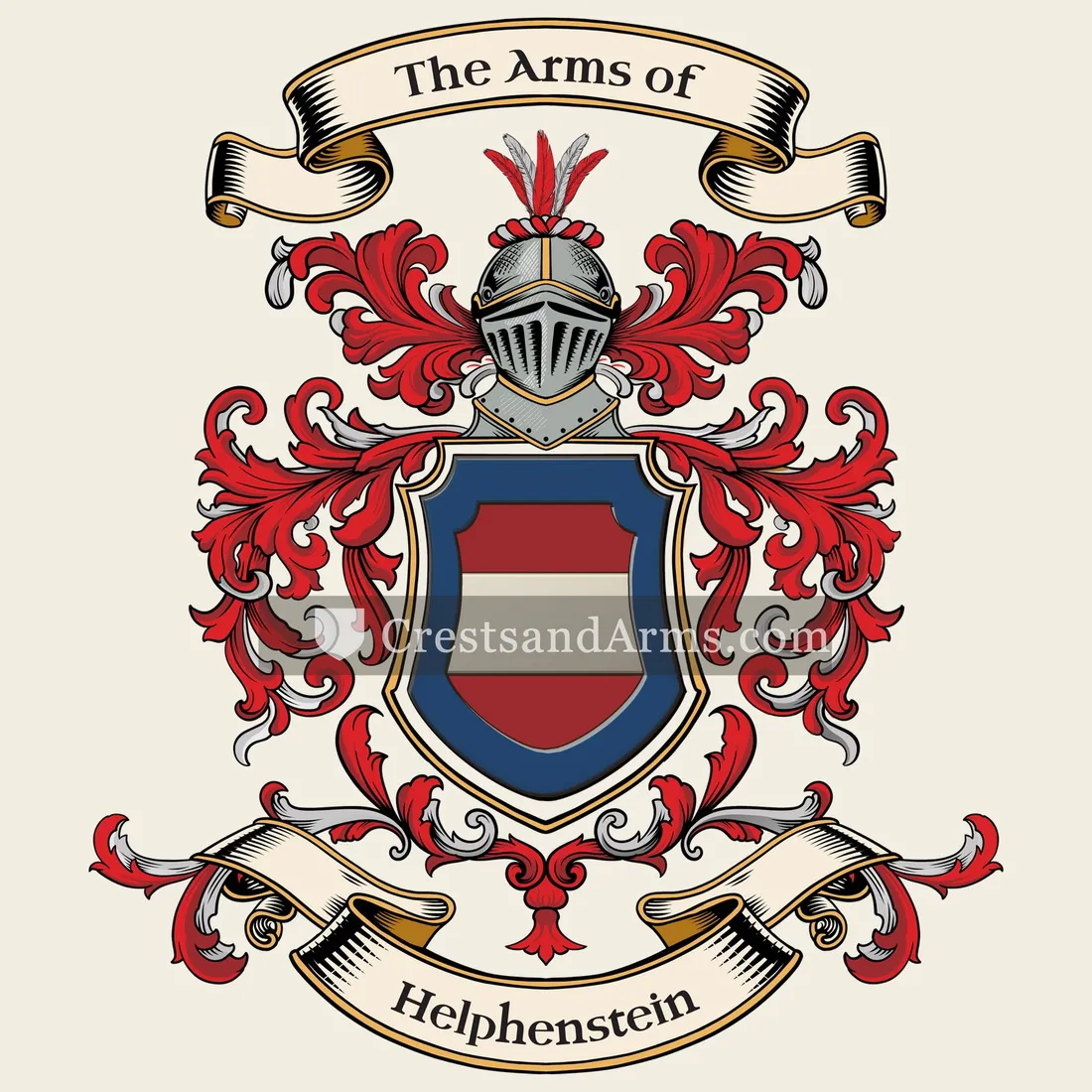
Meaning of the Helphenstein family crest colors & symbols
Symbols on this shield
fessThe military belt, and readiness to serve
Colours
Red (Gules)Means: Military strength
Silver (Argent)Means: Peace and sincerity
Blue (Azure)Means: Loyalty and truth
Historical info
Source
J. B. Rietstap, Armorial Général, Gouda: G. B. van Goor Zonen, 1884–87
Blazon (the actual original written record)
“De gu. à la fasce d'arg.; à la bord. d'azur.”
Francec. 1663
Digital archive packCoat of arms PNG, gold border print PDF, vector SVG and the certificate of authenticity. Sent to your email in minutes.
Map of France showing where the Helphenstein arms are recorded
The Helphenstein arms were recorded in France, c. 1663.
Arms such as these were typically recorded in Bretagne.
More families held coats of arms in Bretagne than anywhere else in France. The land was divided into many small estates rather than a few large ones, so far more households counted as gentry, and each needed a shield of its own to be told apart.
This is where the arms were entered in the register. Families often moved to other parts of the country, so the same name can turn up in more than one region.
The body that granted and recorded arms in France in this period.
Louis XIV of France
Sovereign of the period
Louis XIV of France
1643–1715
Reigning in Germany when the Helphenstein arms are first recorded.
How Arms Worked in France
In France, a coat of arms was a mark of honor that passed down through the male line to all legitimate descendants. Families often used the same shield without changes to show their shared heritage. If a branch wanted to stand out, they could add a small mark to their shield to show their specific place in the family tree.
Granting authority
The Juge d'armes de France acted as the official authority that regulated and verified coats of arms across the country.
How they got arms
Families typically inherited their arms from ancestors, though they could also receive them through royal grants or by proving their noble status.
Where arms were recorded
Coats of arms were officially recorded in the Armorial Général de France, which began its main collection in the year 1696.
The family's standing
Recorded among the armigerous families of France.
Origin & History of the Helphenstein Family in France
The history of the Helphenstein family in France is deeply rooted in the rugged landscape of the Brittany region, where records confirm their presence as early as 1663. During the seventeenth century, Brittany was a province defined by its distinct cultural identity and its strong ties to the maritime economy. Families living in this area often navigated a complex social structure that balanced local traditions with the growing influence of the French monarchy. While the name itself suggests origins that may have crossed linguistic and geographic borders into the Germanic territories, the Helphenstein family integrated into the local Breton community by establishing roots in the rural parishes. By settling in this coastal region, they became part of a society that valued land ownership and local administrative roles, allowing them to maintain a consistent presence in the historical record for generations.
Helphenstein Meaning & Related Branches
Root word
Helfenstein
Derived from the German words for help and stone.
This name
HelphensteinRefers to a person living near a landmark or castle named for helpful stone.
also spelled
Helfensteyn
Helfenstain
Helfenstine
Documented Sources
J. B. Rietstap, Armorial Général, Gouda: G. B. van Goor Zonen, 1884–87
Bader, Karl S., Der deutsche Südwesten in seiner territorialstaatlichen Entwicklung, 1950
Hauptstaatsarchiv Stuttgart, Bestand A 202: Württembergische Regierungsakten, 1620–1650
Schmid, Josef, Geschichte des schwäbischen Dorfes, 1965
Digital archive packCoat of arms PNG, gold border print PDF, vector SVG and the certificate of authenticity. Sent to your email in minutes.


 mountThe ground held, and steadfastness upon it
 bendDefence, and the scarf of a commander
 elephantGreat strength, wit and ambition
 mountThe ground held, and steadfastness upon it
 bendDefence, and the scarf of a commander
 elephantGreat strength, wit and ambition


 fessThe military belt, and readiness to serve