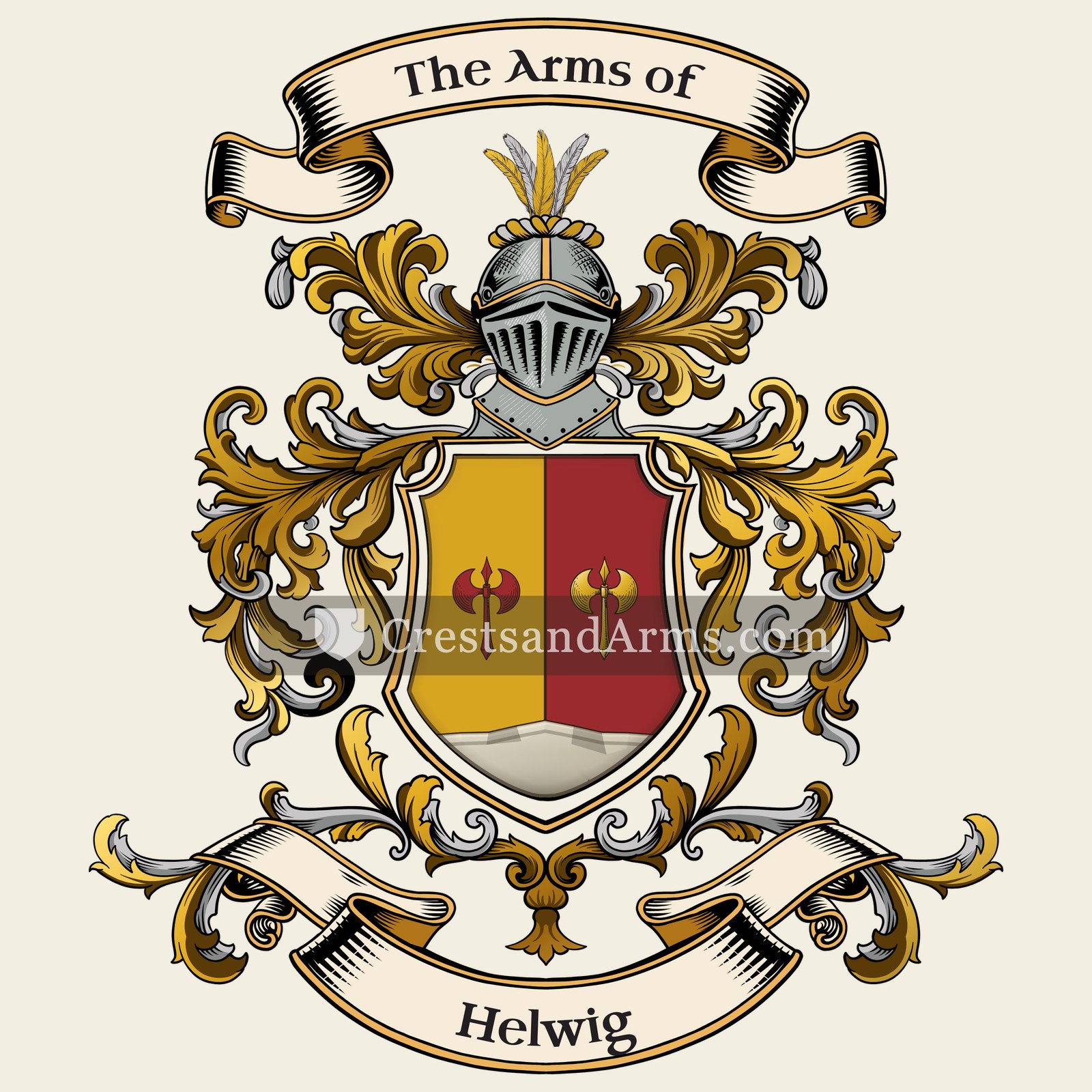
A record of documented arms, meaning and origin, researched for the Helwig family lines. Documented in 2 countries.
Reg. 0953 · German, G–I
Coat of Arms & Family Crest Details
Symbols on this shield
chequyConstancy, and the counting-board
fessThe military belt, and readiness to serve
eagleNobility, strength and a keen mind
Colours
Silver (Argent)Means: Peace and sincerity
Black (Sable)Means: Constancy
Red (Gules)Means: Military strength
Gold (Or)Means: Generosity
Historical info
Source
J. B. Rietstap, Armorial Général, Gouda: G. B. van Goor Zonen, 1884–87
Blazon (the actual original written record)
“Coupé: au 1 d'arg. à une aigle de Prusse; au 2 échiq. de sa. et d'arg. A la fasce de gu., br. sur le coupé. L'écu bordé d'or. Cq. cour. C.: un chevalier iss., arm. de toutes pièces au nat., la visière baissée, le casque panaché de trois pl. d'aut., une de sa. entre deux d'arg., tenant de chaque main un drapeau d'or ch. d'une aigle de sa., enclose dans une couronne de laurier de sin. L. d'arg. et de sa.”
Germanyc. 1816
Digital archive packCoat of arms PNG, gold border print PDF, vector SVG and the certificate of authenticity. Sent to your email in minutes.
Map of Germany showing where the Helwig arms are recorded
The Helwig arms were recorded in Germany, c. 1816.
Arms such as these were typically recorded in Bavaria.
Bavaria was a country of old landed families and walled market towns. Estates passed down the same line for centuries, and both the landowners and the leading townsmen kept arms, which is why so many Bavarian names sit in the registers.
This is where the arms were entered in the register. Families often moved to other parts of the country, so the same name can turn up in more than one region.
The body that granted and recorded arms in Germany in this period.
Frederick William III of Prussia
Sovereign of the period
Frederick William III of Prussia
1797–1840
Reigning in Germany when the Helwig arms are first recorded.
How Arms Worked in Germany
Prussian heraldry was strictly tied to social rank and noble status rather than being a free choice for every citizen. These symbols were treated as permanent family property that moved through the generations to all legitimate heirs. If a family branch wanted to change their design to stand out, they had to apply for official permission to alter their specific version of the shield.
Granting authority
The Prussian Heroldsamt acted as the central state office that managed and strictly controlled all noble titles and coats of arms.
How they got arms
Families usually obtained their arms through formal royal grants or by proving their long-standing noble status to the state authorities.
Where arms were recorded
All official coats of arms were kept in the rolls of the Prussian Heroldsamt, which functioned from 1706 until 1918.
The family's standing
Recorded among the armigerous families of Germany.
Origin & History of the Helwig Family in Germany
The surname Helwig originates from the Old High German name Heilwig, which combines the words for "healthy" or "holy" and "war" or "battle." This name was historically popular among the Germanic tribes and eventually evolved into a hereditary family name as populations grew more settled. By the early 19th century, records confirm that families bearing the name Helwig were well-established in the region of Bavaria. During this period, Bavaria was undergoing significant political changes as it transitioned into a modern kingdom following the Napoleonic Wars. Families like the Helwigs were often part of the agrarian or artisan classes that formed the backbone of Bavarian society. They lived through a time of major administrative reform, where local governments began keeping more consistent birth, marriage, and death records. These documents provide a clear window into how the family integrated into the local community and contributed to the regional identity of southern Germany.
Coat of Arms & Family Crest Details
Symbols on this shield
saltireResolution, and St Andrew's cross
mountThe ground held, and steadfastness upon it
axeThe execution of military duty
Colours
Gold (Or)Means: Generosity
Red (Gules)Means: Military strength
Silver (Argent)Means: Peace and sincerity
Historical info
Source
J. B. Rietstap, Armorial Général, Gouda: G. B. van Goor Zonen, 1884–87
Blazon (the actual original written record)
“Parti d'or et de gu.; à deux hallebardes d'arg., les manches passées en saut., de l'un en l'autre; et un tertre de trois coupeaux d'arg. en p., br. sur le parti. Cq. cour. C.: un vol coupé alt. de gu. et d'or.”
LivoniaLivonia, c. 1744
Digital archive packCoat of arms PNG, gold border print PDF, vector SVG and the certificate of authenticity. Sent to your email in minutes.
Map of Poland showing where the Helwig arms are recorded
The Helwig arms were recorded in Livonia, c. 1744.
Livonia was Baltic country held by a small number of landed families who kept their estates for centuries. Land there passed down whole rather than being divided, and long unbroken tenure is what fills a register.
This is where the arms were entered in the register. Families often moved to other parts of the country, so the same name can turn up in more than one region.
Region
Livonia
First recorded
1744
Granting Authority for the Helwig Arms
Ennoblement by the Sejm
Author: Olek Remesz · CC BY-SA 3.0
The body that granted and recorded arms in Poland in this period.
Augustus III of Poland
Sovereign of the period
Augustus III of Poland
1733–1763
Reigning in Germany when the Helwig arms are first recorded.
How Arms Worked in Poland
Polish noble families shared a single coat of arms across many different surnames, creating large clans rather than individual designs. These symbols were held collectively by all members of the clan regardless of their specific family name. When a new family joined the nobility, they were adopted into an existing clan and began using that group's established shield.
Granting authority
The Sejm, which was the Polish parliament, held the power to grant noble status and the right to bear arms.
How they got arms
Families typically received their coat of arms through a formal act of ennoblement granted by the Sejm for distinguished service.
Where arms were recorded
These grants were officially recorded in the Crown Metrica, which served as the central archive for state documents starting in the sixteenth century.
The family's standing
Recorded among the armigerous families of Livonia.
Origin & History of the Helwig Family in Poland
The Helwig family name carries a deep connection to the complex cultural landscape of the Baltic region and the historical territories of the Polish-Lithuanian Commonwealth. While the name is Germanic in origin, its presence in Livonia by 1744 reflects the migration patterns of merchants, craftsmen, and administrators who moved across the borders of Northern Europe during the eighteenth century. At that time, Livonia was a melting pot of cultures where German, Polish, and Baltic influences intersected. Families like the Helwigs often served as bridges between these different communities, working within the local administrative systems or trade networks that defined the region. By settling in these areas, early family members became part of a mobile social class that helped shape the economic life of the borderlands. Their history is tied to the movement of people who sought new opportunities in the diverse provinces that were frequently influenced by the shifting political power of the Polish crown and its neighbors.
Related Branches & Arms
Root word
Heilwig
Derived from Old High German elements meaning health or fortune and battle.
This name
HelwigA Germanic name signifying a warrior who is healthy, fortunate, or blessed in battle.
also spelled
Hellwig
Helwich
Related arms
Hellwigvariant spelling
Helvigvariant spelling
Documented Sources
J. B. Rietstap, Armorial Général, Gouda: G. B. van Goor Zonen, 1884–87
Bahlow, Hans, Deutsches Namenlexikon: Familien- und Vornamen nach Ursprung und Sinn erklärt, 1967
Bayerisches Hauptstaatsarchiv, Kirchenbücher und Standesamtsunterlagen, 1816
Heintze, Albert, Die deutschen Familiennamen: geschichtlich, geographisch, sprachlich, 1903
Digital archive packCoat of arms PNG, gold border print PDF, vector SVG and the certificate of authenticity. Sent to your email in minutes.


 chequyConstancy, and the counting-board
 fessThe military belt, and readiness to serve
 eagleNobility, strength and a keen mind
 chequyConstancy, and the counting-board
 fessThe military belt, and readiness to serve
 eagleNobility, strength and a keen mind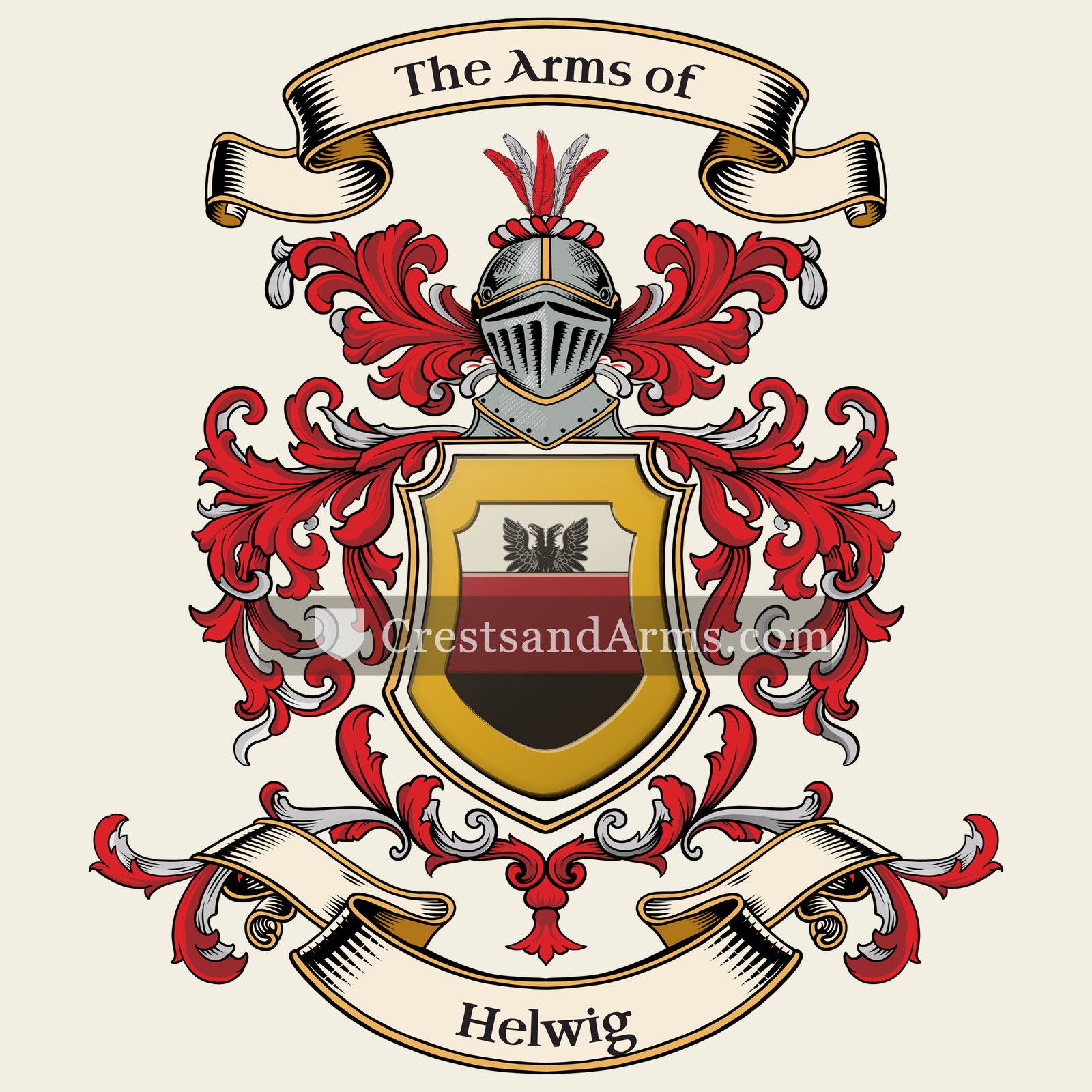


 saltireResolution, and St Andrew's cross
 mountThe ground held, and steadfastness upon it
 axeThe execution of military duty