A record of documented arms, meaning and origin, researched for the Hemond family lines. Documented in 3 countries.
Reg. 9737 · French, G–I
Coat of Arms & Family Crest Details
Symbols on this shield
chevronProtection, and faithful service completed
chiefAuthority, wisdom and dominion
escallopThe pilgrim's shell, and a long journey made
roundelA coin, and one who has been to the crusades
martletA younger son, who must win his own land
wreathHonour, and a victory crowned
roseThe seventh son, and beauty with grace
Colours
Silver (Argent)Means: Peace and sincerity
Gold (Or)Means: Generosity
Green (Vert)Means: Hope
Black (Sable)Means: Constancy
Red (Gules)Means: Military strength
Historical info
Source
J. B. Rietstap, Armorial Général, Gouda: G. B. van Goor Zonen, 1884–87
Blazon (the actual original written record)
“Ec.: aux 1 et 4 d'arg. au chev. de sa., ch. de trois coquilles d'or et acc. en chef de deux tourt. du sec., ch. chacun d'un martinet du champ, et en p. d'une couronne de chêne de sin.; à la bord. engr. de sin. (Hamond); aux 2 et 3 d'or à trois roses de gu., au chef de sa., ch. de trois coquilles du champ (Graeme). Deux cq., le 1 timbré d'une couronne navale d'or. C.: 1º une tête d'aigle de sa.; 2º deux bras de carn., mouv. de nuées, retirant une tête de mort d'une pique; la tête surm. d'une couronne de marquis et le tout accosté de deux palmes, au nat. Au-dessus de ce cimier un listel inscrit des mots SEPULTO VIRESCO. S.: une aigle reg. de sa., et une cigogne au nat., tous deux coll. d'une couronne navale d'or, enchaînée du même. D.: PARATUS ET FIDELIS.”
Francec. 1783
Digital archive packCoat of arms PNG, gold border print PDF, vector SVG and the certificate of authenticity. Sent to your email in minutes.
Map of France showing where the Hemond arms are recorded
The Hemond arms were recorded in France, c. 1783.
Arms such as these were typically recorded in Bretagne.
More families held coats of arms in Bretagne than anywhere else in France. The land was divided into many small estates rather than a few large ones, so far more households counted as gentry, and each needed a shield of its own to be told apart.
This is where the arms were entered in the register. Families often moved to other parts of the country, so the same name can turn up in more than one region.
The body that granted and recorded arms in France in this period.
Louis XVI of France
Sovereign of the period
Louis XVI of France
1774–1791
Reigning in France when the Hemond arms are first recorded.
How Arms Worked in France
In France, a coat of arms was a mark of honor that passed down through the male line to all legitimate descendants. Families often used the same shield without changes to show their shared heritage. If a branch wanted to stand out, they could add a small mark to their shield to show their specific place in the family tree.
Granting authority
The Juge d'armes de France acted as the official authority that regulated and verified coats of arms across the country.
How they got arms
Families typically inherited their arms from ancestors, though they could also receive them through royal grants or by proving their noble status.
Where arms were recorded
Coats of arms were officially recorded in the Armorial Général de France, which began its main collection in the year 1696.
The family's standing
Recorded among the armigerous families of France.
Origin & History of the Hemond Family in France
The family name Hemond finds its deep roots in the historical region of Brittany, France. The name is a variation of the ancient Germanic name Haimo, which translates to home or protector. During the medieval period, names like this evolved as families settled into specific provinces and established their local identities. By the late eighteenth century, the Hemond family was well-established in the Breton landscape, a region known for its strong Celtic heritage and distinct cultural traditions. Living in Brittany during the 1780s meant the family was part of a society deeply connected to the land and the sea. As the French Revolution approached in 1789, these families were often involved in the local agricultural and maritime economies that defined the coastal villages of western France. The persistence of the name in parish records from this era highlights the family's role in the social fabric of the region before many members eventually migrated across the Atlantic to North America.
Coat of Arms & Family Crest Details
Symbols on this shield
crescentHonour by the sovereign, and the second son
Colours
Gold (Or)Means: Generosity
Blue (Azure)Means: Loyalty and truth
Historical info
Source
Sir Bernard Burke, The General Armory of England, Scotland, Ireland and Wales, London: Harrison & Sons, 1884
Blazon (the actual original written record)
“Or, five crescents in cross az”
HantsHants, c. 1620
Digital archive packCoat of arms PNG, gold border print PDF, vector SVG and the certificate of authenticity. Sent to your email in minutes.
Map of England showing where the Hemond arms are recorded
The Hemond arms were recorded in Hants, c. 1620.
Hampshire had the naval dockyards at Portsmouth on one side and good farmland on the other. Sea money and land money both bought estates, and an estate was what brought a family its coat of arms.
This is where the arms were entered in the register. Families often moved to other parts of the country, so the same name can turn up in more than one region.
The body that granted and recorded arms in England in this period.
James VI and I
Sovereign of the period
James VI and I
1603–1625
Reigning in France when the Hemond arms are first recorded.
How Arms Worked in England
English heraldry allowed arms to be shared by all legitimate descendants of the original owner. These symbols were treated as personal property that moved through the generations to all children. While the eldest son kept the original design, other family members could use the same shield without needing to change it or register their own unique versions.
Granting authority
The College of Arms in London has regulated the use of coats of arms throughout England and Wales since 1484.
How they got arms
Families typically obtained their coats of arms through a formal grant from the Crown or by proving their ancient right to them.
Where arms were recorded
All official coats of arms are recorded in the registers kept at the College of Arms, which date back to the fifteenth century.
The family's standing
Recorded among the armigerous families of Hants.
Origin & History of the Hemond Family in England
The family name Hemond has roots that stretch back to the rural landscapes of southern England, where the name was firmly established in the county of Hampshire by the early seventeenth century. During this period, the region was a bustling hub of agricultural activity and maritime trade, providing a stable environment for families to settle and grow. Records from 1620 confirm that members of the Hemond family were active participants in the local community of Hants, likely working as skilled tradespeople or tenant farmers who contributed to the economic life of the English countryside. The name itself reflects the linguistic traditions of the time, often evolving from older Germanic or Old English naming customs that emphasized personal character or local geography. By maintaining a presence in Hampshire during this era, the Hemonds became part of the broader social fabric of England, living through a time of significant transition as the nation prepared for the expansion of the British Empire and the eventual migration of its people across the Atlantic.
Coat of Arms & Family Crest Details
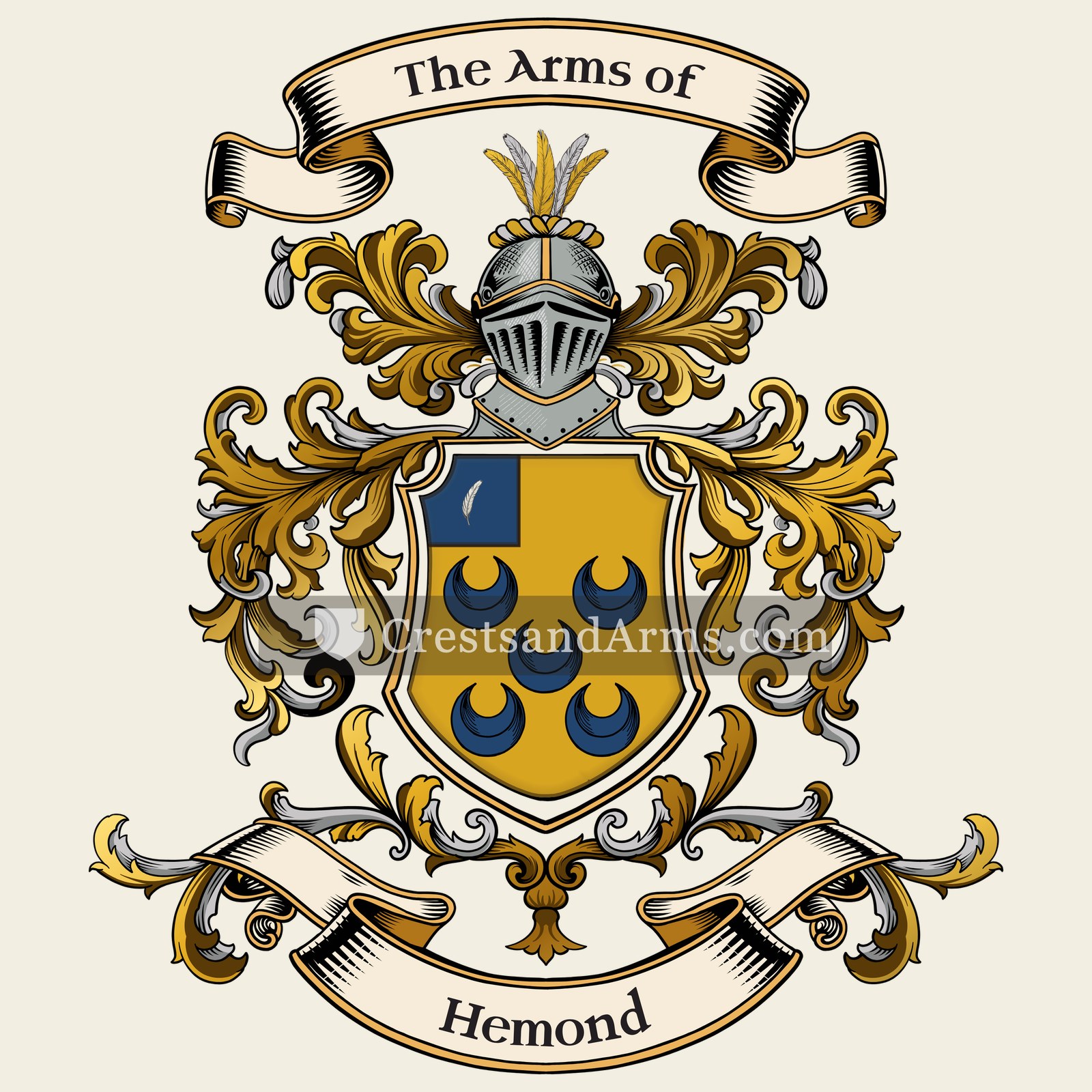
Symbols on this shield
cantonA mark of honour granted by the sovereign
crescentHonour by the sovereign, and the second son
feathersWilling obedience and serenity
Colours
Gold (Or)Means: Generosity
Blue (Azure)Means: Loyalty and truth
Silver (Argent)Means: Peace and sincerity
Historical info
Source
Sir Bernard Burke, The General Armory of England, Scotland, Ireland and Wales, London: Harrison & Sons, 1884
Blazon (the actual original written record)
“Or, five crescents in cross az. on a canton of the last an ostrich's feather in pale ar”
SurreyChertsey · Surrey, c. 1607
Digital archive packCoat of arms PNG, gold border print PDF, vector SVG and the certificate of authenticity. Sent to your email in minutes.
Map of Wales showing where the Hemond arms are recorded
The Hemond arms were recorded in Surrey, c. 1607.
Surrey sat just south of London and filled up with families who had made money in the City. Buying an estate there was the usual next step, and an estate was the usual reason to take arms.
This is where the arms were entered in the register. Families often moved to other parts of the country, so the same name can turn up in more than one region.
The body that granted and recorded arms in Wales in this period.
James VI and I
Sovereign of the period
James VI and I
1603–1625
Reigning in France when the Hemond arms are first recorded.
How Arms Worked in Wales
English heraldry allowed arms to be shared by all legitimate descendants of the original owner. These symbols were treated as personal property that moved through the generations to all children. While the eldest son kept the original design, other family members could use the same shield without needing to change it or register their own unique versions.
Granting authority
The College of Arms in London has regulated the use of coats of arms throughout England and Wales since 1484.
How they got arms
Families typically obtained their coats of arms through a formal grant from the Crown or by proving their ancient right to them.
Where arms were recorded
All official coats of arms are recorded in the registers kept at the College of Arms, which date back to the fifteenth century.
The family's standing
Recorded among the armigerous families of Surrey.
Origin & History of the Hemond Family in Wales
The surname Hemond is rooted in the medieval period, emerging from the Germanic personal name Haimo, which eventually evolved into various forms across Britain. While the family established a notable presence in Surrey by 1607, the name’s deeper history is tied to the movement of people across the British Isles, including the border regions between England and Wales. During the Middle Ages, families with names derived from Haimo often settled in areas where Welsh and English cultures intersected, particularly in the borderlands known as the Marches. As the name moved through these regions, it was adapted by local speakers to fit the phonetic patterns of the area. By the time the family appeared in Surrey records in the early seventeenth century, they were part of a long tradition of families who had migrated from the western territories toward the growing administrative and commercial hubs of southern England.
Related Branches & Arms
Root word
Haimo
A Germanic name derived from the word for home or house.
This name
HemondA patronymic surname indicating a descendant of someone named Haimo, meaning home protector.
also spelled
Hammond
Hamont
Hamon
Hammon
Documented Sources
J. B. Rietstap, Armorial Général, Gouda: G. B. van Goor Zonen, 1884–87
Dauzat, Albert. Dictionnaire étymologique des noms et prénoms de France. 1951
Morlet, Marie-Thérèse. Dictionnaire étymologique des noms de famille. 1991
Digital archive packCoat of arms PNG, gold border print PDF, vector SVG and the certificate of authenticity. Sent to your email in minutes.


 chevronProtection, and faithful service completed
 chiefAuthority, wisdom and dominion
 escallopThe pilgrim's shell, and a long journey made
 roundelA coin, and one who has been to the crusades
 martletA younger son, who must win his own land
 wreathHonour, and a victory crowned
 roseThe seventh son, and beauty with grace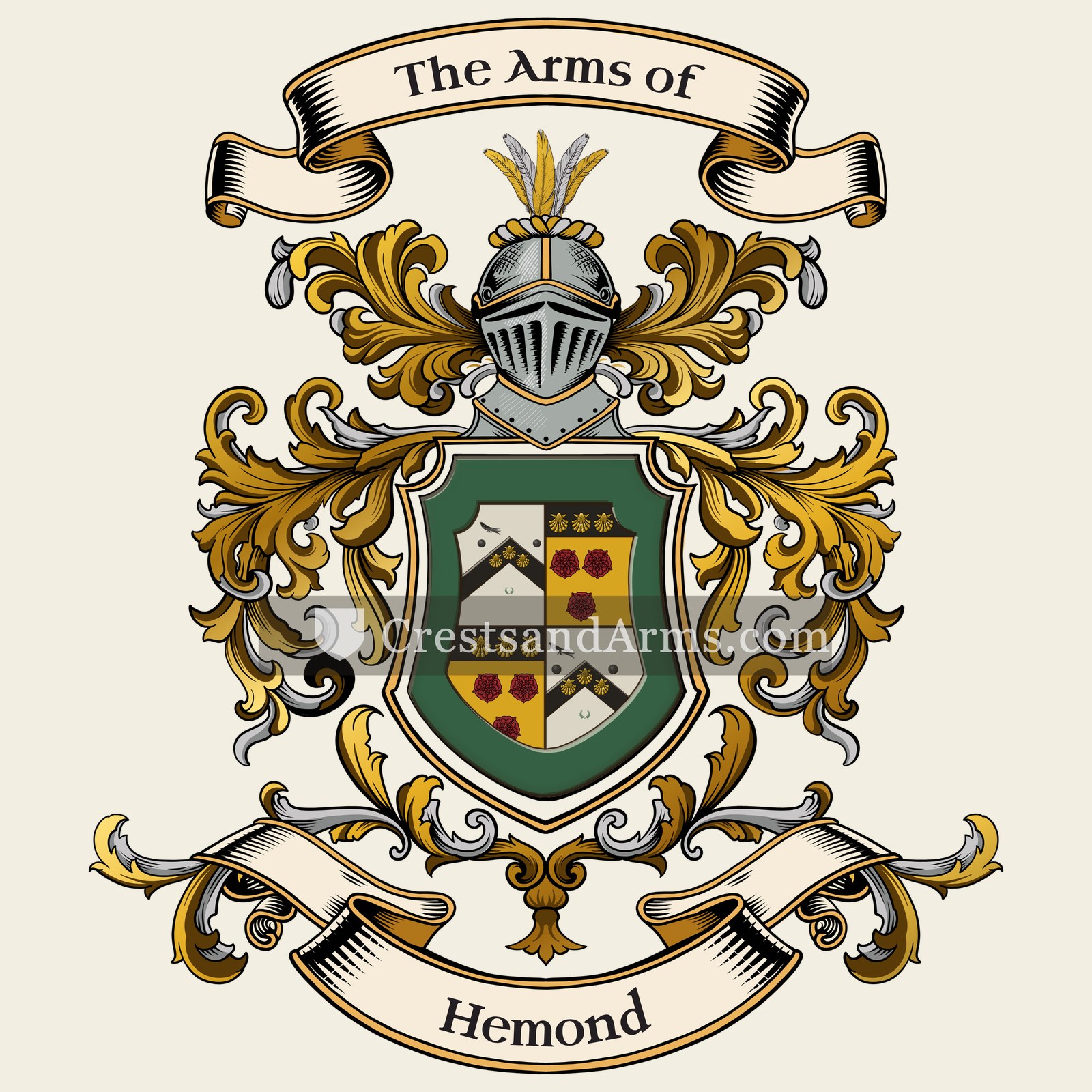


 crescentHonour by the sovereign, and the second son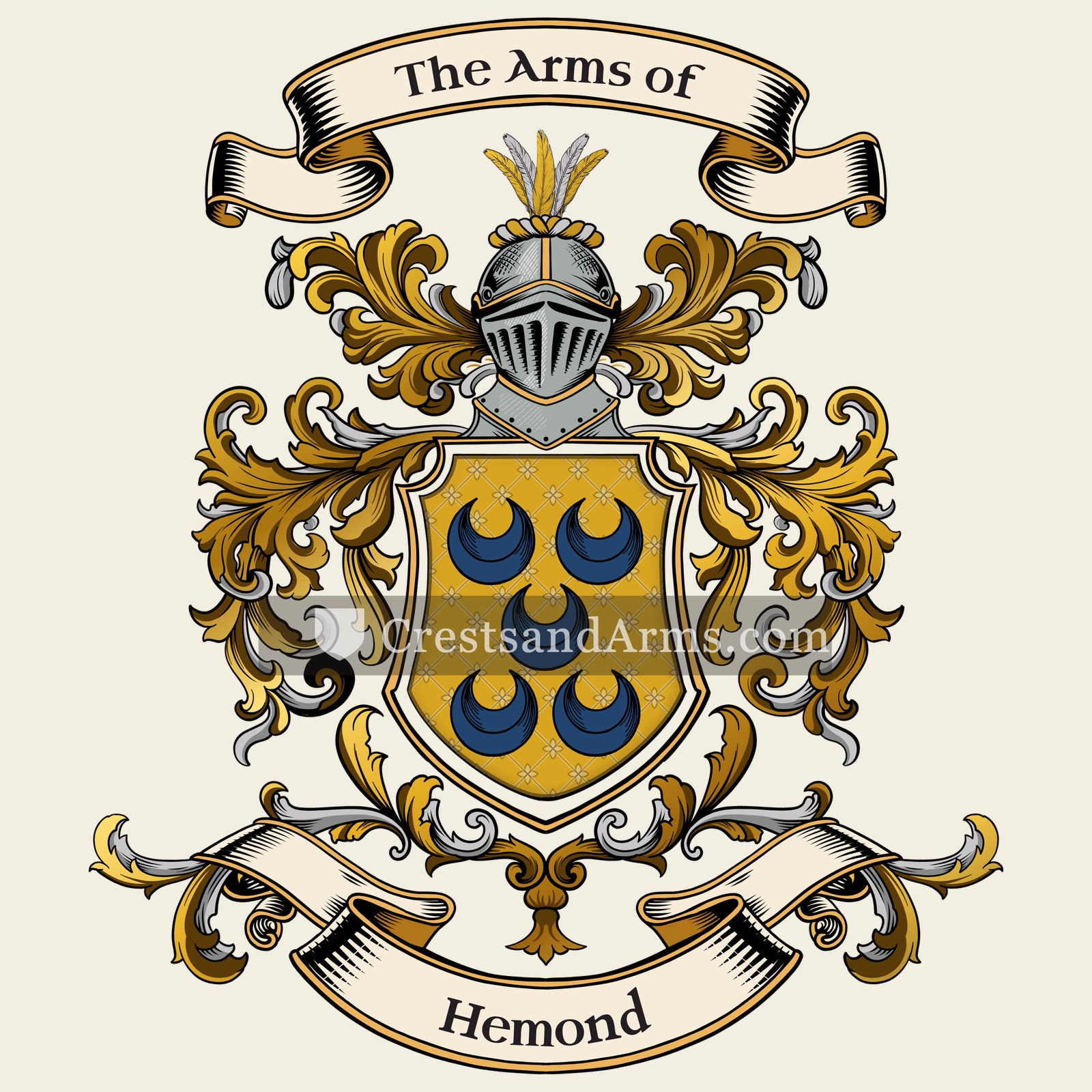


 cantonA mark of honour granted by the sovereign
 feathersWilling obedience and serenity