Map of England showing where the Henderson arms are recorded
The Henderson arms were recorded in Surrey, c. 1865.
Surrey sat just south of London and filled up with families who had made money in the City. Buying an estate there was the usual next step, and an estate was the usual reason to take arms.
This is where the arms were entered in the register. Families often moved to other parts of the country, so the same name can turn up in more than one region.
The body that granted and recorded arms in England in this period.
Victoria
Sovereign of the period
Victoria
1837–1901
Reigning in England when the Henderson arms are first recorded.
How Arms Worked in England
English heraldry allowed arms to be shared by all legitimate descendants of the original owner. These symbols were treated as personal property that moved through the generations to all children. While the eldest son kept the original design, other family members could use the same shield without needing to change it or register their own unique versions.
Granting authority
The College of Arms in London has regulated the use of coats of arms throughout England and Wales since 1484.
How they got arms
Families typically obtained their coats of arms through a formal grant from the Crown or by proving their ancient right to them.
Where arms were recorded
All official coats of arms are recorded in the registers kept at the College of Arms, which date back to the fifteenth century.
The family's standing
Recorded among the armigerous families of Surrey.
Origin & History of the Henderson Family in England
The surname Henderson is a patronymic name, which means it was originally created to identify a person as the son of a man named Henry. While the name has strong roots in the northern regions of Britain, families bearing this name gradually spread throughout England over many centuries. By the mid-nineteenth century, the Henderson family had established a notable presence in the county of Surrey. During this period, England was undergoing rapid industrial and social changes, and families often moved to areas like Surrey to take advantage of new opportunities in trade and local administration. The presence of the family in Surrey by 1865 reflects this broader pattern of internal migration, where individuals moved across the country to seek better livelihoods and contribute to the growing communities of the Victorian era.
Coat of Arms & Family Crest Details
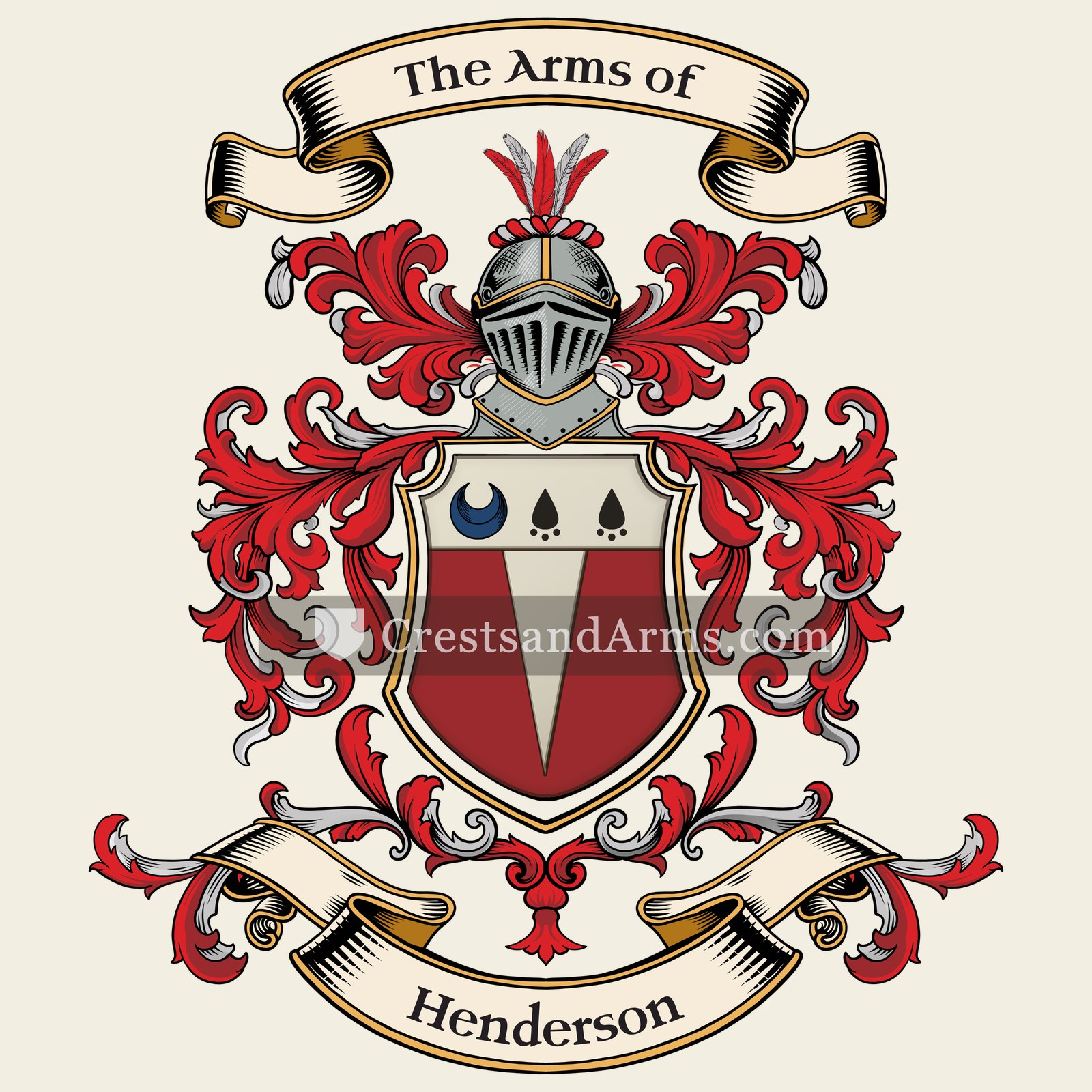
Symbols on this shield
pileWell-doing, and a mark of distinction
chiefAuthority, wisdom and dominion
ermineDignity and rank
paleMilitary strength, and a fortified defence
crescentHonour by the sovereign, and the second son
Colours
Red (Gules)Means: Military strength
Silver (Argent)Means: Peace and sincerity
Blue (Azure)Means: Loyalty and truth
Black (Sable)Means: Constancy
Historical info
Source
Sir Bernard Burke, The General Armory of England, Scotland, Ireland and Wales, London: Harrison & Sons, 1884
Blazon (the actual original written record)
“Gu. three piles issuing out of the sinister side ar. on a chief of the last a crescent az. betw. two erm. spots. (An older blazon is, per pale indented sa. and ar. on a chief of the second a crescent vert betw. two erm. spots)”
FifeFordell · Fife, c. 1664
Digital archive packCoat of arms PNG, gold border print PDF, vector SVG and the certificate of authenticity. Sent to your email in minutes.
Map of Scotland showing where the Henderson arms are recorded
The Henderson arms were recorded in Fife, c. 1664.
Fife was farming country between two firths, with royal palaces and old burghs along its coast. Its landed families were numerous and close to the court, and closeness to the court brought arms.
This is where the arms were entered in the register. Families often moved to other parts of the country, so the same name can turn up in more than one region.
The body that granted and recorded arms in Scotland in this period.
Charles II of England
Sovereign of the period
Charles II of England
1660–1685
Reigning in England when the Henderson arms are first recorded.
How Arms Worked in Scotland
Scottish heraldry is unique because it treats a coat of arms as a piece of personal property protected by law. Only one person can own a specific design at any given time. When a family grows, the head keeps the original shield while other relatives must apply for their own distinct version with slight changes to prove their specific identity.
Granting authority
The Court of the Lord Lyon acts as the official body that regulates and controls all heraldic matters throughout Scotland.
How they got arms
Individuals obtain a legal right to their arms through a formal petition process that confirms their identity and family connection.
Where arms were recorded
All valid coats of arms are officially entered into the Public Register of All Arms and Bearings starting from 1672.
The family's standing
Recorded among the armigerous families of Fife.
Origin & History of the Henderson Family in Scotland
The name Henderson is a patronymic surname, which means it originated as a way to identify a person as the son of Henry. While the name appears in various parts of the British Isles, its roots in Scotland are deeply tied to the Lowlands and the border regions. By the mid-seventeenth century, the family had established a notable presence in the county of Fife. Records from 1664 confirm that members of the Henderson family were active in this area during a time of significant social and religious change in Scotland. These early settlers were often involved in local agriculture or trade, helping to build the foundations of the community in the eastern coastal regions. Over time, the family grew and spread across the country, becoming a recognized part of the Scottish landscape through their contributions to local life and their long-standing ties to the land.
Related Branches & Arms
Root word
Henry
Derived from the Germanic name Heimirich meaning home ruler.
This name
HendersonPatronymic surname meaning son of Henry or son of Hendry.
also spelled
Hendryson
Henrison
Hendreson
Documented Sources
Sir Bernard Burke, The General Armory of England, Scotland, Ireland and Wales, London: Harrison & Sons, 1884
Reaney, P.H. and Wilson, R.M., A Dictionary of English Surnames, 1991
The National Archives, Census Returns of England and Wales, 1861 and 1871, series RG 9 and RG 10
Surrey History Centre, Parish Records and Local Census Data, series CC/1865
Digital archive packCoat of arms PNG, gold border print PDF, vector SVG and the certificate of authenticity. Sent to your email in minutes.


 pileWell-doing, and a mark of distinction
 chiefAuthority, wisdom and dominion
 pileWell-doing, and a mark of distinction
 chiefAuthority, wisdom and dominion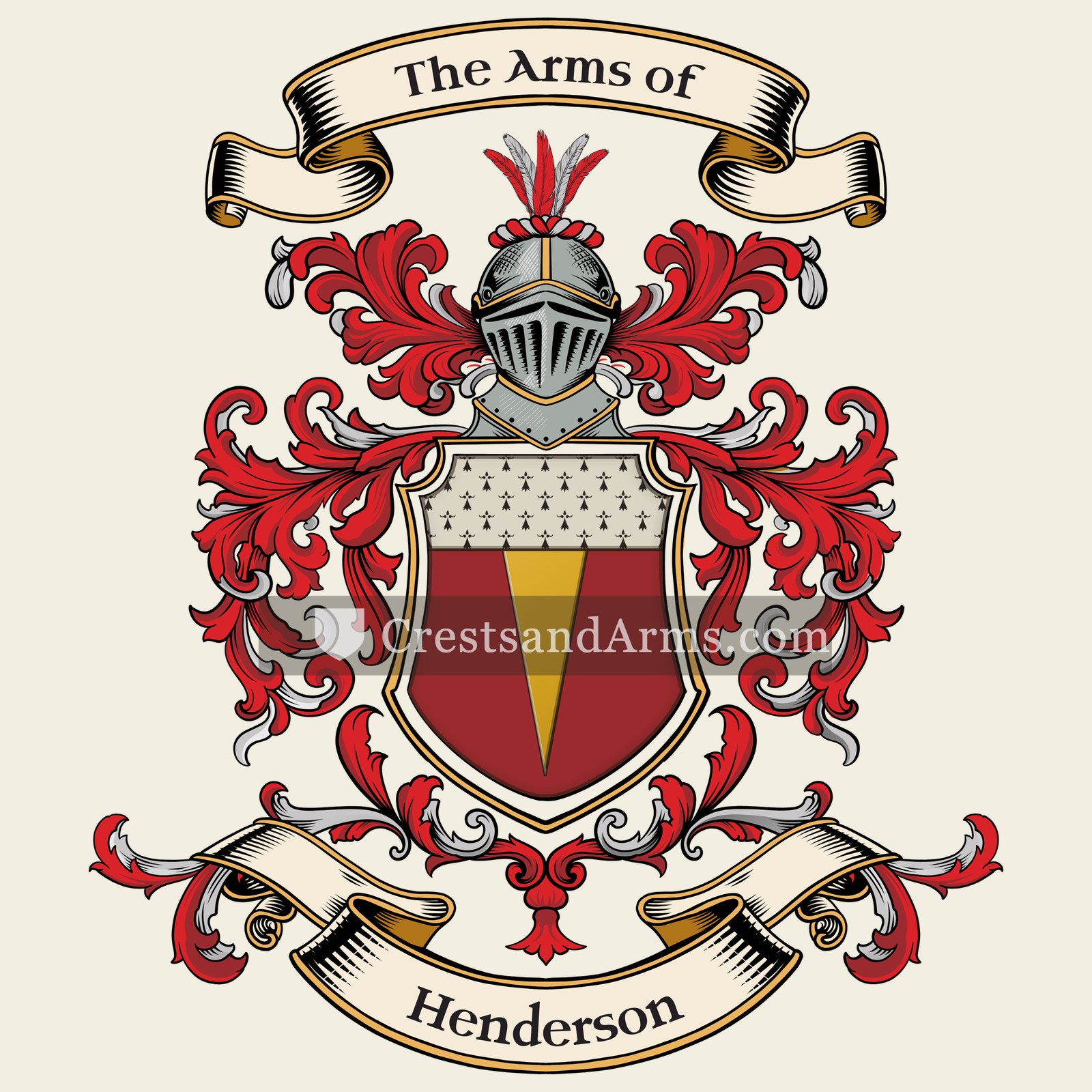


 ermineDignity and rank
 paleMilitary strength, and a fortified defence
 crescentHonour by the sovereign, and the second son