Map of Germany showing where the Hendrich arms are recorded
The Hendrich arms were recorded in Saxony, c. 1765.
Saxony had mines, trade and old landed families all at once. Silver made some fortunes and land held others, and both sorts of family kept arms, which is why Saxon names appear so often in the registers.
This is where the arms were entered in the register. Families often moved to other parts of the country, so the same name can turn up in more than one region.
The body that granted and recorded arms in Germany in this period.
Francis I, Holy Roman Emperor
Sovereign of the period
Francis I, Holy Roman Emperor
1745–1765
Reigning in Germany when the Hendrich arms are first recorded.
How Arms Worked in Germany
In the Holy Roman Empire, coats of arms were often granted to individuals by the Emperor or his representatives. These arms were then passed down through the generations to all legitimate descendants of the original holder. Younger branches of a family usually kept the same shield design without needing to change it, as the arms belonged to the entire lineage.
Granting authority
The Holy Roman Emperor held the sole power to grant new coats of arms throughout his vast imperial territories.
How they got arms
Families typically obtained their coats of arms through a formal imperial grant or by proving their noble status to the authorities.
Where arms were recorded
These grants were officially recorded in the Imperial Chancery registers, which began keeping formal records of such honors during the Middle Ages.
The family's standing
Recorded among the armigerous families of Saxony.
Origin & History of the Hendrich Family in Germany
The surname Hendrich originates from the Germanic personal name Heinrich, which translates to ruler of the home. During the Middle Ages, it was common for people to adopt the names of respected ancestors or local leaders as their own surnames. By the mid-18th century, the Hendrich family was well-established within the region of Saxony. This area was a major cultural and economic hub in the Holy Roman Empire, known for its dense forests and industrious mining communities. Families living in Saxony during this period often worked in agriculture or skilled trades, contributing to the growth of local villages and towns. The presence of the Hendrich name in 1765 suggests that the family was deeply rooted in the social fabric of this German territory, likely participating in the traditions and daily life that defined the Saxon landscape for generations.
Related Branches & Arms
Root word
Heinrich
Derived from Germanic elements meaning home ruler or enclosure ruler.
This name
HendrichA German patronymic surname signifying descendant of the ruler of the home.
also spelled
Hendreich
Hendrick
Related arms
Hendreichvariant spelling
Documented Sources
J. B. Rietstap, Armorial Général, Gouda: G. B. van Goor Zonen, 1884–87
Bahlow, Hans, Deutsches Namenlexikon: Familien- und Vornamen nach Ursprung und Sinn erklärt, 1967
Heintze, Albert, Die deutschen Familien-Namen: geschichtlich, geographisch, sprachlich, 1903
Sächsisches Staatsarchiv, Kirchenbücher der evangelisch-lutherischen Landeskirche Sachsens, 1765
Digital archive packCoat of arms PNG, gold border print PDF, vector SVG and the certificate of authenticity. Sent to your email in minutes.


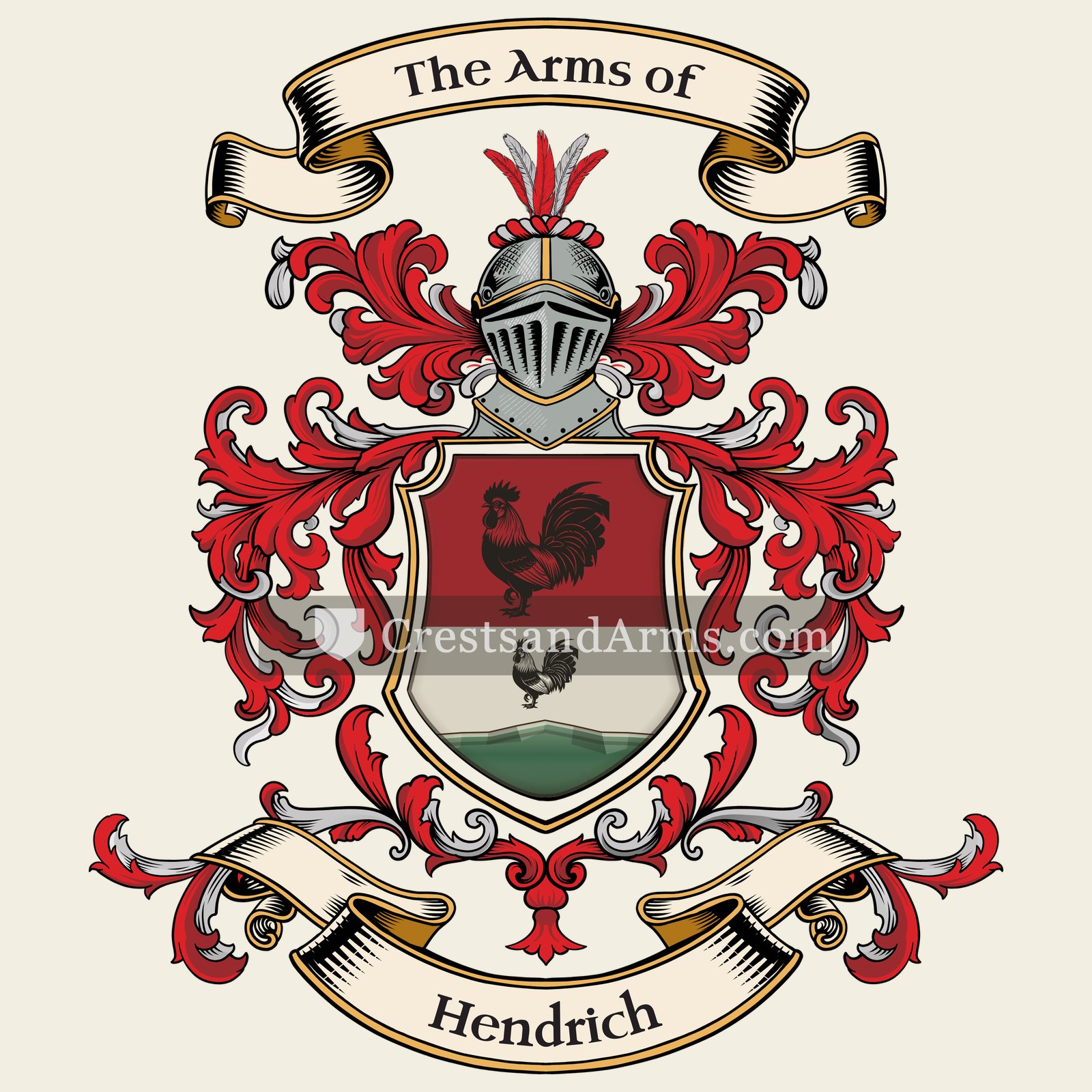
 mountThe ground held, and steadfastness upon it
 cockCourage, vigilance and readiness for battle
 mountThe ground held, and steadfastness upon it
 cockCourage, vigilance and readiness for battle