Map of Switzerland showing where the Hengen arms are recorded
The Hengen arms were recorded in Valais, c. 1745.
This is where the arms were entered in the register. Families often moved to other parts of the country, so the same name can turn up in more than one region.
The body that granted and recorded arms in Switzerland in this period.
How Arms Worked in Switzerland
In Switzerland, coats of arms were not restricted to the nobility and were often adopted by common citizens and families. These symbols were passed down through generations to show family identity. When branches of a family grew, they often changed small details of the design to distinguish their own line from the original group.
Granting authority
Cantonal and civic authorities managed the use of coats of arms within their specific regions and local jurisdictions.
How they got arms
Families typically assumed their own coats of arms based on local custom rather than receiving them from a central monarch.
Where arms were recorded
Arms were recorded in various cantonal and civic registers starting from the fourteenth century throughout the Swiss region.
The family's standing
Recorded among the armigerous families of Switzerland.
Origin & History of the Hengen Family in Switzerland
The Hengen family name is deeply rooted in the rugged landscape of the Valais region in Switzerland. Historical records confirm that members of the family were established in this area by 1745. During this period, the Valais was a collection of independent communities that relied heavily on alpine agriculture and trade routes through the mountain passes. Families like the Hengens often lived in small, tight-knit villages where they managed livestock and worked the steep terraced fields. The name itself likely evolved from local dialects spoken in the German-speaking upper part of the canton. Because travel was difficult in the eighteenth century, the family remained closely tied to their specific valley for generations. This isolation helped preserve their unique traditions and allowed the family to become an integral part of the local social structure.
Related Branches & Arms
Root word
Hango
An ancient Germanic personal name derived from the word for hook.
This name
HengenA patronymic surname indicating descent from an ancestor originally named Hango or Hengo.
also spelled
Hensen
Documented Sources
J. B. Rietstap, Armorial Général, Gouda: G. B. van Goor Zonen, 1884–87
Archives de l'État du Valais, Registres paroissiaux de l'ancien diocèse de Sion
Archives de l'État du Valais, Fonds de la famille Hengen
Anton Riva, Die Walliser Familiennamen, 1982
Gregor Zenhäusern, Geschichte des Wallis, 2001
Digital archive packCoat of arms PNG, gold border print PDF, vector SVG and the certificate of authenticity. Sent to your email in minutes.


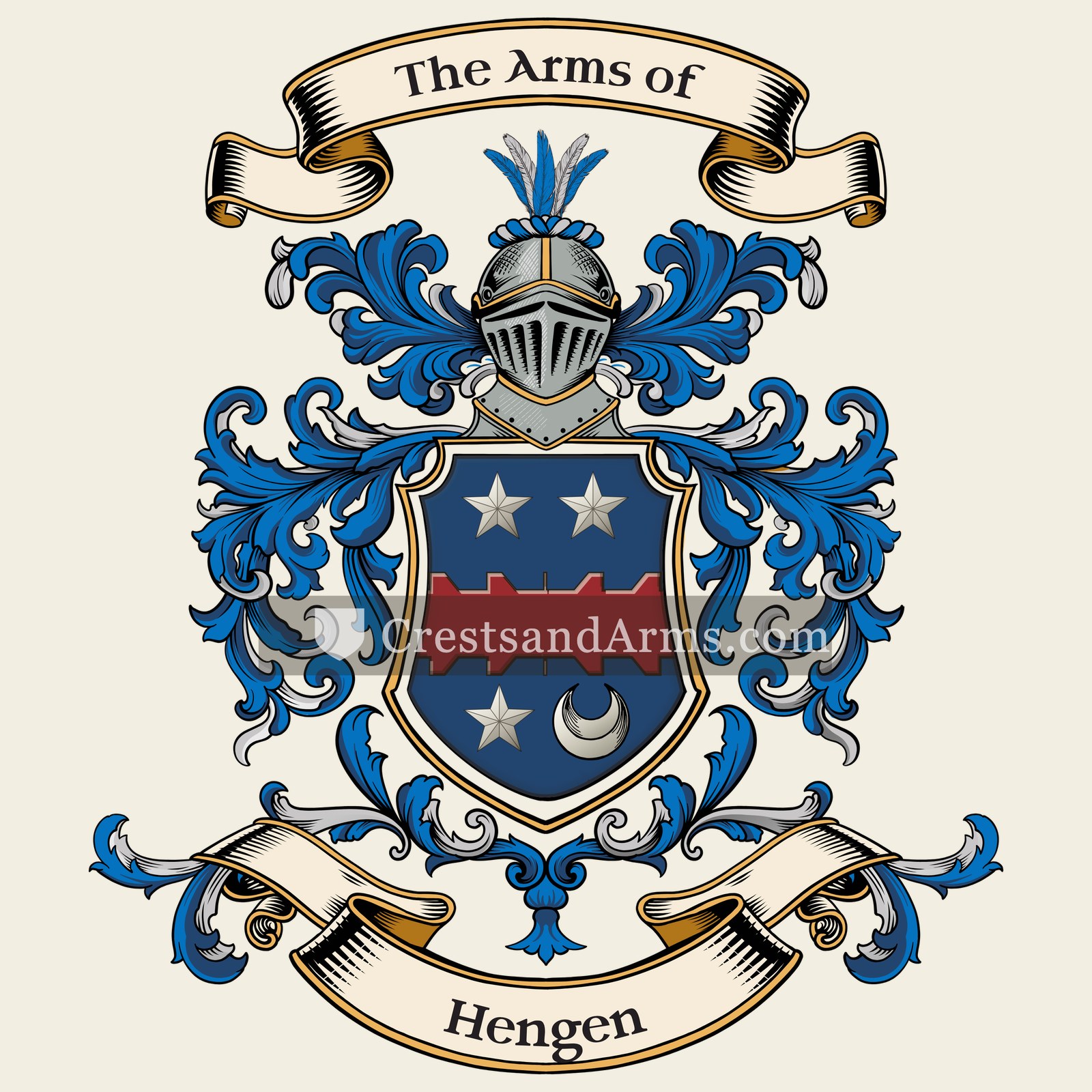
 fessThe military belt, and readiness to serve
 mulletThe third son, and a divine quality from above
 crescentHonour by the sovereign, and the second son
 fessThe military belt, and readiness to serve
 mulletThe third son, and a divine quality from above
 crescentHonour by the sovereign, and the second son