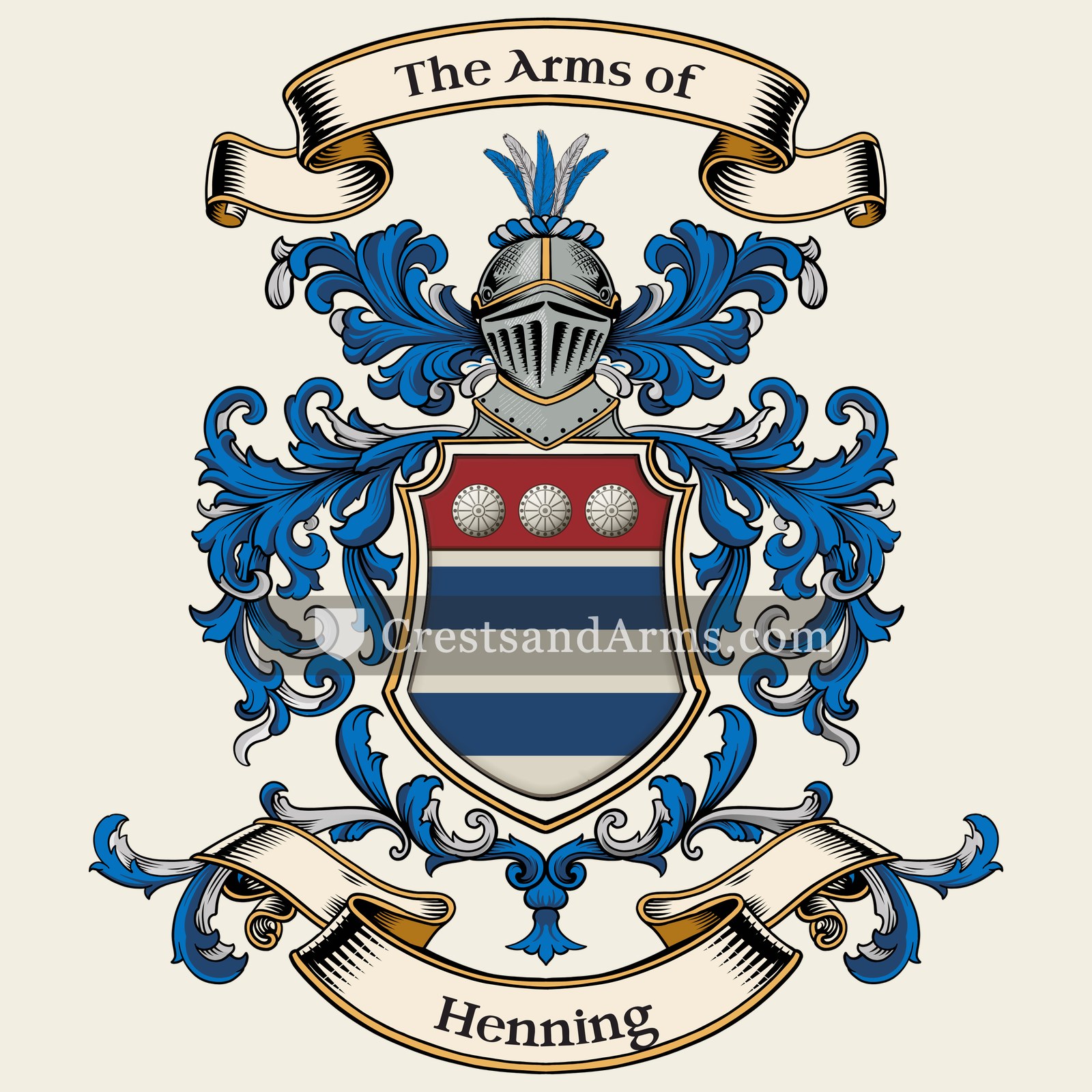
A record of documented arms, meaning and origin, researched for the Henning family lines. Documented in 3 countries.
Reg. 5201 · Polish, G–I
Coat of Arms & Family Crest Details
Symbols on this shield
cockCourage, vigilance and readiness for battle
Colours
Blue (Azure)Means: Loyalty and truth
Silver (Argent)Means: Peace and sincerity
Historical info
Source
J. B. Rietstap, Armorial Général, Gouda: G. B. van Goor Zonen, 1884–87
Blazon (the actual original written record)
“D'azur à une poule d'arg., crêtée et barbée de gu., perchée sur un chicot au nat., posé en bande, poussant de chaque côté une branche feuillée de sin. Cq. cour. C.: la poule iss. L. d'arg. et d'azur.”
CourlandCourland, c. 1566
Digital archive packCoat of arms PNG, gold border print PDF, vector SVG and the certificate of authenticity. Sent to your email in minutes.
Map of Poland showing where the Henning arms are recorded
The Henning arms were recorded in Courland, c. 1566.
Courland was Baltic coast country held in large estates by a small number of families. They kept their land for generations and served as officers abroad, and both landholding and service brought arms with them.
This is where the arms were entered in the register. Families often moved to other parts of the country, so the same name can turn up in more than one region.
Region
Courland
First recorded
1566
Granting Authority for the Henning Arms
Ennoblement by the Sejm
Author: Olek Remesz · CC BY-SA 3.0
The body that granted and recorded arms in Poland in this period.
Sigismund II Augustus
Sovereign of the period
Sigismund II Augustus
1530–1572
Reigning in Poland when the Henning arms are first recorded.
How Arms Worked in Poland
Polish noble families shared a single coat of arms across many different surnames, creating large clans rather than individual designs. These symbols were held collectively by all members of the clan regardless of their specific family name. When a new family joined the nobility, they were adopted into an existing clan and began using that group's established shield.
Granting authority
The Sejm, which was the Polish parliament, held the power to grant noble status and the right to bear arms.
How they got arms
Families typically received their coat of arms through a formal act of ennoblement granted by the Sejm for distinguished service.
Where arms were recorded
These grants were officially recorded in the Crown Metrica, which served as the central archive for state documents starting in the sixteenth century.
The family's standing
Recorded among the armigerous families of Courland.
Origin & History of the Henning Family in Poland
The name Henning has deep roots in the Baltic region, serving as a patronymic derived from a shortened form of the name Johannes. By the mid-sixteenth century, members of the family were firmly established in the Duchy of Courland, a territory that maintained strong political and cultural ties to the Polish-Lithuanian Commonwealth. Because Courland was a vassal state of the Polish crown starting in 1561, families living there often moved between the Baltic lands and the broader Polish territories for trade, military service, and administrative roles. The presence of the Henning family in Courland by 1566 suggests they were part of a mobile class of settlers who helped bridge the gap between German-speaking administrative traditions and the legal frameworks of the Polish-Lithuanian state. Over time, these families became integrated into the social fabric of the region, often serving as local officials or landowners who helped manage the complex borders of the Baltic frontier.
Coat of Arms & Family Crest Details
Symbols on this shield
lionCourage, strength and royalty
escallopThe pilgrim's shell, and a long journey made
Colours
Black (Sable)Means: Constancy
Gold (Or)Means: Generosity
Silver (Argent)Means: Peace and sincerity
Historical info
Source
J. B. Rietstap, Armorial Général, Gouda: G. B. van Goor Zonen, 1884–87
Blazon (the actual original written record)
“De sa. au lion naiss. d'or, supp. de ses pattes une église d'arg., essorée de gu.; à la champagne du sec., ch. de trois coquilles d'arg. C.: le lion; entre un vol, coupé alt. de sa. et d'or. L. d'or et de sa.”
SilesiaRiga · Silesia, c. 1615
Digital archive packCoat of arms PNG, gold border print PDF, vector SVG and the certificate of authenticity. Sent to your email in minutes.
Map of Germany showing where the Henning arms are recorded
The Henning arms were recorded in Silesia, c. 1615.
Silesia was farming country in the east of the German lands, held in large estates by families who stayed put for generations. Owning land was what entitled a family to arms, so the region fills a good deal of the register.
This is where the arms were entered in the register. Families often moved to other parts of the country, so the same name can turn up in more than one region.
The body that granted and recorded arms in Germany in this period.
Matthias, Holy Roman Emperor
Sovereign of the period
Matthias, Holy Roman Emperor
1612–1619
Reigning in Poland when the Henning arms are first recorded.
How Arms Worked in Germany
In the Holy Roman Empire, coats of arms were often granted to individuals by the Emperor or his representatives. These arms were then passed down through the generations to all legitimate descendants of the original holder. Younger branches of a family usually kept the same shield design without needing to change it, as the arms belonged to the entire lineage.
Granting authority
The Holy Roman Emperor held the sole power to grant new coats of arms throughout his vast imperial territories.
How they got arms
Families typically obtained their coats of arms through a formal imperial grant or by proving their noble status to the authorities.
Where arms were recorded
These grants were officially recorded in the Imperial Chancery registers, which began keeping formal records of such honors during the Middle Ages.
The family's standing
Recorded among the armigerous families of Silesia.
Origin & History of the Henning Family in Germany
The name Henning originated as a shortened form of the Germanic name Johannes, which eventually became a popular given name throughout the region. During the Middle Ages, it was common for people to adopt these short forms as surnames as populations grew and record-keeping became more formal. By the early 17th century, the family had established a notable presence in the region of Silesia. Historical records confirm that members of the Henning family were living there by 1615. At that time, Silesia was a crossroads of culture and trade within the Holy Roman Empire. Families like the Hennings often worked as landowners, merchants, or skilled craftsmen in these developing communities. Their presence in the area during this period suggests they were part of the social fabric that helped shape the local economy and regional identity before the major conflicts of the 17th century changed the landscape of Central Europe.
Coat of Arms & Family Crest Details
Symbols on this shield
chiefAuthority, wisdom and dominion
roundelA coin, and one who has been to the crusades
Colours
Silver (Argent)Means: Peace and sincerity
Red (Gules)Means: Military strength
Blue (Azure)Means: Loyalty and truth
Historical info
Source
Sir Bernard Burke, The General Armory of England, Scotland, Ireland and Wales, London: Harrison & Sons, 1884
Blazon (the actual original written record)
“Barry wavy of six ar. and az. on a chief gu. three plates”
DorsetPoxwell · Dorset, c. 1610
Digital archive packCoat of arms PNG, gold border print PDF, vector SVG and the certificate of authenticity. Sent to your email in minutes.
Map of England showing where the Henning arms are recorded
The Henning arms were recorded in Dorset, c. 1610.
Dorset was quiet farming and grazing country along the south coast. Its gentry were middling rather than grand, but they held their manors for a very long time, and long holding is what puts a name in the records.
This is where the arms were entered in the register. Families often moved to other parts of the country, so the same name can turn up in more than one region.
The body that granted and recorded arms in England in this period.
James VI and I
Sovereign of the period
James VI and I
1603–1625
Reigning in Poland when the Henning arms are first recorded.
How Arms Worked in England
English heraldry allowed arms to be shared by all legitimate descendants of the original owner. These symbols were treated as personal property that moved through the generations to all children. While the eldest son kept the original design, other family members could use the same shield without needing to change it or register their own unique versions.
Granting authority
The College of Arms in London has regulated the use of coats of arms throughout England and Wales since 1484.
How they got arms
Families typically obtained their coats of arms through a formal grant from the Crown or by proving their ancient right to them.
Where arms were recorded
All official coats of arms are recorded in the registers kept at the College of Arms, which date back to the fifteenth century.
The family's standing
Recorded among the armigerous families of Dorset.
Origin & History of the Henning Family in England
The surname Henning has roots that stretch back to the medieval period, originating as a patronymic name derived from the Germanic personal name Hanning or Henning. While the name is deeply connected to Northern European history, it established a firm presence in England by the early 17th century. Records confirm that members of the Henning family were well-settled in the county of Dorset by 1610, where they became prominent figures in local society. During this era, families with this name often held positions of influence, serving as landowners and local officials who helped shape the development of their communities. The name reflects a long tradition of migration and settlement, showing how families moved across borders to build new lives and leave a lasting mark on the English countryside.
Related Branches & Arms
Root word
Johannes
God is gracious
This name
HenningA diminutive form of the name John, signifying a gift from God.
also spelled
Hening
Hennyng
Hennynge
Related arms
Ostrichsame arms
Hemingesimilar arms
Barclay de Tollyrecorded with Henning, same area
Bergmannrecorded with Henning, same area
Documented Sources
J. B. Rietstap, Armorial Général, Gouda: G. B. van Goor Zonen, 1884–87
Arbusov, Leonid. Grundriss der Geschichte Liv-, Est- und Kurlands. 1918
Dunsdorfs, Edgars. Der große schwedische Kataster in Livland 1681-1710. 1974
Latvian State Historical Archives (Latvijas Valsts vēstures arhīvs), Kurzemes un Zemgales hercogistes dokumenti (Documents of the Duchy of Courland and Semigallia)
Digital archive packCoat of arms PNG, gold border print PDF, vector SVG and the certificate of authenticity. Sent to your email in minutes.


 cockCourage, vigilance and readiness for battle
 cockCourage, vigilance and readiness for battle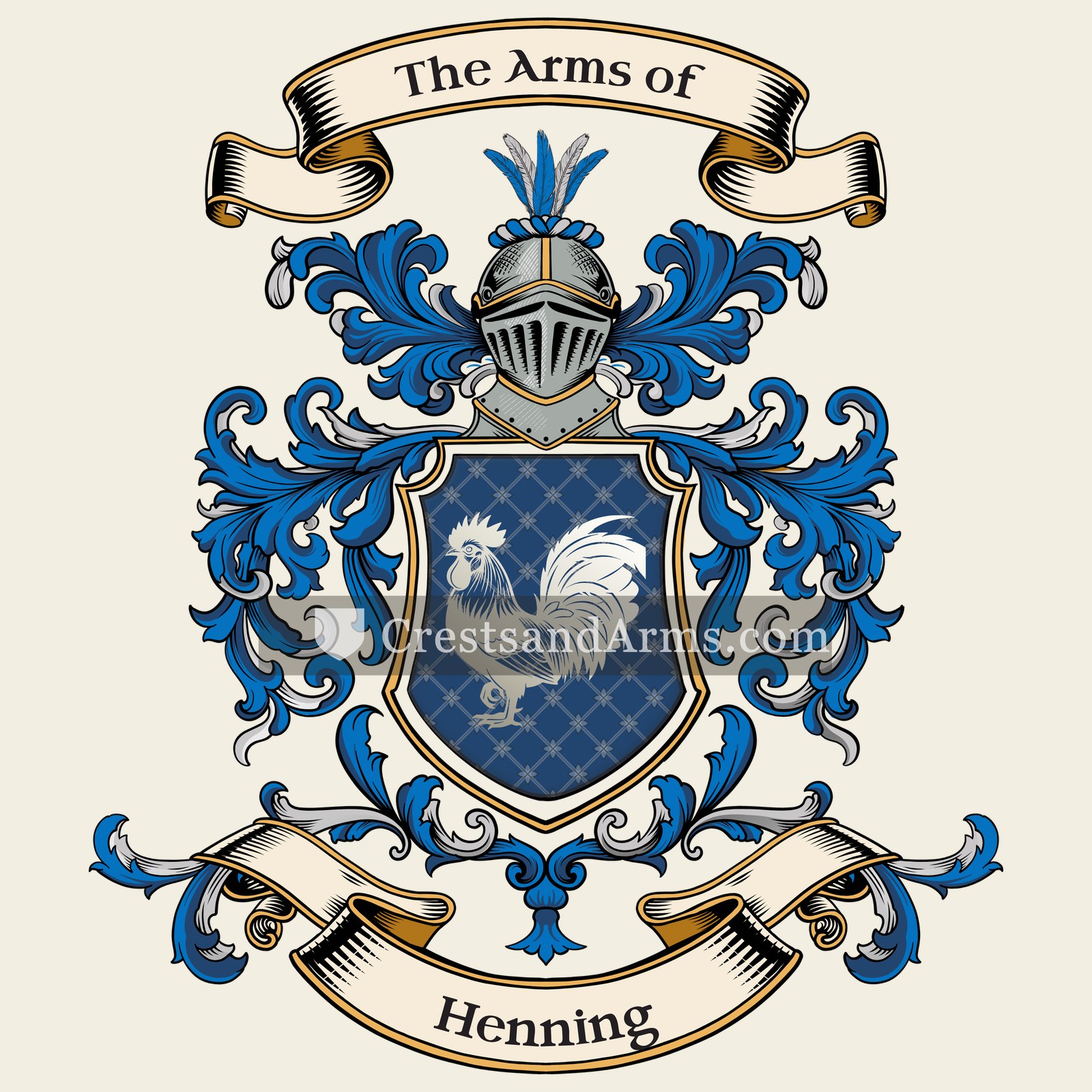


 lionCourage, strength and royalty
 escallopThe pilgrim's shell, and a long journey made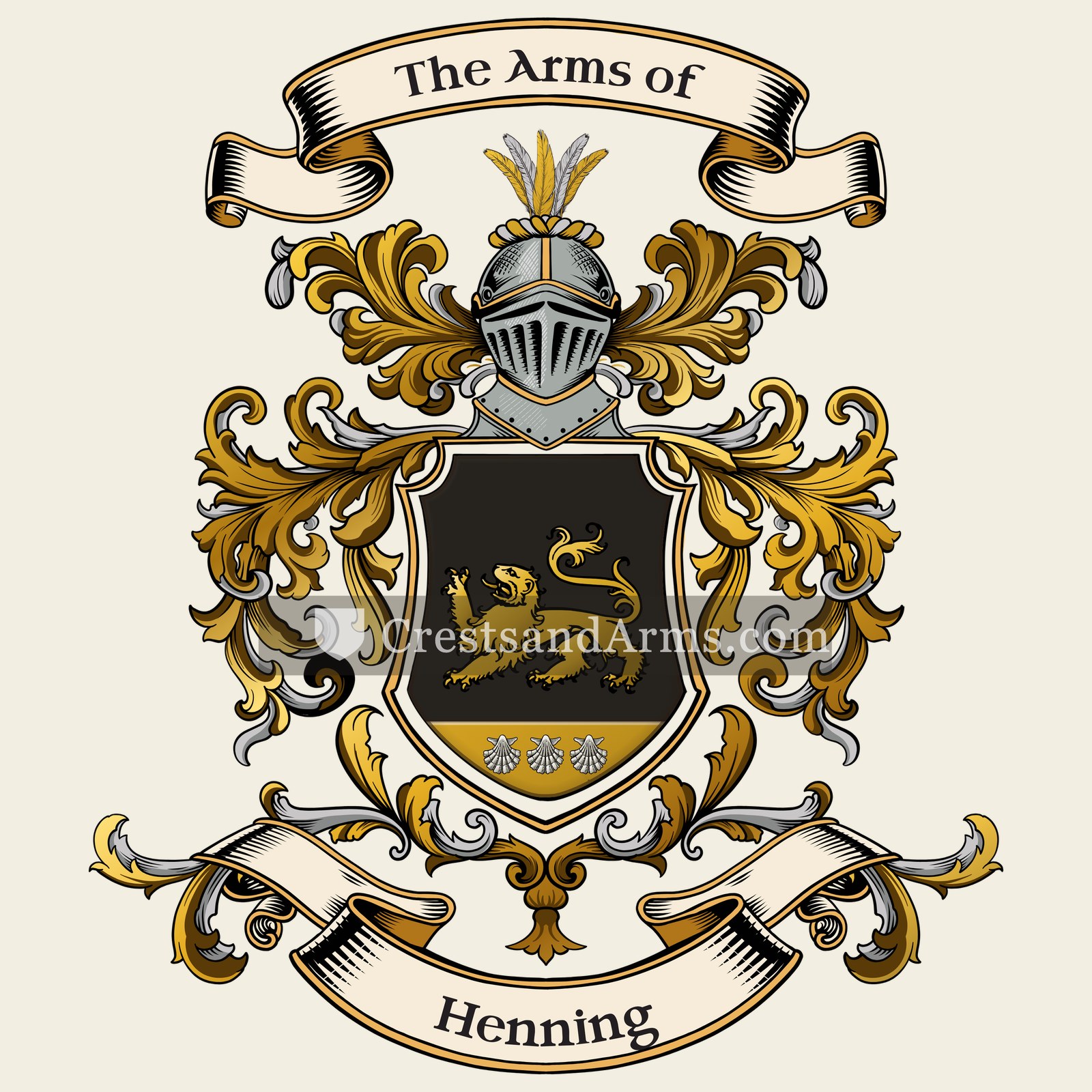


 chiefAuthority, wisdom and dominion
 roundelA coin, and one who has been to the crusades