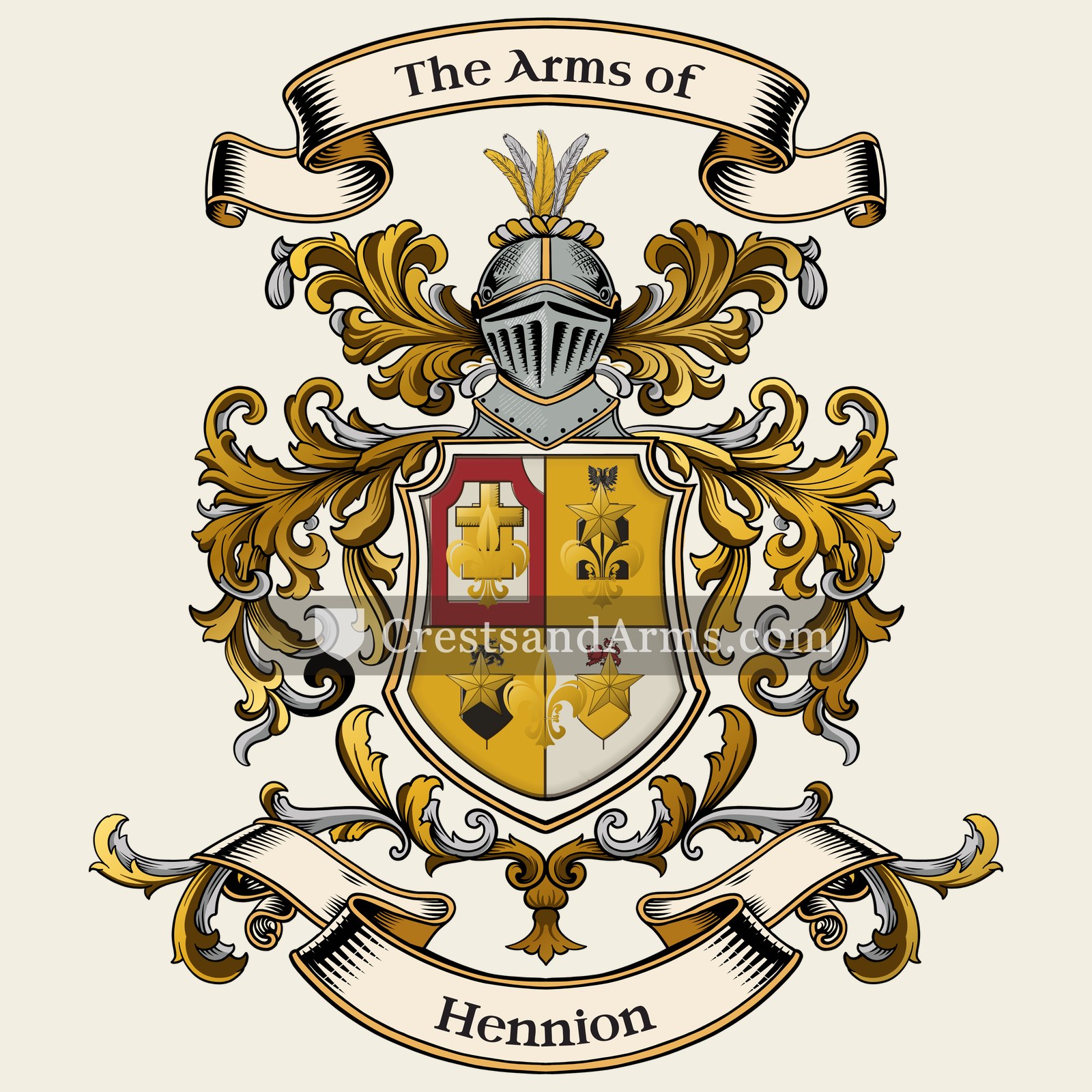
A record of documented arms, meaning and origin, researched for the Hennion family of Spain.
Reg. 3990 · Spanish, G–I
Coat of Arms & Family Crest Details
Symbols on this shield
paleMilitary strength, and a fortified defence
fessThe military belt, and readiness to serve
cross symbolChristian faith and service
fleur de lisPurity, light, and the sixth son
mulletThe third son, and a divine quality from above
towerGrandeur and solidity, and a stronghold defended
eagleNobility, strength and a keen mind
lionCourage, strength and royalty
Colours
Silver (Argent)Means: Peace and sincerity
Gold (Or)Means: Generosity
Red (Gules)Means: Military strength
Black (Sable)Means: Constancy
Historical info
Source
J. B. Rietstap, Armorial Général, Gouda: G. B. van Goor Zonen, 1884–87
Blazon (the actual original written record)
“Ec.: au 1 d'arg. à un château de gu.; à la bord. comp. de gu. et d'or; au 2 d'or à l'aigle ép. de sa., bq. et m. du champ; au 3 d'or au lion de sa.; au 4 d'arg. au lion de gu., arm. et lamp. d'azur. Enté en p. de gu. à un monde d'or. Sur le tout éc.: a. d'or à quatre pals de gu.; b. d'or à la fasce de gu.; c. d'arg. à la croix d'or; d. d'azur à trois fleurs-de-lis d'or. Sur le tout du tout d'azur, à trois étoiles d'or, entourées des mots AVE MARIA GRATIA PLENA, aussi d'or. Trois cq., les 1 et 2 cour. C.: 1º une tête et col de cheval cont., au nat.; l. d'arg. et d'azur; 2º le château de l'écu; l. d'arg. et de gu.; 3º un monde d'or, soutenu d'un coussin de gu.; l. d'arg. et de gu. T.: deux Faunes, arm. de massues, tenant chacun une bannière, celle à dextre d'azur à trois étoiles d'or, celle à sen. de gu. à un monde d'or.”
LiegeLiege, c. 1769
Digital archive packCoat of arms PNG, gold border print PDF, vector SVG and the certificate of authenticity. Sent to your email in minutes.
Map of Spain showing where the Hennion arms are recorded
The Hennion arms were recorded in Liege, c. 1769.
Liege was a prosperous town and its surrounding country, living on metalworking and trade. Merchant families grew rich, bought land outside the walls, and took arms as landowners rather than tradesmen.
This is where the arms were entered in the register. Families often moved to other parts of the country, so the same name can turn up in more than one region.
The body that granted and recorded arms in Spain in this period.
Charles III of Spain
Sovereign of the period
Charles III of Spain
1759–1788
Reigning in Spain when the Hennion arms are first recorded.
How Arms Worked in Spain
In Spain, a coat of arms was considered a form of property that belonged to the entire family line. These arms were passed down from a father to all his children equally. Younger branches of the family usually kept the original design without needing to add any special marks to distinguish their specific line.
Granting authority
The Cronista Rey de Armas was the official body that regulated and granted coats of arms throughout Spain.
How they got arms
Families often obtained their arms through royal grants or by proving their noble status to the official heraldic authority.
Where arms were recorded
Coats of arms were officially recorded in the registers of the Cronista Rey de Armas starting in 1496.
The family's standing
Recorded among the armigerous families of Liege.
Origin & History of the Hennion Family in Spain
The family name Hennion is deeply rooted in the historical landscape of the Prince-Bishopric of Liège, a region that served as a vital crossroads for trade and culture in Western Europe. By the year 1769, records confirm that members of the family were well-established residents within this territory, which was then a sovereign state within the Holy Roman Empire. The name itself likely evolved as a diminutive form of the name Henri, reflecting a common naming tradition where local families adapted personal names to identify their specific lineage. During this era, the people of Liège were known for their industrious spirit and their involvement in the thriving metalworking and coal industries that defined the Meuse River valley. As the family lived through the late eighteenth century, they would have experienced the significant social and political shifts that eventually led to the end of the old feudal order and the rise of the modern Belgian state.
Related Branches & Arms
Root word
Johannes
God is gracious
This name
HennionA patronymic derivative indicating a descendant of someone named Henry or John.
also spelled
Hennion
Henion de las Torres
Documented Sources
J. B. Rietstap, Armorial Général, Gouda: G. B. van Goor Zonen, 1884–87
Archives: Archives de l'État à Liège, Registres paroissiaux de la ville de Liège
Books: Kupper, Jean-Louis, Liège et l'Église impériale, XIe-XIIe siècles, 1981
Books: Pirenne, Henri, Histoire de Belgique, 1900
Digital archive packCoat of arms PNG, gold border print PDF, vector SVG and the certificate of authenticity. Sent to your email in minutes.


 paleMilitary strength, and a fortified defence
 fessThe military belt, and readiness to serve
 cross symbolChristian faith and service
 fleur de lisPurity, light, and the sixth son
 mulletThe third son, and a divine quality from above
 towerGrandeur and solidity, and a stronghold defended
 eagleNobility, strength and a keen mind
 lionCourage, strength and royalty