Map of France showing where the Hermansen arms are recorded
The Hermansen arms were recorded in Flandre, c. 1663.
Flandre grew rich on cloth, and its towns were among the busiest in Europe. Merchant families bought land with their profits and took arms to go with it, so trade put as many names in the registers here as land did.
This is where the arms were entered in the register. Families often moved to other parts of the country, so the same name can turn up in more than one region.
The body that granted and recorded arms in France in this period.
Louis XIV of France
Sovereign of the period
Louis XIV of France
1643–1715
Reigning in France when the Hermansen arms are first recorded.
How Arms Worked in France
In France, a coat of arms was a mark of honor that passed down through the male line to all legitimate descendants. Families often used the same shield without changes to show their shared heritage. If a branch wanted to stand out, they could add a small mark to their shield to show their specific place in the family tree.
Granting authority
The Juge d'armes de France acted as the official authority that regulated and verified coats of arms across the country.
How they got arms
Families typically inherited their arms from ancestors, though they could also receive them through royal grants or by proving their noble status.
Where arms were recorded
Coats of arms were officially recorded in the Armorial Général de France, which began its main collection in the year 1696.
The family's standing
Recorded among the armigerous families of Flandre.
Origin & History of the Hermansen Family in France
The history of the Hermansen name in France is deeply rooted in the cultural landscape of the Flanders region during the seventeenth century. By 1663, records confirm that families bearing this name were already established within the northern territories of France, an area that was then undergoing significant political shifts due to the expansion of the French crown. The name itself reflects a Germanic influence, likely brought into the region through centuries of trade and migration across the borders of the Low Countries. As these families settled in the towns of Flandre, they integrated into the local social fabric, often working as skilled laborers or merchants who helped sustain the regional economy. Their presence in the area during this era suggests that the family was part of a larger movement of people who navigated the complex identity of a borderland that blended French and Flemish traditions. Over time, the Hermansen line became a quiet but persistent thread in the history of the region, reflecting the resilience of families who built their lives in the path of shifting national boundaries.
Coat of Arms & Family Crest Details
Symbols on this shield
saltireResolution, and St Andrew's cross
Colours
Blue (Azure)Means: Loyalty and truth
Gold (Or)Means: Generosity
Historical info
Source
J. B. Rietstap, Armorial Général, Gouda: G. B. van Goor Zonen, 1884–87
Blazon (the actual original written record)
“D'azur au saut. engr. d'or.”
Belgiumc. 1737
Digital archive packCoat of arms PNG, gold border print PDF, vector SVG and the certificate of authenticity. Sent to your email in minutes.
Map of Belgium showing where the Hermansen arms are recorded
The Hermansen arms were recorded in Belgium, c. 1737.
Arms such as these were typically recorded in Brabant.
Brabant lay at the heart of the Low Countries, where the trade routes met. Its towns were wealthy and its landowners many, and both kinds of family kept arms, which is why the region is so heavily represented.
This is where the arms were entered in the register. Families often moved to other parts of the country, so the same name can turn up in more than one region.
The body that granted and recorded arms in Belgium in this period.
Charles VI, Holy Roman Emperor
Sovereign of the period
Charles VI, Holy Roman Emperor
1711–1740
Reigning in France when the Hermansen arms are first recorded.
How Arms Worked in Belgium
In Belgium, a coat of arms is considered personal property that is passed down through the male line to legitimate descendants. Families often use the same shield design across generations to show their shared heritage. If a branch of the family wants to change the design, they must apply for an official update to their specific version of the arms.
Granting authority
The Conseil héraldique is the official body that regulates and approves all coats of arms in Belgium.
How they got arms
Families obtain their coats of arms through formal royal grants or by confirming their historical right to use existing designs.
Where arms were recorded
All approved coats of arms are officially recorded in the public registers of the Conseil héraldique since 1844.
The family's standing
Recorded among the armigerous families of Belgium.
Origin & History of the Hermansen Family in Belgium
The family name Hermansen is a patronymic surname, meaning it was originally formed by combining the given name Herman with the suffix -sen, which translates to "son of." While this naming style is most commonly associated with Scandinavian regions, its appearance in the Duchy of Brabant by 1737 highlights the movement of people across Northern Europe during the eighteenth century. At that time, Brabant was a bustling center of trade and agriculture under the rule of the Austrian Netherlands. Families like the Hermansens often settled in these regions to work in specialized crafts or local administration. By establishing themselves in this specific territory, the early members of the family became part of a diverse social landscape that bridged the gap between Germanic naming traditions and the local customs of the Low Countries. Their presence in the historical records of Brabant serves as a testament to the migration patterns that shaped the population of modern-day Belgium.
Coat of Arms & Family Crest Details
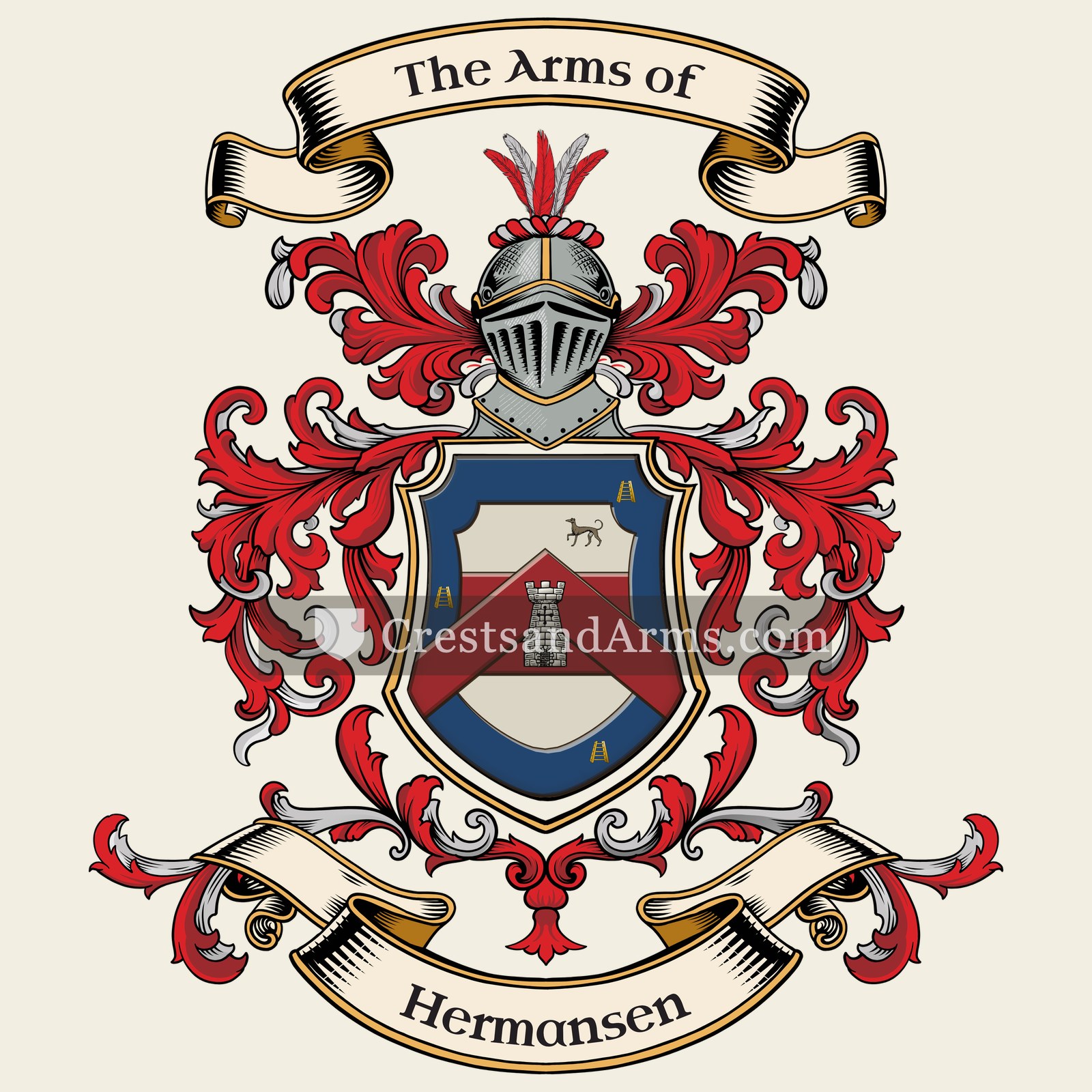
Symbols on this shield
fessThe military belt, and readiness to serve
chevronProtection, and faithful service completed
towerGrandeur and solidity, and a stronghold defended
greyhoundCourage, vigilance and loyalty
ladderAmbition, and a fearless assault
Colours
Silver (Argent)Means: Peace and sincerity
Red (Gules)Means: Military strength
Blue (Azure)Means: Loyalty and truth
Gold (Or)Means: Generosity
Historical info
Source
J. B. Rietstap, Armorial Général, Gouda: G. B. van Goor Zonen, 1884–87
Blazon (the actual original written record)
“D'arg. à la fasce de gu., supp. une tour du même et acc. en p. d'un lévrier pass. au nat., soutenu d'un fascé-ondé d'azur et d'arg. de six pièces; à la bord. d'azur, ch. de trois chevrons alésés d'arg., 1 en chef et 2 en flancs, et de trois échelles d'or, 2 dans les angles du chef, en barre et en bande, et 1 en p., posée en fasce.”
AndalusiaAndalusia, c. 1722
Digital archive packCoat of arms PNG, gold border print PDF, vector SVG and the certificate of authenticity. Sent to your email in minutes.
Map of Spain showing where the Hermansen arms are recorded
The Hermansen arms were recorded in Andalusia, c. 1722.
Andalusia was the last part of Spain taken back from the Moors, and the land was shared out among the men who took it. A grant of land came with a grant of arms, so the region produced a great many.
This is where the arms were entered in the register. Families often moved to other parts of the country, so the same name can turn up in more than one region.
The body that granted and recorded arms in Spain in this period.
Philip V of Spain
Sovereign of the period
Philip V of Spain
1714–1724
Reigning in France when the Hermansen arms are first recorded.
How Arms Worked in Spain
In Spain, a coat of arms was considered a form of property that belonged to the entire family line. These arms were passed down from a father to all his children equally. Younger branches of the family usually kept the original design without needing to add any special marks to distinguish their specific line.
Granting authority
The Cronista Rey de Armas was the official body that regulated and granted coats of arms throughout Spain.
How they got arms
Families often obtained their arms through royal grants or by proving their noble status to the official heraldic authority.
Where arms were recorded
Coats of arms were officially recorded in the registers of the Cronista Rey de Armas starting in 1496.
The family's standing
Recorded among the armigerous families of Andalusia.
Origin & History of the Hermansen Family in Spain
The history of the Hermansen name in Spain is a fascinating study of migration and cultural integration during the early eighteenth century. While the name is of Scandinavian origin, records confirm that members of the family were established in the Andalusia region by 1722. During this period, southern Spain served as a vital hub for international trade, attracting merchants and skilled laborers from across Northern Europe who sought new opportunities in Mediterranean markets. The Hermansen family likely arrived in cities like Cádiz or Seville to participate in the lucrative colonial trade routes connecting Spain to the Americas. By settling in Andalusia, these early family members had to adapt to a new language and social structure while maintaining their distinct identity. Their presence in the region highlights how families from the north integrated into the diverse fabric of Spanish society during the Enlightenment era.
Related Branches & Arms
Root word
Herman
Derived from Germanic elements meaning army and man.
This name
HermansenPatronymic surname indicating descent from a man named Herman.
also spelled
Hermanss
Documented Sources
J. B. Rietstap, Armorial Général, Gouda: G. B. van Goor Zonen, 1884–87
Archives départementales du Nord, Série B: Cours et juridictions
Archives départementales du Pas-de-Calais, Série E: Familles et seigneuries
Lottin, Alain, Histoire des provinces françaises du Nord, 1989
Pirenne, Henri, Histoire de Belgique, 1900
Digital archive packCoat of arms PNG, gold border print PDF, vector SVG and the certificate of authenticity. Sent to your email in minutes.




 saltireResolution, and St Andrew's cross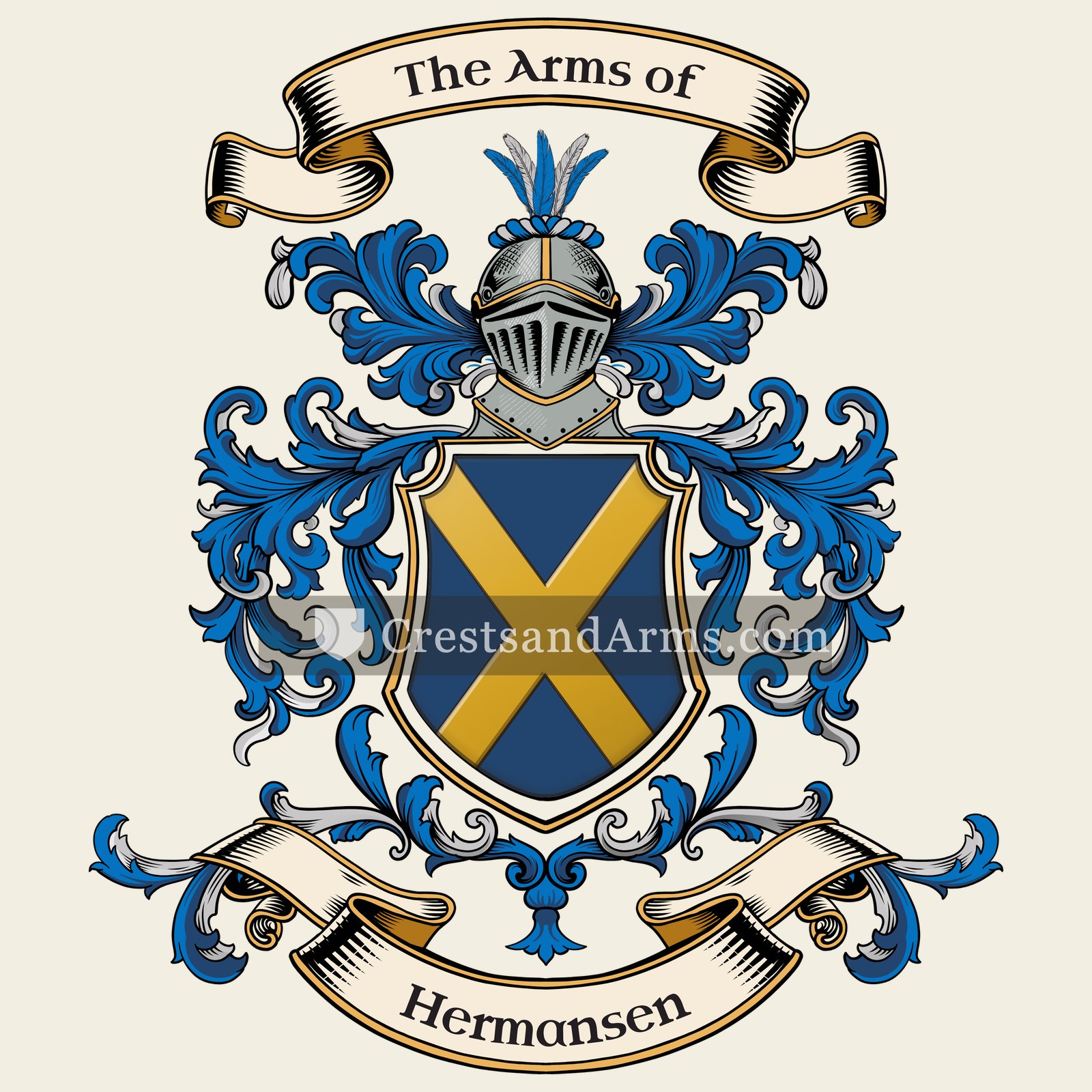


 fessThe military belt, and readiness to serve
 chevronProtection, and faithful service completed
 towerGrandeur and solidity, and a stronghold defended
 greyhoundCourage, vigilance and loyalty
 ladderAmbition, and a fearless assault