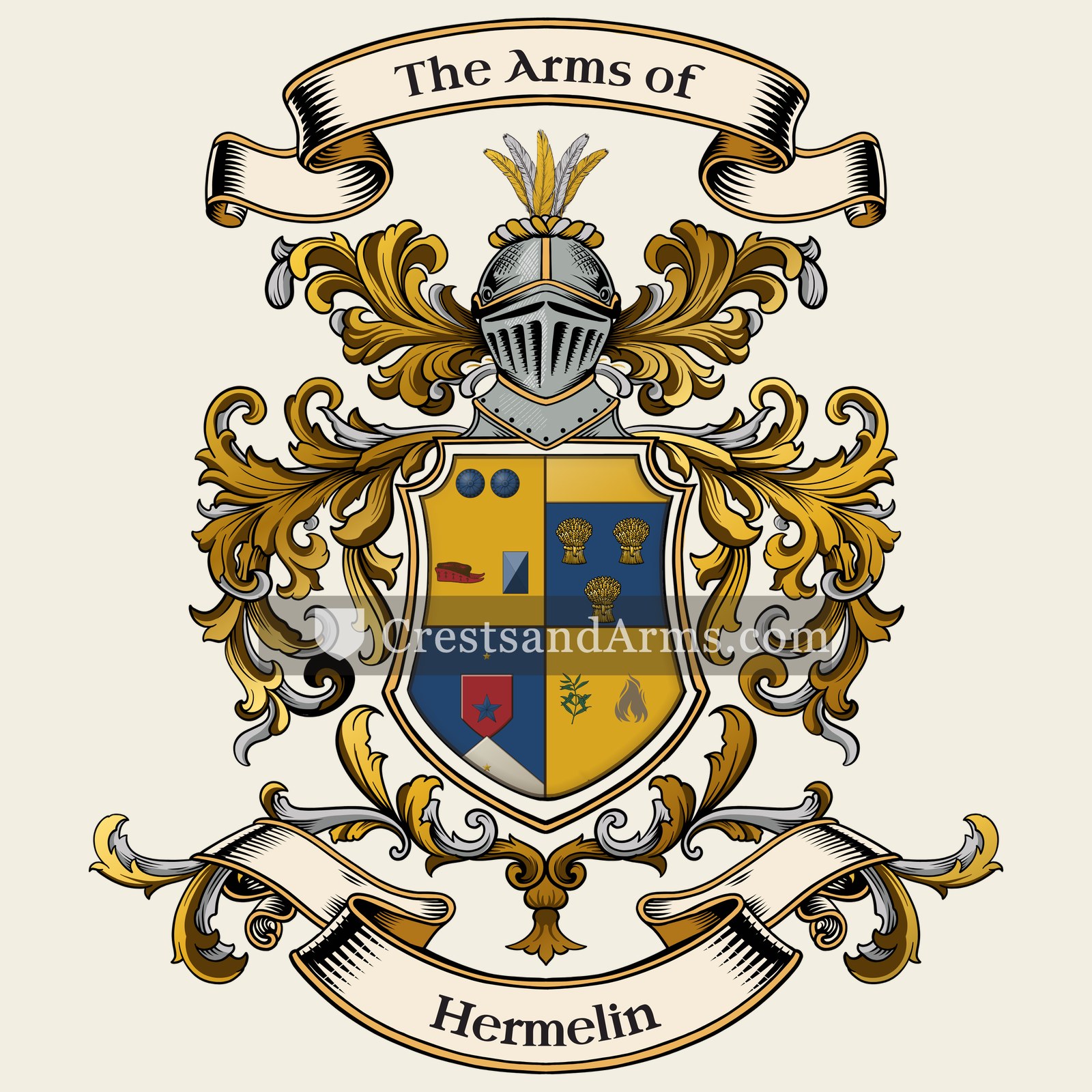
A record of documented arms, meaning and origin, researched for the Hermelin family of Sweden.
Reg. 6793 · Swedish, G–I
Coat of Arms & Family Crest Details
Symbols on this shield
chiefAuthority, wisdom and dominion
saltireResolution, and St Andrew's cross
hat or capDignity, and the honour of office
roundelA coin, and one who has been to the crusades
billetThe sealed letter, and a message delivered
wheatsheafPlenty, and the harvest of one's own labour
mulletThe third son, and a divine quality from above
branchPeace, and new growth
fireZeal and purification
Colours
Gold (Or)Means: Generosity
Blue (Azure)Means: Loyalty and truth
Red (Gules)Means: Military strength
Silver (Argent)Means: Peace and sincerity
Green (Vert)Means: Hope
Historical info
Source
J. B. Rietstap, Armorial Général, Gouda: G. B. van Goor Zonen, 1884–87
Blazon (the actual original written record)
“Ec.: au 1 d'or à un chapeau de gu., le bord d'arg., en chef, deux tourt. d'azur en fasce, et une billette d'azur en p.; au 2 d'a-zur à trois épis feuillés d'or, mouv. d'une même tige, et au chef d'or; au 3 d'azur à une pointe d'arg., ch. d'une étoile de gu. et accostée en chef de deux étoiles d'or; au 4 d'arg. à une branche de laurier de sin., posée en bande, et une torche allumée au nat., posée en barre, passées en saut. Sur le tout d'azur à une hermine ramp. d'arg. et un chef d'herm. Deux cq. cour. C.: 1º une hermine ramp. d'arg.; entre un vol, coupé alt. d'or et d'azur; 2º une grue d'arg., tenant de sa patte dextre levée trois épis d'or; entre deux pl. d'aut., coupées alt. d'or et de gu. S.: à dextre une aigle reg. au nat., à sen. un cerf reg. au nat.”
Swedenc. 1766
Digital archive packCoat of arms PNG, gold border print PDF, vector SVG and the certificate of authenticity. Sent to your email in minutes.
Map of Sweden showing where the Hermelin arms are recorded
The Hermelin arms were recorded in Sweden, c. 1766.
Arms such as these were typically recorded in Stockholm.
Stockholm held the Swedish court and the House of Nobility, where every noble family's arms were entered and kept. Families ennobled for service registered there, which is why so many are recorded around the city.
This is where the arms were entered in the register. Families often moved to other parts of the country, so the same name can turn up in more than one region.
The body that granted and recorded arms in Sweden in this period.
Adolf Fredrik of Sweden
Sovereign of the period
Adolf Fredrik of Sweden
1751–1771
Reigning in Sweden when the Hermelin arms are first recorded.
How Arms Worked in Sweden
In Sweden, a coat of arms belonged to a noble family as a whole rather than just one individual. These arms were passed down through the generations to all legitimate descendants. Younger branches of the family used the same shield without needing to change it. This system ensured that the entire lineage shared the same identity and status under the law.
Granting authority
The Riddarhuset, or House of Nobility, regulated all noble coats of arms in Sweden under royal authority.
How they got arms
Families received their coats of arms through royal grants of nobility which were then officially registered with the House.
Where arms were recorded
Coats of arms were officially recorded in the Swedish House of Nobility register starting in the year 1626.
The family's standing
Recorded among the armigerous families of Sweden.
Origin & History of the Hermelin Family in Sweden
The Hermelin family name is deeply rooted in the history of the Swedish nobility, with records confirming their prominent presence in Stockholm by 1766. The family originally rose to significance through their contributions to Swedish administration, mining, and scientific exploration during the eighteenth century. Members of the family were known for their intellectual curiosity and their active roles in the development of Swedish industry. They often held positions of influence that allowed them to shape the cultural and economic landscape of the capital city. By the mid-1700s, the name had become synonymous with a dedication to public service and the advancement of knowledge. This legacy of leadership helped the family maintain a respected status in Swedish society for many generations.
Related Branches & Arms
Root word
Hermelin
Derived from the Germanic word for the stoat or ermine animal.
This name
HermelinRefers to the ermine, a small weasel known for its white winter fur, symbolizing purity or nobility.
also spelled
Hermeline
Documented Sources
J. B. Rietstap, Armorial Général, Gouda: G. B. van Goor Zonen, 1884–87
Anrep, Gabriel, Svenska adelns ättar-taflor, 1860
Elgenstierna, Gustaf, Den introducerade svenska adelns ättartavlor, 1925
Riksarkivet (National Archives of Sweden), Adelsbrev, Riksregistraturet
Digital archive packCoat of arms PNG, gold border print PDF, vector SVG and the certificate of authenticity. Sent to your email in minutes.


 chiefAuthority, wisdom and dominion
 saltireResolution, and St Andrew's cross
 hat or capDignity, and the honour of office
 roundelA coin, and one who has been to the crusades
 billetThe sealed letter, and a message delivered
 wheatsheafPlenty, and the harvest of one's own labour
 mulletThe third son, and a divine quality from above
 branchPeace, and new growth
 fireZeal and purification