Map of France showing where the Heron arms are recorded
The Heron arms were recorded in Paris, c. 1663.
This is where the arms were entered in the register. Families often moved to other parts of the country, so the same name can turn up in more than one region.
The body that granted and recorded arms in France in this period.
Louis XIV of France
Sovereign of the period
Louis XIV of France
1643–1715
Reigning in France when the Heron arms are first recorded.
How Arms Worked in France
In France, a coat of arms was a mark of honor that passed down through the male line to all legitimate descendants. Families often used the same shield without changes to show their shared heritage. If a branch wanted to stand out, they could add a small mark to their shield to show their specific place in the family tree.
Granting authority
The Juge d'armes de France acted as the official authority that regulated and verified coats of arms across the country.
How they got arms
Families typically inherited their arms from ancestors, though they could also receive them through royal grants or by proving their noble status.
Where arms were recorded
Coats of arms were officially recorded in the Armorial Général de France, which began its main collection in the year 1696.
The family's standing
Recorded among the armigerous families of France.
Origin & History of the Heron Family in France
The history of the Heron family in France is deeply rooted in the social fabric of the seventeenth century, particularly within the bustling environment of Paris. By 1663, records confirm that members of the family were established residents of the capital, likely participating in the professional and administrative life of a city undergoing rapid expansion under the reign of Louis XIV. The name itself is thought to have evolved from a descriptive nickname, perhaps reflecting the observant or graceful nature of an early ancestor, which was a common practice for naming families during the Middle Ages. As the family integrated into Parisian society, they likely navigated the complex hierarchies of the era, moving through the guilds or legal circles that defined the city’s middle class. Their presence in the heart of France during this period suggests a family that was well-connected to the urban developments and cultural shifts that characterized the French Golden Age.
Coat of Arms & Family Crest Details
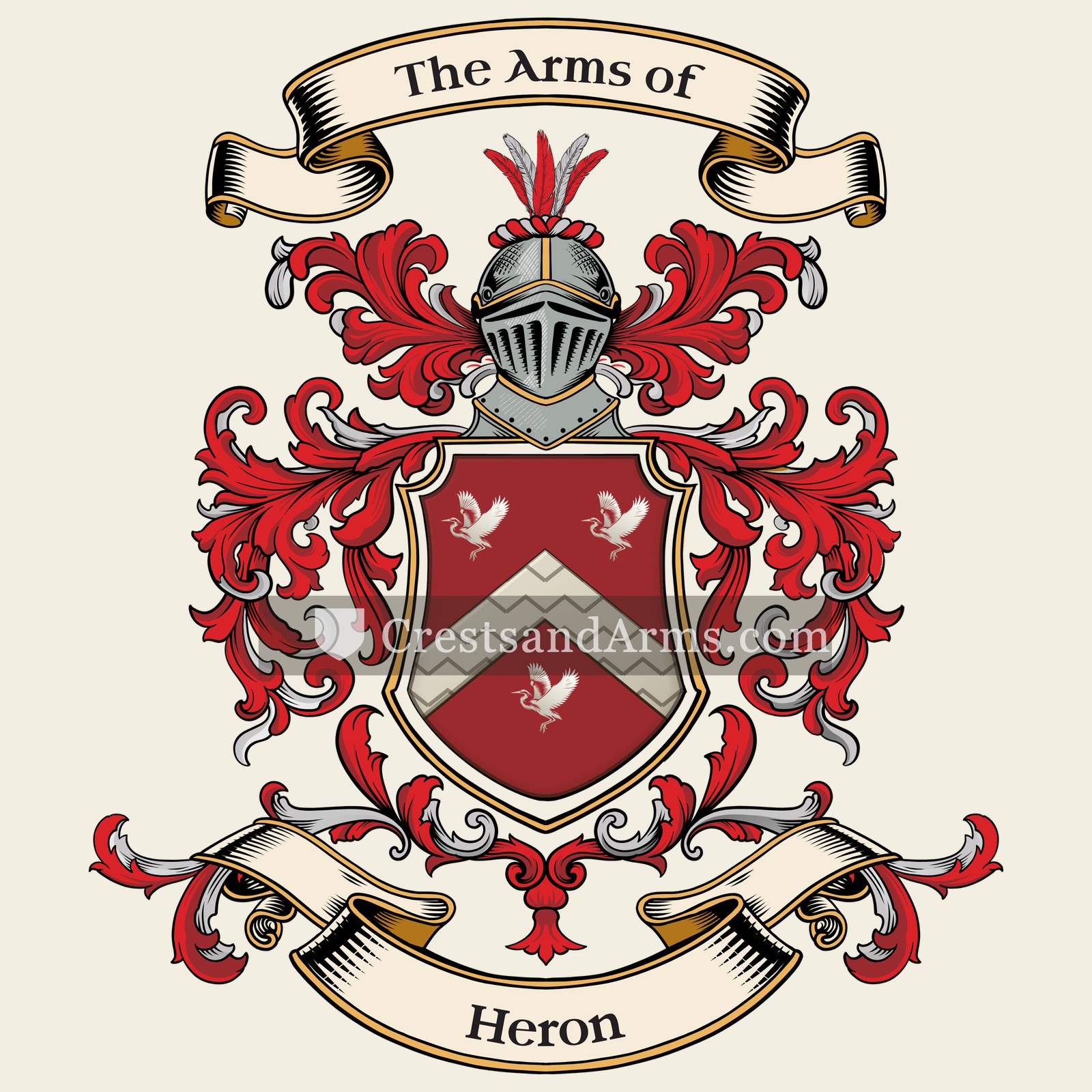
Symbols on this shield
chevronProtection, and faithful service completed
heronPatience and quiet watchfulness
Colours
Red (Gules)Means: Military strength
Silver (Argent)Means: Peace and sincerity
Historical info
Source
J. B. Rietstap, Armorial Général, Gouda: G. B. van Goor Zonen, 1884–87
Blazon (the actual original written record)
“De gu. au chev. d'arg., acc. de trois hérons du même.”
Britainc. 1700
Digital archive packCoat of arms PNG, gold border print PDF, vector SVG and the certificate of authenticity. Sent to your email in minutes.
Map of Britain showing where the Heron arms are recorded
The Heron arms were recorded in Britain, c. 1700.
Arms such as these were typically recorded in Kent.
Kent sits between London and the short crossing to Europe, and the trade passing through made it wealthy. Merchant families bought land with that money, and it was landowners who took coats of arms.
This is where the arms were entered in the register. Families often moved to other parts of the country, so the same name can turn up in more than one region.
The body that granted and recorded arms in Britain in this period.
William III of England
Sovereign of the period
William III of England
1694–1702
Reigning in France when the Heron arms are first recorded.
How Arms Worked in Britain
English heraldry allowed arms to be shared by all legitimate descendants of the original owner. These symbols were treated as personal property that moved through the generations to all children. While the eldest son kept the original design, other family members could use the same shield without needing to change it or register their own unique versions.
Granting authority
The College of Arms in London has regulated the use of coats of arms throughout England and Wales since 1484.
How they got arms
Families typically obtained their coats of arms through a formal grant from the Crown or by proving their ancient right to them.
Where arms were recorded
All official coats of arms are recorded in the registers kept at the College of Arms, which date back to the fifteenth century.
The family's standing
Recorded among the armigerous families of Britain.
Origin & History of the Heron Family in Britain
The surname Heron has deep roots in the British landscape, emerging as a descriptive name long before it became a fixed family identifier. In its earliest form, the name was often linked to the Old English word for the long-legged water bird, suggesting that early ancestors may have been nicknamed for their physical stature or their association with marshy environments. By the time the family established a clear presence in Kent during the early 1700s, the name had already transitioned from a simple nickname into a stable hereditary surname. During this period, families in Kent were often tied to the local agricultural economy, and the Herons likely lived as part of the growing rural population that defined the county’s social structure. As the eighteenth century progressed, the family name became firmly woven into the local parish records, reflecting the broader movement of families who settled into specific regions to build long-term lives and livelihoods.
Coat of Arms & Family Crest Details
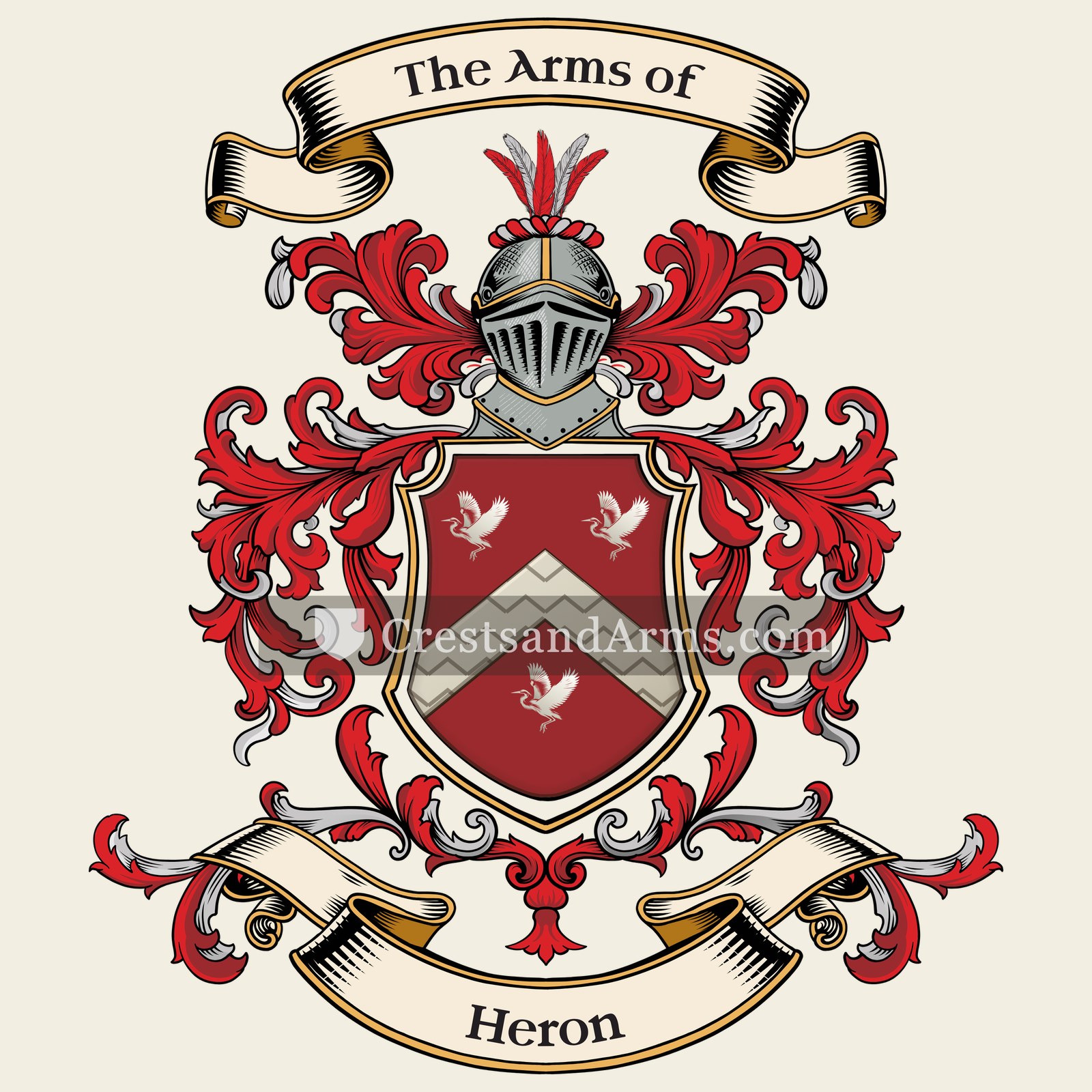
Symbols on this shield
chevronProtection, and faithful service completed
heronPatience and quiet watchfulness
Colours
Red (Gules)Means: Military strength
Silver (Argent)Means: Peace and sincerity
Historical info
Source
Sir Bernard Burke, The General Armory of England, Scotland, Ireland and Wales, London: Harrison & Sons, 1884
Blazon (the actual original written record)
“Gu. a chev. betw. three herons ar”
Englandc. 1371
Digital archive packCoat of arms PNG, gold border print PDF, vector SVG and the certificate of authenticity. Sent to your email in minutes.
Map of England showing where the Heron arms are recorded
The Heron arms were recorded in England, c. 1371.
Arms such as these were typically recorded in York.
Yorkshire is the largest of the English counties, and it held more gentry families than any other. Land there was split among a great many households rather than a few, so a great many of them carried arms.
This is where the arms were entered in the register. Families often moved to other parts of the country, so the same name can turn up in more than one region.
The body that granted and recorded arms in England in this period.
Edward III of England
Sovereign of the period
Edward III of England
1327–1377
Reigning in France when the Heron arms are first recorded.
How Arms Worked in England
English heraldry allowed arms to be shared by all legitimate descendants of the original owner. These symbols were treated as personal property that moved through the generations to all children. While the eldest son kept the original design, other family members could use the same shield without needing to change it or register their own unique versions.
Granting authority
The College of Arms in London has regulated the use of coats of arms throughout England and Wales since 1484.
How they got arms
Families typically obtained their coats of arms through a formal grant from the Crown or by proving their ancient right to them.
Where arms were recorded
All official coats of arms are recorded in the registers kept at the College of Arms, which date back to the fifteenth century.
The family's standing
Recorded among the armigerous families of England.
Origin & History of the Heron Family in England
The name Heron has deep roots in the northern regions of England, where it emerged as a distinct surname during the Middle Ages. By the year 1371, records confirm that members of the family were already established in the city of York, serving as a sign of the name's early influence in that area. The name itself is thought to be a nickname, likely given to someone who possessed a long neck or a tall, slender build similar to the wading bird. During this period, surnames were often adopted to help distinguish individuals in growing towns, and the Heron family became part of the social fabric of northern English life. As the family grew, they moved across the border regions and into various professional roles, helping to cement the name in local history long before modern record-keeping began.
Heron Meaning & Related Branches
Root word
Haron
Old Germanic name meaning warrior or army.
This name
HeronA nickname derived from the bird, often referring to a tall, thin person.
also spelled
Heronne
Herne
Hearon
Related arms
Hearnevariant spelling
Hearonvariant spelling
Hernevariant spelling
Bowdenrecorded with Heron, same area
Documented Sources
J. B. Rietstap, Armorial Général, Gouda: G. B. van Goor Zonen, 1884–87
Archives Nationales de France, Minutier central des notaires de Paris, Series MC/ET/LXXIII
Boutier, Jean, Les plans de Paris des origines à 1789, 2002
Favier, Jean, Paris au XVe siècle, 1974
Digital archive packCoat of arms PNG, gold border print PDF, vector SVG and the certificate of authenticity. Sent to your email in minutes.


 heronPatience and quiet watchfulness
 heronPatience and quiet watchfulness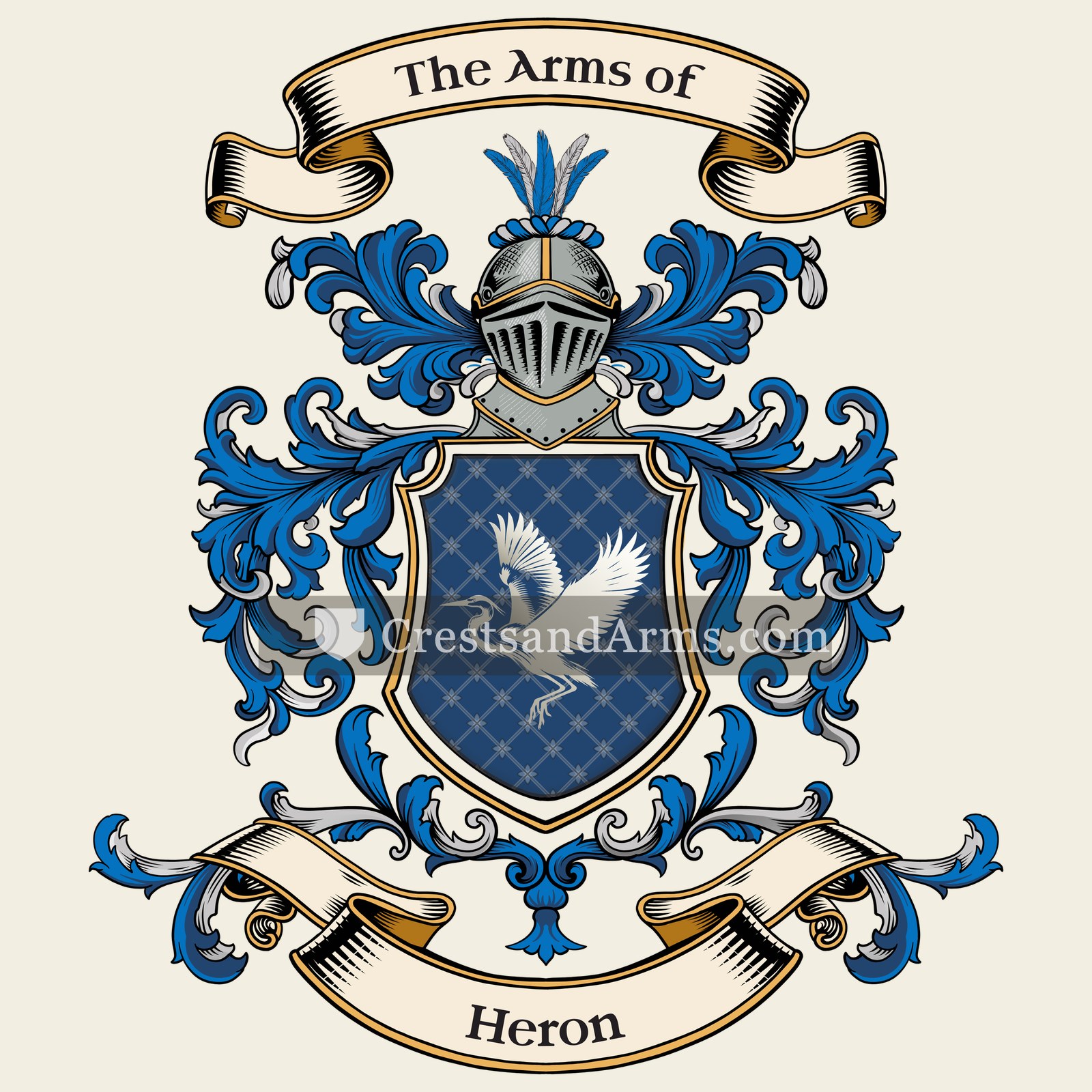


 chevronProtection, and faithful service completed