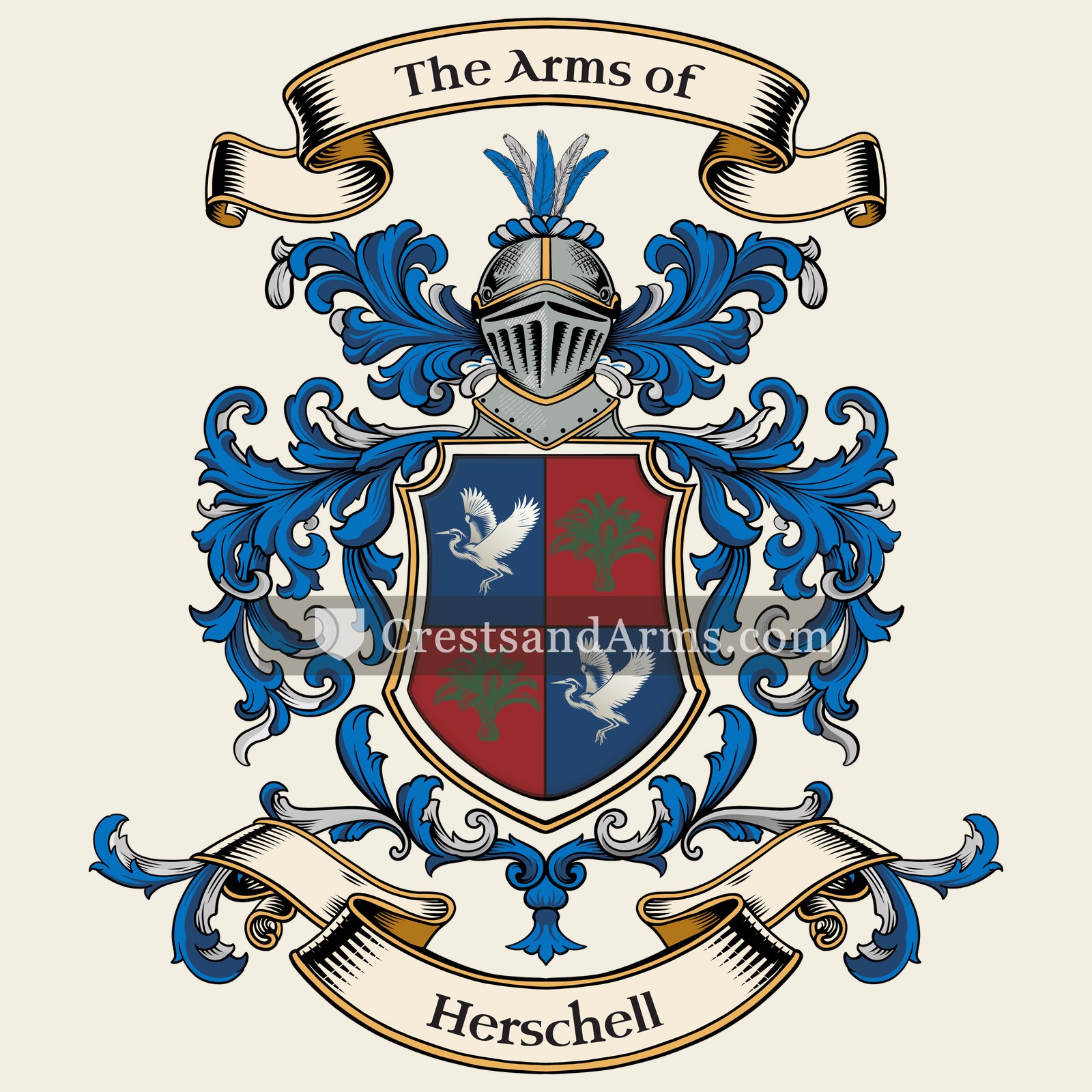
A record of documented arms, meaning and origin, researched for the Herschell family of Germany.
Reg. 2470 · German, G–I
Coat of Arms & Family Crest Details
Symbols on this shield
heronPatience and quiet watchfulness
palm treeVictory, and righteousness that flourishes
Colours
Blue (Azure)Means: Loyalty and truth
Red (Gules)Means: Military strength
Silver (Argent)Means: Peace and sincerity
Green (Vert)Means: Hope
Historical info
Source
J. B. Rietstap, Armorial Général, Gouda: G. B. van Goor Zonen, 1884–87
Blazon (the actual original written record)
“Ec.: aux 1 et 4 d'azur à une grue avec sa vigilance, d'arg.; aux 2 et 3 de gu. à un palmier de sin. C.: la grue; entre un vol, d'azur et de gu. L. d'azur et de gu.”
GermanyDresde, c. 1765
Digital archive packCoat of arms PNG, gold border print PDF, vector SVG and the certificate of authenticity. Sent to your email in minutes.
Map of Germany showing where the Herschell arms are recorded
The Herschell arms were recorded in Dresde, c. 1765.
This is where the arms were entered in the register. Families often moved to other parts of the country, so the same name can turn up in more than one region.
The body that granted and recorded arms in Germany in this period.
Francis I, Holy Roman Emperor
Sovereign of the period
Francis I, Holy Roman Emperor
1745–1765
Reigning in Germany when the Herschell arms are first recorded.
How Arms Worked in Germany
In the Holy Roman Empire, coats of arms were often granted to individuals by the Emperor or his representatives. These arms were then passed down through the generations to all legitimate descendants of the original holder. Younger branches of a family usually kept the same shield design without needing to change it, as the arms belonged to the entire lineage.
Granting authority
The Holy Roman Emperor held the sole power to grant new coats of arms throughout his vast imperial territories.
How they got arms
Families typically obtained their coats of arms through a formal imperial grant or by proving their noble status to the authorities.
Where arms were recorded
These grants were officially recorded in the Imperial Chancery registers, which began keeping formal records of such honors during the Middle Ages.
The family's standing
Recorded among the armigerous families of Germany.
Origin & History of the Herschell Family in Germany
The family name Herschell is rooted in the German-speaking regions of Central Europe, where it evolved as a variation of the name Hirsch. This name is derived from the German word for deer, which was often used as a descriptive nickname or a symbolic reference in Jewish naming traditions. By 1765, records confirm that members of the family were well-established in the city of Dresden. During this period, Dresden served as a major cultural and intellectual hub under the rule of the Electors of Saxony. Living in such a prominent city suggests that early family members were likely integrated into the active trade and professional life of the region. As the family grew, the name spread across borders, eventually becoming associated with notable figures in science and music who carried the Herschell name into international history.
Related Branches & Arms
Root word
Hirsch
A male deer or stag.
This name
HerschellA diminutive form referring to a small deer, often used as a Jewish occupational or ornamental surname.
also spelled
Herschel
Herschell
Herrschl
Herrshel
Documented Sources
J. B. Rietstap, Armorial Général, Gouda: G. B. van Goor Zonen, 1884–87
Bahlow, Hans, Deutsches Namenlexikon: Familien- und Vornamen nach Ursprung und Sinn erklärt, 1967
Lübke, Christian, Das östliche Europa: Geschichte einer europäischen Region, 2004
Sächsisches Staatsarchiv, Bestand 10024 (Geheimer Rat)
Stadtarchiv Dresden, Bestand 2.1.3 (Bürger- und Einwohnerverzeichnisse)
Digital archive packCoat of arms PNG, gold border print PDF, vector SVG and the certificate of authenticity. Sent to your email in minutes.


 heronPatience and quiet watchfulness
 palm treeVictory, and righteousness that flourishes
 heronPatience and quiet watchfulness
 palm treeVictory, and righteousness that flourishes