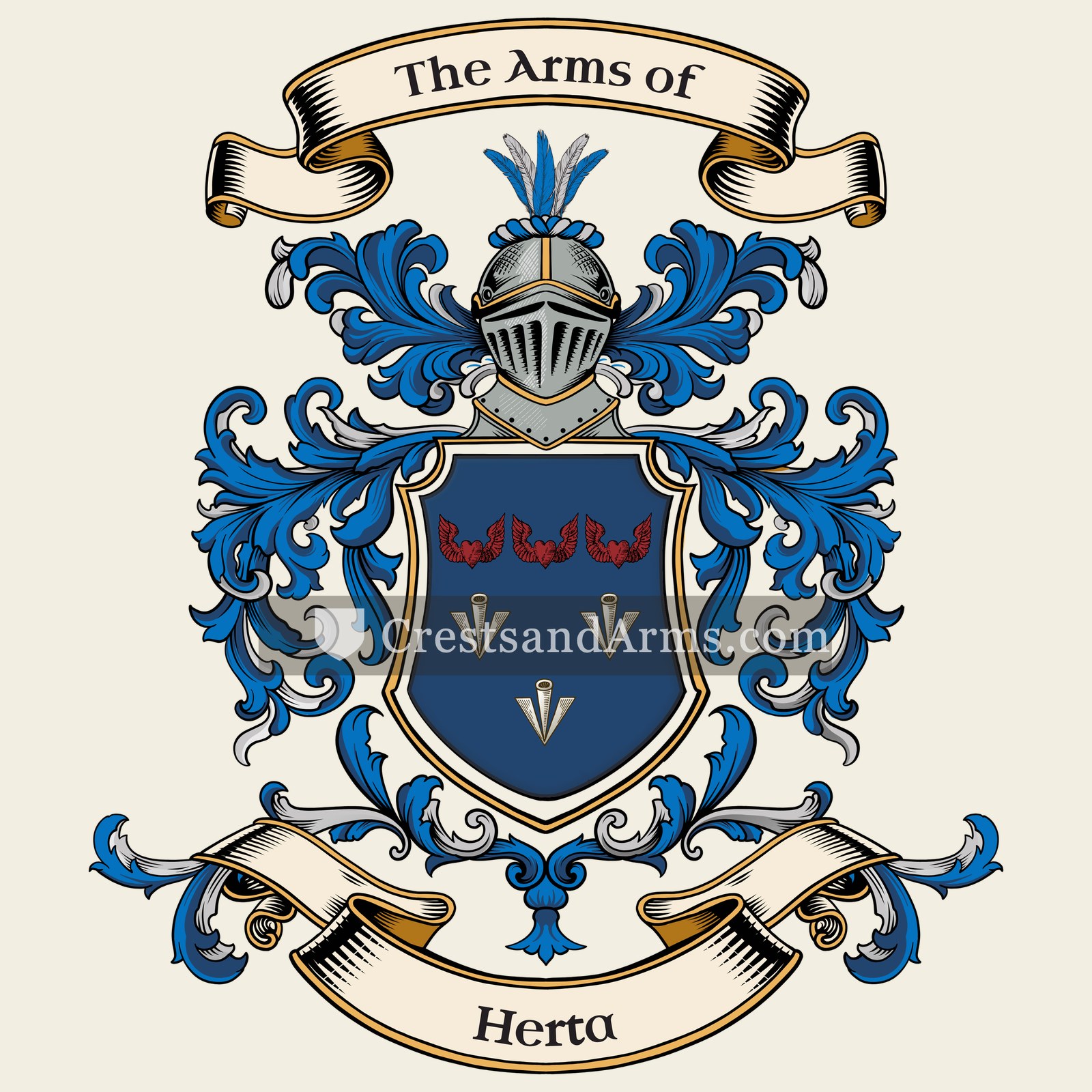
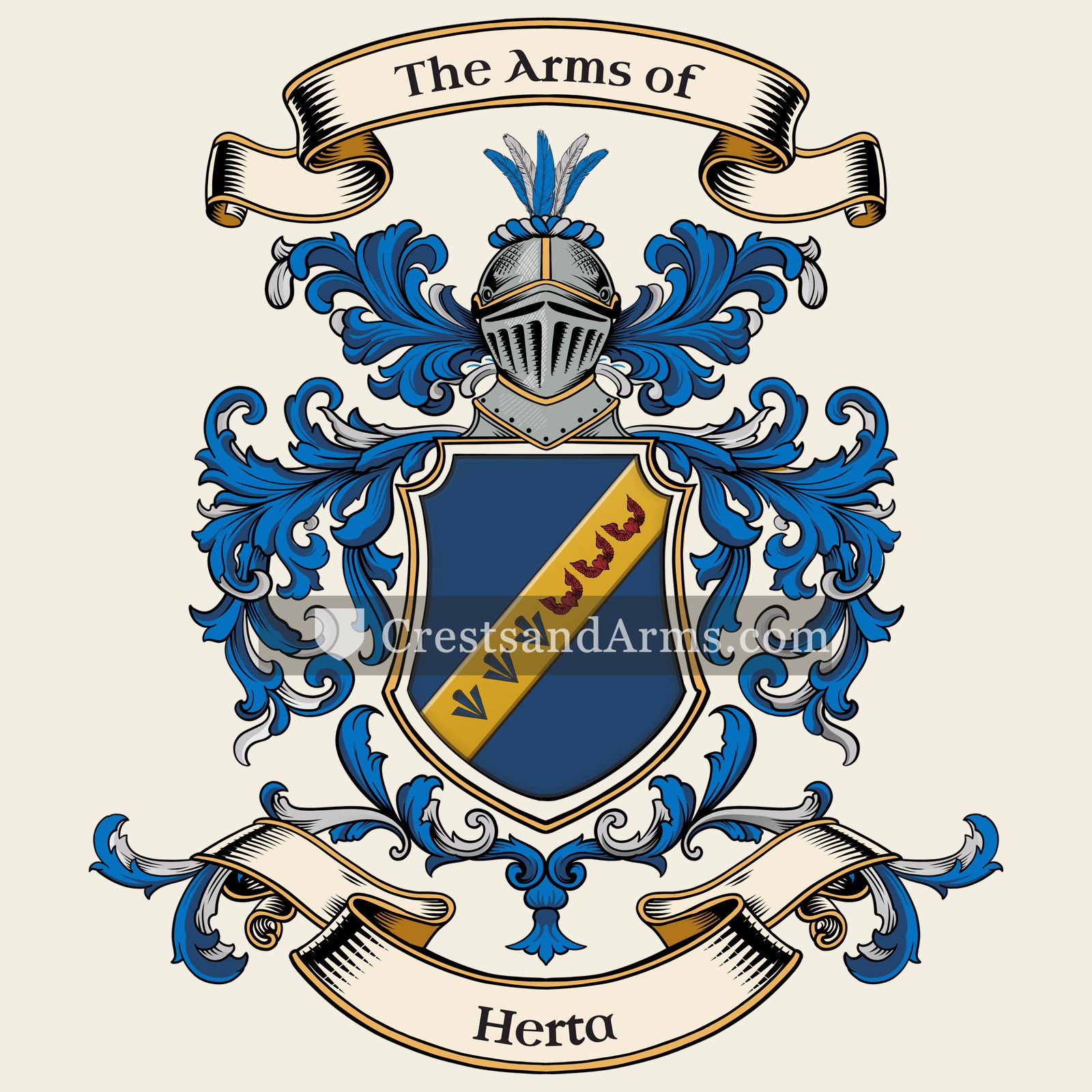
A record of documented arms, meaning and origin, researched for the Herta family lines. Documented in 2 countries.
Reg. 2467 · Swedish, G–I
Coat of Arms & Family Crest Details
Symbols on this shield
heartSincerity, charity and true affection
arrowReadiness for battle, and affliction endured
Colours
Blue (Azure)Means: Loyalty and truth
Red (Gules)Means: Military strength
Silver (Argent)Means: Peace and sincerity
Historical info
Source
J. B. Rietstap, Armorial Général, Gouda: G. B. van Goor Zonen, 1884–87
Blazon (the actual original written record)
“D'azur à trois coeurs de gu., posés chacun en bande, rangés en barre, percés d'une flèche d'arg. en barre, la pointe en bas. C.: trois flèches accostées d'arg., les pointes en bas. L.: à dextre d'or et de gu., à sen. d'or et d'azur.”
Swedenc. 1700
Digital archive packCoat of arms PNG, gold border print PDF, vector SVG and the certificate of authenticity. Sent to your email in minutes.
Map of Sweden showing where the Herta arms are recorded
The Herta arms were recorded in Sweden, c. 1700.
Arms such as these were typically recorded in Stockholm.
Stockholm held the Swedish court and the House of Nobility, where every noble family's arms were entered and kept. Families ennobled for service registered there, which is why so many are recorded around the city.
This is where the arms were entered in the register. Families often moved to other parts of the country, so the same name can turn up in more than one region.
The body that granted and recorded arms in Sweden in this period.
Carl XII of Sweden
Sovereign of the period
Carl XII of Sweden
1697–1718
Reigning in Sweden when the Herta arms are first recorded.
How Arms Worked in Sweden
In Sweden, a coat of arms belonged to a noble family as a whole rather than just one individual. These arms were passed down through the generations to all legitimate descendants. Younger branches of the family used the same shield without needing to change it. This system ensured that the entire lineage shared the same identity and status under the law.
Granting authority
The Riddarhuset, or House of Nobility, regulated all noble coats of arms in Sweden under royal authority.
How they got arms
Families received their coats of arms through royal grants of nobility which were then officially registered with the House.
Where arms were recorded
Coats of arms were officially recorded in the Swedish House of Nobility register starting in the year 1626.
The family's standing
Recorded among the armigerous families of Sweden.
Origin & History of the Herta Family in Sweden
The name Herta emerged within the bustling social landscape of eighteenth-century Stockholm, where the family established its roots during a period of significant urban growth. By the year 1700, members of the family were already active participants in the capital’s economy, likely working as skilled tradespeople or merchants who helped shape the city’s developing infrastructure. During this era, surnames in Sweden were often adopted to reflect a person’s occupation, their place of origin, or a distinct personal quality, and the Herta name likely served as a marker of identity for a family integrated into the professional guilds of the time. As the family navigated the rigid social hierarchies of the Swedish Empire, they contributed to the local community by maintaining steady livelihoods and participating in the parish life that defined Stockholm’s neighborhoods. Their presence in the city records from the turn of the century suggests a family that valued stability and professional reputation, laying a foundation that allowed the name to persist through generations of Swedish history.
Coat of Arms & Family Crest Details
Symbols on this shield
heartSincerity, charity and true affection
arrowReadiness for battle, and affliction endured
Colours
Blue (Azure)Means: Loyalty and truth
Gold (Or)Means: Generosity
Red (Gules)Means: Military strength
Historical info
Source
J. B. Rietstap, Armorial Général, Gouda: G. B. van Goor Zonen, 1884–87
Blazon (the actual original written record)
“D'azur à la barre d'or, ch. de trois coeurs de gu., posés chacun en bande, percés d'une flèche d'azur en barre, la”
Finlandc. 1771
Digital archive packCoat of arms PNG, gold border print PDF, vector SVG and the certificate of authenticity. Sent to your email in minutes.
Map of Finland showing where the Herta arms are recorded
The Herta arms were recorded in Finland, c. 1771.
Arms such as these were typically recorded in Uusimaa.
Uusimaa was the Finnish coast facing Sweden, and the part of the country most closely tied to Stockholm. Its landowners and officers served the Swedish crown, and that service is what put their arms on record.
This is where the arms were entered in the register. Families often moved to other parts of the country, so the same name can turn up in more than one region.
The body that granted and recorded arms in Finland in this period.
How Arms Worked in Finland
Nobility in Finland held the exclusive right to register their coats of arms with the House of Nobility. These symbols were tied to the family name and were inherited by all members of the noble house. If a family branch moved or changed status, they kept their original design to maintain their identity within the official records.
Granting authority
The Finnish House of Nobility served as the official body that managed and protected all noble coats of arms.
How they got arms
Families received their arms through formal letters of nobility or by having their existing ancestral symbols confirmed by the House.
Where arms were recorded
All approved coats of arms were officially recorded in the Finnish House of Nobility Armorial starting in 1818.
The family's standing
Recorded among the armigerous families of Finland.
Origin & History of the Herta Family in Finland
The history of the Herta family in Finland is deeply connected to the rural landscape of the Uusimaa region during the late eighteenth century. By 1771, records confirm that members of the family were already established in this area, which was then part of the Kingdom of Sweden. During this period, families in Uusimaa often lived in small agricultural communities where life revolved around the changing seasons and local parish activities. The name Herta likely emerged from these close-knit social structures, reflecting the naming customs of the time where surnames were often tied to specific homesteads or geographic features. As the family grew, they became part of the local fabric of the region, contributing to the development of the coastal villages that defined the southern Finnish landscape. Their presence in the historical record provides a window into the lives of ordinary people who helped shape the cultural identity of Uusimaa before the major political shifts of the nineteenth century.
Related Branches & Arms
Root word
Hard
Germanic root meaning strong, hardy, or brave.
This name
HertaA feminine name derived from the Germanic elements for strength and heart.
also spelled
Hjert
Jerta
Hierta
Yerta
Herta
Documented Sources
J. B. Rietstap, Armorial Général, Gouda: G. B. van Goor Zonen, 1884–87
Stockholm City Archive (Stockholms stadsarkiv), Överståthållarämbetet för uppbördsärenden
National Archives of Sweden (Riksarkivet), Mantalslängder för Stockholms stad
Lundkvist, Sven, Stockholms historia: Från äldsta tid till våra dagar, 1981
Söderlund, Ernst, Stockholms hantverkarklass 1720–1780, 1943
Digital archive packCoat of arms PNG, gold border print PDF, vector SVG and the certificate of authenticity. Sent to your email in minutes.


 heartSincerity, charity and true affection
 arrowReadiness for battle, and affliction endured
 heartSincerity, charity and true affection
 arrowReadiness for battle, and affliction endured