A record of documented arms, meaning and origin, researched for the Hertel family lines. Documented in 2 countries.
Reg. 9875 · Polish, G–I
Coat of Arms & Family Crest Details
Symbols on this shield
mountThe ground held, and steadfastness upon it
treeLife, endurance and deep roots
Colours
Silver (Argent)Means: Peace and sincerity
Green (Vert)Means: Hope
Historical info
Source
J. B. Rietstap, Armorial Général, Gouda: G. B. van Goor Zonen, 1884–87
Blazon (the actual original written record)
“D'arg. à un tronc de chêne au nat., terrassé de sin., poussant des branches feuillées du même et englanté de trois pièces d'or. Cq. cour. C.: le meuble de l'écu. L. d'arg. et de sin.”
LivoniaLivonia, c. 1787
Digital archive packCoat of arms PNG, gold border print PDF, vector SVG and the certificate of authenticity. Sent to your email in minutes.
Map of Poland showing where the Hertel arms are recorded
The Hertel arms were recorded in Livonia, c. 1787.
Livonia was Baltic country held by a small number of landed families who kept their estates for centuries. Land there passed down whole rather than being divided, and long unbroken tenure is what fills a register.
This is where the arms were entered in the register. Families often moved to other parts of the country, so the same name can turn up in more than one region.
Region
Livonia
First recorded
1787
Granting Authority for the Hertel Arms
Ennoblement by the Sejm
Author: Olek Remesz · CC BY-SA 3.0
The body that granted and recorded arms in Poland in this period.
Stanisław August Poniatowski
Sovereign of the period
Stanisław August Poniatowski
1764–1795
Reigning in Poland when the Hertel arms are first recorded.
How Arms Worked in Poland
Polish noble families shared a single coat of arms across many different surnames, creating large clans rather than individual designs. These symbols were held collectively by all members of the clan regardless of their specific family name. When a new family joined the nobility, they were adopted into an existing clan and began using that group's established shield.
Granting authority
The Sejm, which was the Polish parliament, held the power to grant noble status and the right to bear arms.
How they got arms
Families typically received their coat of arms through a formal act of ennoblement granted by the Sejm for distinguished service.
Where arms were recorded
These grants were officially recorded in the Crown Metrica, which served as the central archive for state documents starting in the sixteenth century.
The family's standing
Recorded among the armigerous families of Livonia.
Origin & History of the Hertel Family in Poland
The history of the Hertel family in the Polish-Lithuanian sphere is deeply connected to the movement of German-speaking settlers into the Baltic territories. By the late eighteenth century, members of the family were firmly established in Livonia, a region that served as a cultural bridge between Central Europe and the Russian Empire. During this period, the name was often associated with families who served in administrative or professional roles within the local Baltic German community. As these families integrated into the broader society of the Polish-Lithuanian Commonwealth and its neighboring provinces, they often adapted to the shifting political borders of the era. The presence of the Hertel name in 1787 records suggests that the family had already spent generations building their social and economic standing in the region before the partitions of Poland fundamentally changed the landscape of the Baltic lands.
Coat of Arms & Family Crest Details
Symbols on this shield
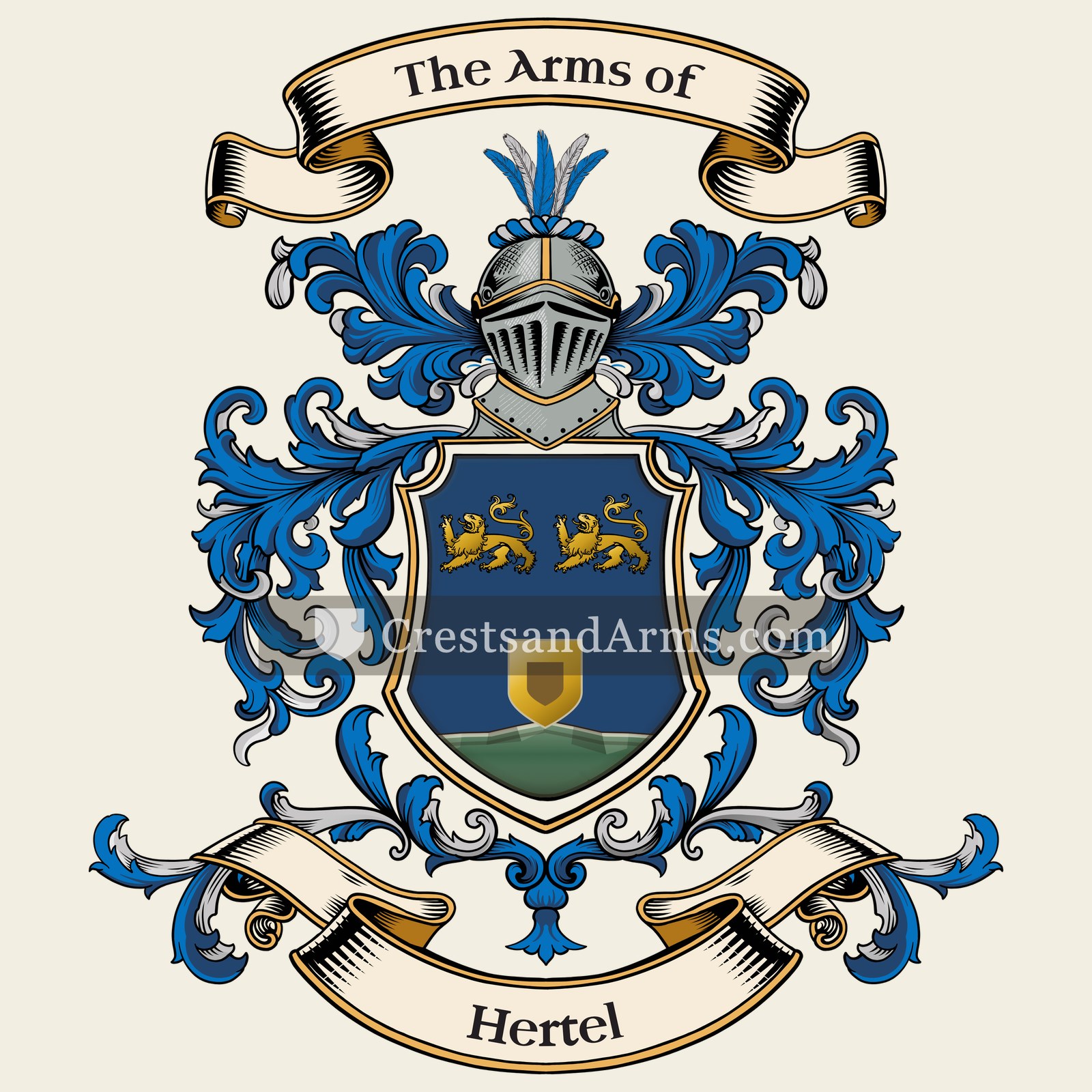
mountThe ground held, and steadfastness upon it
lionCourage, strength and royalty
escutcheonA shield within a shield, and a claim inherited
Colours
Blue (Azure)Means: Loyalty and truth
Green (Vert)Means: Hope
Gold (Or)Means: Generosity
Historical info
Source
J. B. Rietstap, Armorial Général, Gouda: G. B. van Goor Zonen, 1884–87
Blazon (the actual original written record)
“D'azur à deux lions affr. d'or, soutenus d'un tertre de sin., supp. ensemble un écusson d'or, cour. du même et ch. d'un coeur de gu. Cq. cour. C.: une aigle ép. de sa. L. d'or et d'azur.”
GermanyMunich, c. 1765
Digital archive packCoat of arms PNG, gold border print PDF, vector SVG and the certificate of authenticity. Sent to your email in minutes.
Map of Germany showing where the Hertel arms are recorded
The Hertel arms were recorded in Munich, c. 1765.
This is where the arms were entered in the register. Families often moved to other parts of the country, so the same name can turn up in more than one region.
The body that granted and recorded arms in Germany in this period.
Francis I, Holy Roman Emperor
Sovereign of the period
Francis I, Holy Roman Emperor
1745–1765
Reigning in Poland when the Hertel arms are first recorded.
How Arms Worked in Germany
In the Holy Roman Empire, coats of arms were often granted to individuals by the Emperor or his representatives. These arms were then passed down through the generations to all legitimate descendants of the original holder. Younger branches of a family usually kept the same shield design without needing to change it, as the arms belonged to the entire lineage.
Granting authority
The Holy Roman Emperor held the sole power to grant new coats of arms throughout his vast imperial territories.
How they got arms
Families typically obtained their coats of arms through a formal imperial grant or by proving their noble status to the authorities.
Where arms were recorded
These grants were officially recorded in the Imperial Chancery registers, which began keeping formal records of such honors during the Middle Ages.
The family's standing
Recorded among the armigerous families of Germany.
Origin & History of the Hertel Family in Germany
The surname Hertel has deep roots in the German-speaking regions of Europe, originating as a diminutive form of the Germanic name Hartwig or Hartmann. The name is composed of the elements "hard," meaning brave or hardy, and "walt," meaning rule or power. By the time members of the family were documented in Munich in 1765, the name had already been established for several centuries across various German states. During this period, families bearing the name were often involved in the skilled trades or local administration within growing urban centers. As the family settled into the social fabric of Munich, they became part of the vibrant cultural and economic life of Bavaria. The name reflects a long history of migration and social integration, as families moved between villages and cities to pursue new opportunities in an evolving German society.
Related Branches & Arms
Root word
Hart
A male deer or stag.
This name
HertelDerived from a diminutive form of names containing the element hart, meaning deer.
also spelled
Herte
Hartel
Documented Sources
J. B. Rietstap, Armorial Général, Gouda: G. B. van Goor Zonen, 1884–87
Hassel, Georg, Statistischer Umriss der russischen Erwerbungen in Europa und Asien, 1823


 mountThe ground held, and steadfastness upon it
 treeLife, endurance and deep roots
 mountThe ground held, and steadfastness upon it
 treeLife, endurance and deep roots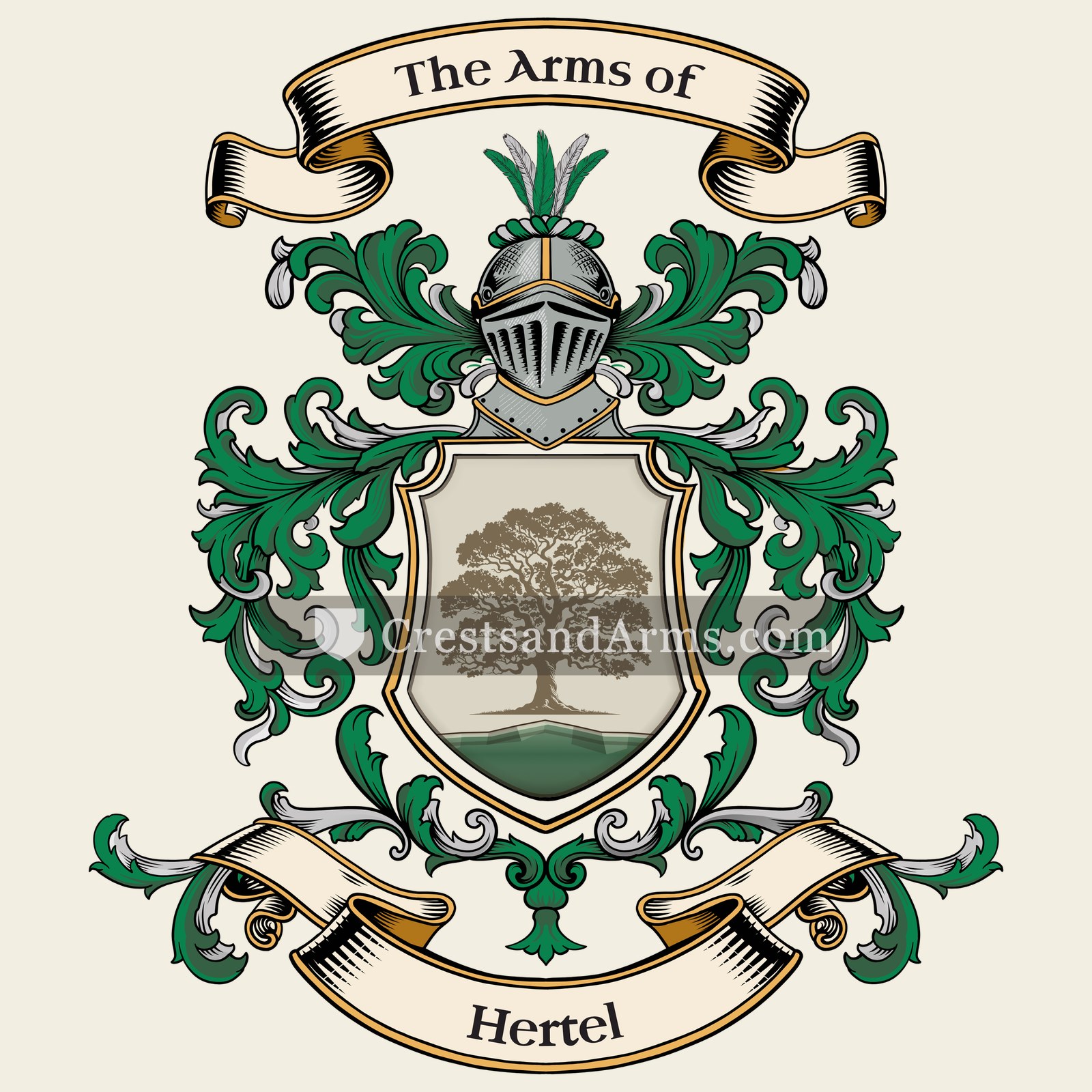


 lionCourage, strength and royalty
 escutcheonA shield within a shield, and a claim inherited