A record of documented arms, meaning and origin, researched for the Hervey family lines. Documented in 3 countries.
Reg. 6829 · French, G–I
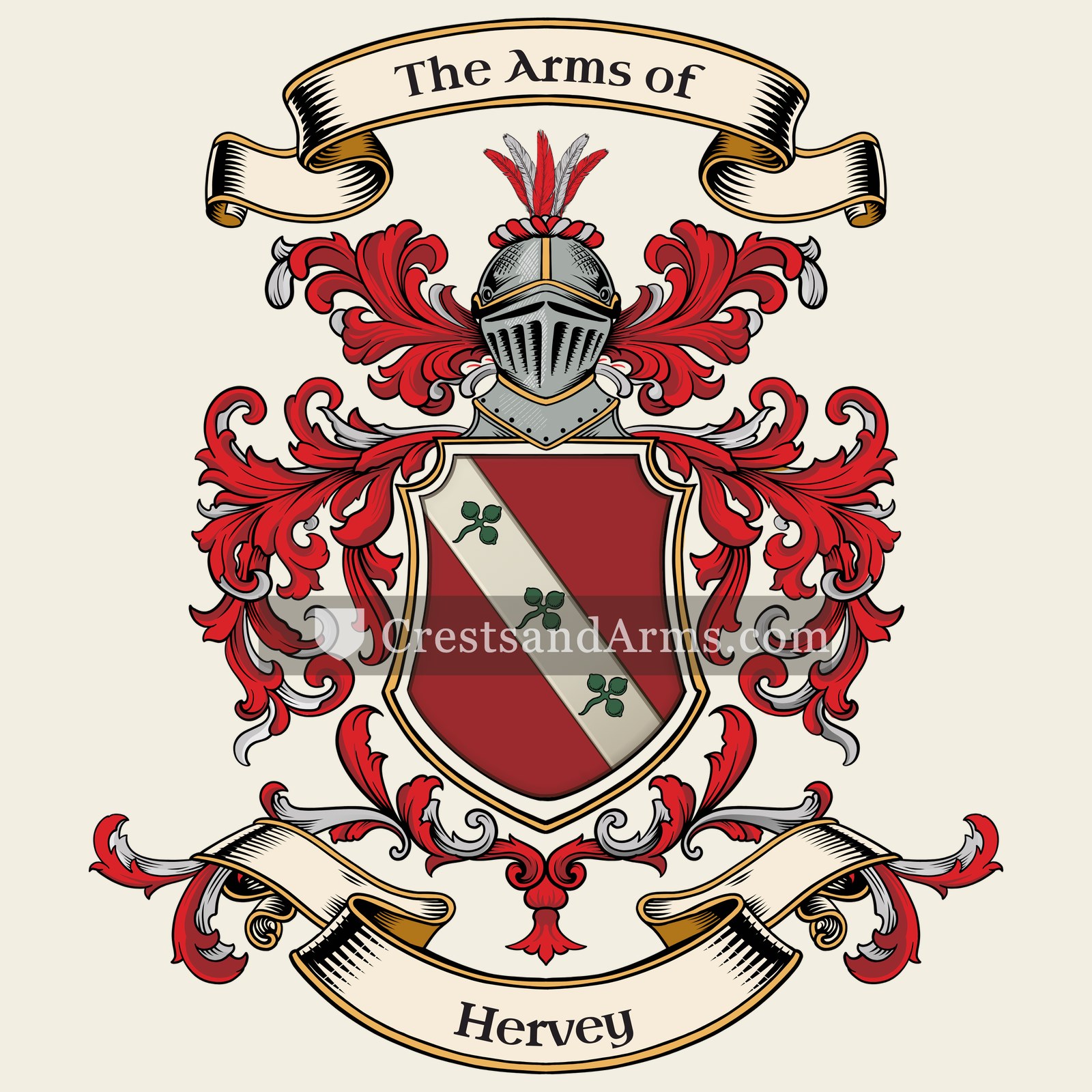
Coat of Arms & Family Crest Details
Symbols on this shield
bendDefence, and the scarf of a commander
trefoilPerpetuity, and the Trinity
Colours
Red (Gules)Means: Military strength
Silver (Argent)Means: Peace and sincerity
Green (Vert)Means: Hope
Historical info
Source
J. B. Rietstap, Armorial Général, Gouda: G. B. van Goor Zonen, 1884–87
Blazon (the actual original written record)
“De gu. à la bande d'arg., ch. de trois trèfles de sin., posés dans le sens de la bande. C.: un léopard de sa., semé de bes. d'or, coll. d'une couronne d'or, enchaîné du même, tenant de sa patte dextre levée un trèfle de sin. S.: deux léopards de sa., semés de bes. d'or, coll. de couronnes d'or, enchaînés du même. D.: JE N'OUBLIERAY JAMAIS.”
Francec. 1703
Digital archive packCoat of arms PNG, gold border print PDF, vector SVG and the certificate of authenticity. Sent to your email in minutes.
Map of France showing where the Hervey arms are recorded
The Hervey arms were recorded in France, c. 1703.
Arms such as these were typically recorded in Bretagne.
More families held coats of arms in Bretagne than anywhere else in France. The land was divided into many small estates rather than a few large ones, so far more households counted as gentry, and each needed a shield of its own to be told apart.
This is where the arms were entered in the register. Families often moved to other parts of the country, so the same name can turn up in more than one region.
The body that granted and recorded arms in France in this period.
Louis XIV of France
Sovereign of the period
Louis XIV of France
1643–1715
Reigning in France when the Hervey arms are first recorded.
How Arms Worked in France
In France, a coat of arms was a mark of honor that passed down through the male line to all legitimate descendants. Families often used the same shield without changes to show their shared heritage. If a branch wanted to stand out, they could add a small mark to their shield to show their specific place in the family tree.
Granting authority
The Juge d'armes de France acted as the official authority that regulated and verified coats of arms across the country.
How they got arms
Families typically inherited their arms from ancestors, though they could also receive them through royal grants or by proving their noble status.
Where arms were recorded
Coats of arms were officially recorded in the Armorial Général de France, which began its main collection in the year 1696.
The family's standing
Recorded among the armigerous families of France.
Origin & History of the Hervey Family in France
The family name Hervey traces its roots to the ancient Germanic name Hervé, which translates to battle worthy. By the early eighteenth century, the family established a clear presence in the region of Bretagne in northwestern France. During this period, the name was deeply connected to the local social and agricultural landscape of the province. Families living in Bretagne at that time often centered their lives around parish communities and local trade networks. Because the name Hervé was popular throughout the region, those who carried it were often integrated into the daily life of rural villages. The transition of the name into its various forms reflects the linguistic shifts occurring in France as families moved through different provinces. By 1703, the Hervey name was already well-rooted in the traditions and records of the Breton people.
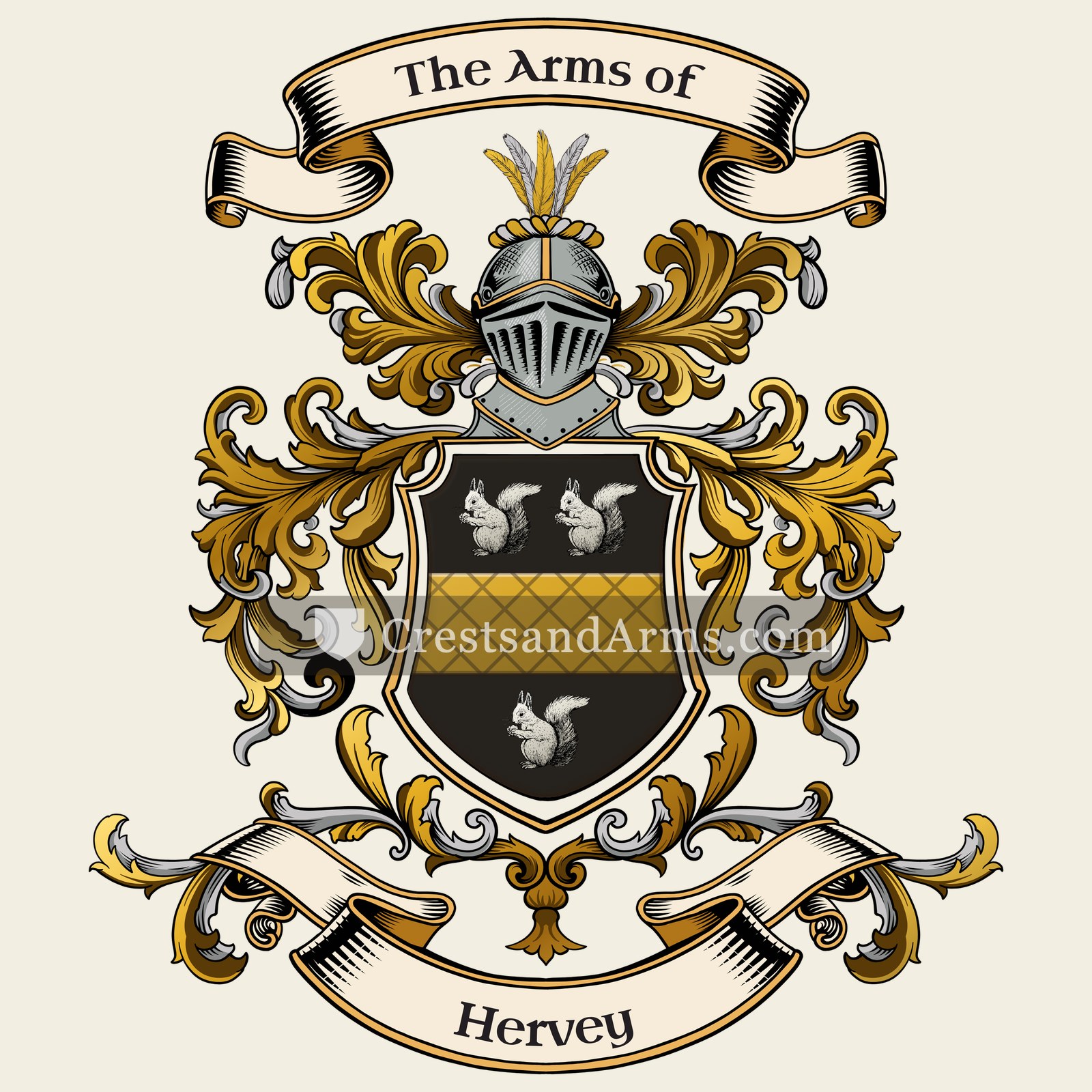
Coat of Arms & Family Crest Details
Symbols on this shield
fessThe military belt, and readiness to serve
squirrelPatience and foresight in gathering
Colours
Black (Sable)Means: Constancy
Gold (Or)Means: Generosity
Silver (Argent)Means: Peace and sincerity
Historical info
Source
Sir Bernard Burke, The General Armory of England, Scotland, Ireland and Wales, London: Harrison & Sons, 1884
Blazon (the actual original written record)
“Sa. a fesse or, betw. three squirrels sejant ar”
SomersetSomerset, c. 1620
Digital archive packCoat of arms PNG, gold border print PDF, vector SVG and the certificate of authenticity. Sent to your email in minutes.
Map of England showing where the Hervey arms are recorded
The Hervey arms were recorded in Somerset, c. 1620.
Somerset was rich farming country with a thick scattering of manor houses. Its gentry were numerous and long-settled, and a settled landed family almost always ended up with arms.
This is where the arms were entered in the register. Families often moved to other parts of the country, so the same name can turn up in more than one region.
The body that granted and recorded arms in England in this period.
James VI and I
Sovereign of the period
James VI and I
1603–1625
Reigning in France when the Hervey arms are first recorded.
How Arms Worked in England
English heraldry allowed arms to be shared by all legitimate descendants of the original owner. These symbols were treated as personal property that moved through the generations to all children. While the eldest son kept the original design, other family members could use the same shield without needing to change it or register their own unique versions.
Granting authority
The College of Arms in London has regulated the use of coats of arms throughout England and Wales since 1484.
How they got arms
Families typically obtained their coats of arms through a formal grant from the Crown or by proving their ancient right to them.
Where arms were recorded
All official coats of arms are recorded in the registers kept at the College of Arms, which date back to the fifteenth century.
The family's standing
Recorded among the armigerous families of Somerset.
Origin & History of the Hervey Family in England
The surname Hervey traces its origins to the ancient Germanic name Herveus, which combines elements meaning army and battle. Following the Norman Conquest of 1066, the name became established in England as it was brought over by settlers from France. Over several centuries, the spelling evolved through various forms, eventually settling into the version we recognize today. By the early seventeenth century, members of the family were firmly rooted in the county of Somerset. These early inhabitants were part of the local social fabric, living through a period of significant agricultural and economic change in the English countryside. Their presence in the region by 1620 suggests that the family had successfully integrated into the local community and established a stable life in the West Country long before the major migrations to the New World.
Coat of Arms & Family Crest Details
Symbols on this shield
bendDefence, and the scarf of a commander
trefoilPerpetuity, and the Trinity
Colours
Red (Gules)Means: Military strength
Silver (Argent)Means: Peace and sincerity
Green (Vert)Means: Hope
Historical info
Source
Sir Bernard Burke, The General Armory of England, Scotland, Ireland and Wales, London: Harrison & Sons, 1884
Blazon (the actual original written record)
“Gu. on a bend ar. three trefoils slipped vert”
WexfordKilliane Castle · Wexford, c. 1645
Digital archive packCoat of arms PNG, gold border print PDF, vector SVG and the certificate of authenticity. Sent to your email in minutes.
Map of Ireland showing where the Hervey arms are recorded
The Hervey arms were recorded in Wexford, c. 1645.
Wexford was the corner of Ireland closest to Wales, settled early by Norman families. They held their land under arms and kept it for generations, which is why so many Wexford names carry recorded shields.
This is where the arms were entered in the register. Families often moved to other parts of the country, so the same name can turn up in more than one region.
The body that granted and recorded arms in Ireland in this period.
Charles I of England
Sovereign of the period
Charles I of England
1625–1649
Reigning in France when the Hervey arms are first recorded.
How Arms Worked in Ireland
The Ulster King of Arms granted coats of arms to individuals who proved their social standing and good character. These symbols were typically inherited by all legitimate descendants of the original holder. If a family branch wanted a unique look, they could apply for a specific change to their design through the office to ensure their identity remained distinct.
Granting authority
The Ulster King of Arms acted as the official body that regulated and issued all coats of arms throughout Ireland.
How they got arms
Families obtained their arms through formal grants issued by the office after proving their eligibility and paying the required fees.
Where arms were recorded
All official grants were recorded in the registers held by the Ulster King of Arms starting from the year 1552.
The family's standing
Recorded among the armigerous families of Wexford.
Origin & History of the Hervey Family in Ireland
The Hervey family name has deep roots that stretch back to the turbulent period of the mid-seventeenth century in Ireland. By 1645, records confirm that members of the family were already established in County Wexford, a region that served as a significant gateway for settlers during that era. The name itself is of Norman origin, derived from the personal name Hervé, which means battle-worthy. Over time, families bearing this name integrated into the local landscape, often becoming involved in the agricultural and administrative life of the southeastern coast. As they settled into the Irish countryside, the Herveys became part of the complex social fabric of Wexford, navigating the shifting political landscape of the seventeenth century while maintaining their presence in the region for generations.
Related Branches & Arms
Root word
Harivig
Derived from Germanic elements meaning army and battle or war.
This name
HerveyA name signifying a battle-worthy warrior or one who is strong in conflict.
also spelled
Harvey
Herwie
Harvie
Related arms
Grossimilar arms
Harveyvariant spelling
Harvievariant spelling
Hervyvariant spelling
Documented Sources
J. B. Rietstap, Armorial Général, Gouda: G. B. van Goor Zonen, 1884–87
Dauzat, Albert, Dictionnaire étymologique des noms et prénoms de France, 1951
Morvan, Françoise, Bretagne est une île, 2005
Archives départementales d’Ille-et-Vilaine, Registres paroissiaux et d'état civil, 1703
Digital archive packCoat of arms PNG, gold border print PDF, vector SVG and the certificate of authenticity. Sent to your email in minutes.


 bendDefence, and the scarf of a commander
 trefoilPerpetuity, and the Trinity
 bendDefence, and the scarf of a commander
 trefoilPerpetuity, and the Trinity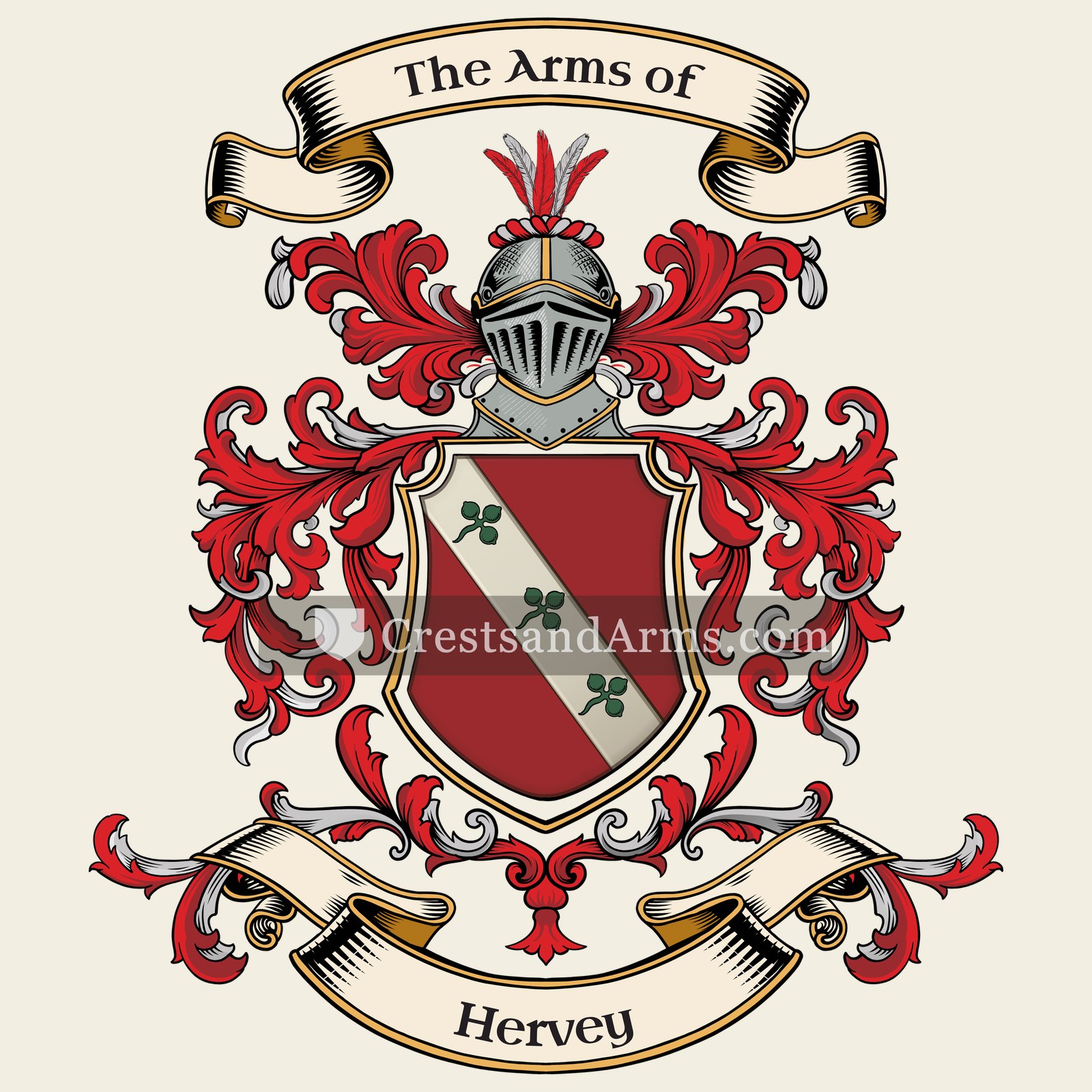


 fessThe military belt, and readiness to serve
 squirrelPatience and foresight in gathering