Map of Netherlands showing where the Heye arms are recorded
The Heye arms were recorded in Leyde, c. 1815.
This is where the arms were entered in the register. Families often moved to other parts of the country, so the same name can turn up in more than one region.
Region
Leyde
Town
Leyde
First recorded
1815
Granting Authority for the Heye Arms
Hoge Raad van Adel
Photograph made by me · CC BY-SA 3.0
The body that granted and recorded arms in Netherlands in this period.
William I of the Netherlands
Sovereign of the period
William I of the Netherlands
1815–1840
Reigning in Netherlands when the Heye arms are first recorded.
How Arms Worked in Netherlands
In the Netherlands, coats of arms were often used by noble families and those who held specific public offices. These arms were passed down through the generations to legitimate descendants. Younger branches of a family usually kept the original design without needing to add special marks. This system ensured that the family identity remained clear and consistent over many years.
Granting authority
The Hoge Raad van Adel is the official body that regulates and manages noble titles and coats of arms in the Netherlands.
How they got arms
Families typically obtained their coats of arms through official royal grants or by proving their long-standing historical use of the symbols.
Where arms were recorded
Coats of arms are officially recorded in the registers held by the Hoge Raad van Adel, which began its work in 1814.
The family's standing
Recorded among the armigerous families of Netherlands.
Origin & History of the Heye Family in Netherlands
The family name Heye traces its roots to the Low Countries, where it functioned as a patronymic name derived from the Germanic given name Heio or Heye. By the early 19th century, the family established a notable presence in the city of Leiden. This period was a time of significant transition for the Netherlands as the nation emerged from the Napoleonic era to form the United Kingdom of the Netherlands. Records from 1815 indicate that members of the Heye family were active participants in the civic life of Leiden, a city then renowned for its historic university and its role as a center for trade and manufacturing. As the family settled into the social fabric of the region, they contributed to the local community during a time when the Dutch government began formalizing civil registration and standardized naming practices across the country.
Coat of Arms & Family Crest Details
Symbols on this shield
lionCourage, strength and royalty
Colours
Gold (Or)Means: Generosity
Red (Gules)Means: Military strength
Historical info
Source
J. B. Rietstap, Armorial Général, Gouda: G. B. van Goor Zonen, 1884–87
Blazon (the actual original written record)
“D'or au lion de gu. C.: cinq pl. d'aut., alt. d'or et de gu.”
Denmarkc. 1678
Digital archive packCoat of arms PNG, gold border print PDF, vector SVG and the certificate of authenticity. Sent to your email in minutes.
Map of Denmark showing where the Heye arms are recorded
The Heye arms were recorded in Denmark, c. 1678.
Arms such as these were typically recorded in Sjaælland.
Zealand held the Danish court, the crown's offices and Copenhagen itself. Families who served the king kept estates within reach of it, and royal service was the ordinary route to a coat of arms.
This is where the arms were entered in the register. Families often moved to other parts of the country, so the same name can turn up in more than one region.
The body that granted and recorded arms in Denmark in this period.
Christian V of Denmark
Sovereign of the period
Christian V of Denmark
1670–1699
Reigning in Netherlands when the Heye arms are first recorded.
How Arms Worked in Denmark
Danish heraldry during this period was closely tied to noble status and royal favor rather than being open to all citizens. Arms were typically granted by the monarch to individuals, and these symbols were then shared by all members of the noble house. If a family line died out, the right to use those specific arms ended with them.
Granting authority
The Danish royal chancery held the power to issue and regulate official coats of arms for the kingdom.
How they got arms
Families usually received their arms through a formal royal grant that confirmed their noble status and rights.
Where arms were recorded
These grants were officially recorded in the Danish Royal Chancery records starting in the sixteenth century.
The family's standing
Recorded among the armigerous families of Denmark.
Origin & History of the Heye Family in Denmark
The history of the Heye family in Denmark begins with documented records of members living on the island of Sjælland as early as 1678. During this period, the name was closely tied to the social and economic structures of the Danish countryside. Families like the Heyes were often part of the rural population that navigated the transition from feudal land systems to more organized agricultural communities. Because Sjælland served as the political and cultural heart of the kingdom, the family was positioned near the center of national life during the late seventeenth century. Over the following generations, the name became established within local parish registers, which tracked the births, marriages, and deaths of the population. These early records suggest that the Heye family was a stable part of the local community, contributing to the development of the region through their roles in farming and local trade.
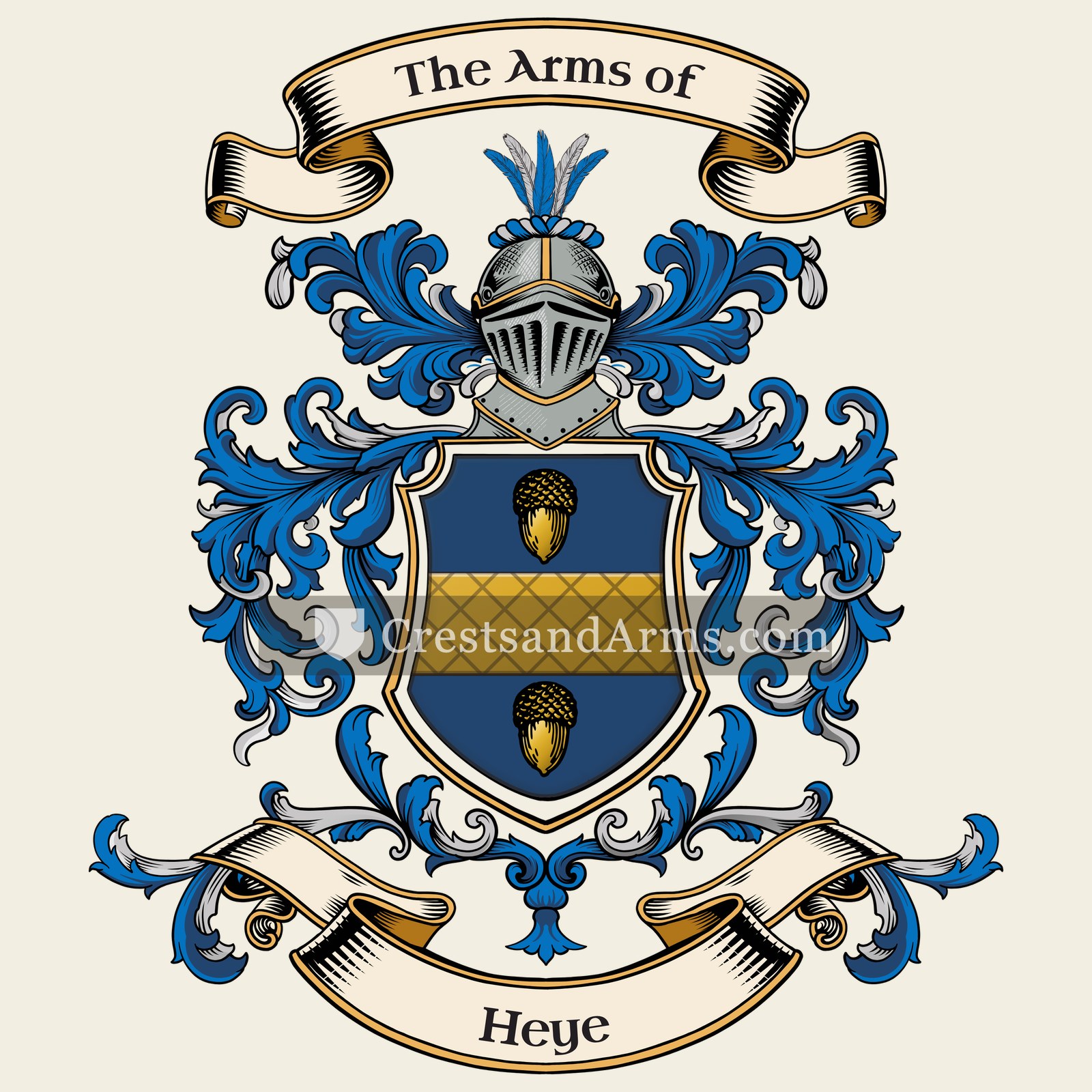
Coat of Arms & Family Crest Details
Symbols on this shield
fessThe military belt, and readiness to serve
acornAntiquity and strength from small beginnings
Colours
Blue (Azure)Means: Loyalty and truth
Gold (Or)Means: Generosity
Historical info
Source
J. B. Rietstap, Armorial Général, Gouda: G. B. van Goor Zonen, 1884–87
Blazon (the actual original written record)
“D'azur à la fasce, acc. de deux glands feuillés, les queues en bas, 1 en chef et 1 en p., le tout d'or.”
Francec. 1663
Digital archive packCoat of arms PNG, gold border print PDF, vector SVG and the certificate of authenticity. Sent to your email in minutes.
Map of France showing where the Heye arms are recorded
The Heye arms were recorded in France, c. 1663.
Arms such as these were typically recorded in Bretagne.
More families held coats of arms in Bretagne than anywhere else in France. The land was divided into many small estates rather than a few large ones, so far more households counted as gentry, and each needed a shield of its own to be told apart.
This is where the arms were entered in the register. Families often moved to other parts of the country, so the same name can turn up in more than one region.
The body that granted and recorded arms in France in this period.
Louis XIV of France
Sovereign of the period
Louis XIV of France
1643–1715
Reigning in Netherlands when the Heye arms are first recorded.
How Arms Worked in France
In France, a coat of arms was a mark of honor that passed down through the male line to all legitimate descendants. Families often used the same shield without changes to show their shared heritage. If a branch wanted to stand out, they could add a small mark to their shield to show their specific place in the family tree.
Granting authority
The Juge d'armes de France acted as the official authority that regulated and verified coats of arms across the country.
How they got arms
Families typically inherited their arms from ancestors, though they could also receive them through royal grants or by proving their noble status.
Where arms were recorded
Coats of arms were officially recorded in the Armorial Général de France, which began its main collection in the year 1696.
The family's standing
Recorded among the armigerous families of France.
Origin & History of the Heye Family in France
The family name Heye traces its roots in France to the historic region of Bretagne, where records confirm the presence of family members as early as 1663. During the seventeenth century, Bretagne was a distinct province with its own unique customs and strong ties to the sea. Families living in this area were often influenced by the rugged coastal landscape and the maritime trade routes that connected the region to the rest of Europe. The name Heye likely emerged within this local community as a way to identify specific households or individuals during a time when surnames were becoming more permanent for tax and legal purposes. Life in rural Bretagne at this time centered around parish life, and the Heye family would have been deeply integrated into the local social structure through church records and agricultural work. By settling in this region, the early members of the family became part of the long and complex history of a territory known for its independent spirit and ancient traditions.
Related Branches & Arms
Root word
Hagano
A Germanic element meaning hedge, enclosure, or protected area.
This name
HeyeDerived from a short form of Germanic names containing the element for enclosure.
also spelled
Heie
Haye
High
Related arms
van der Heyvariant spelling
Documented Sources
J. B. Rietstap, Armorial Général, Gouda: G. B. van Goor Zonen, 1884–87
Nationaal Archief, Bevolkingsregister van Leiden
Erfgoed Leiden en Omstreken, Doop-, trouw- en begraafboeken (DTB) en Burgerlijke Stand
Meertens, P.J., De betekenis van de Nederlandse familienamen, 1950
Van der Schaar, J., Woordenboek van voornamen, 1964
Digital archive packCoat of arms PNG, gold border print PDF, vector SVG and the certificate of authenticity. Sent to your email in minutes.


 fessThe military belt, and readiness to serve
 fessThe military belt, and readiness to serve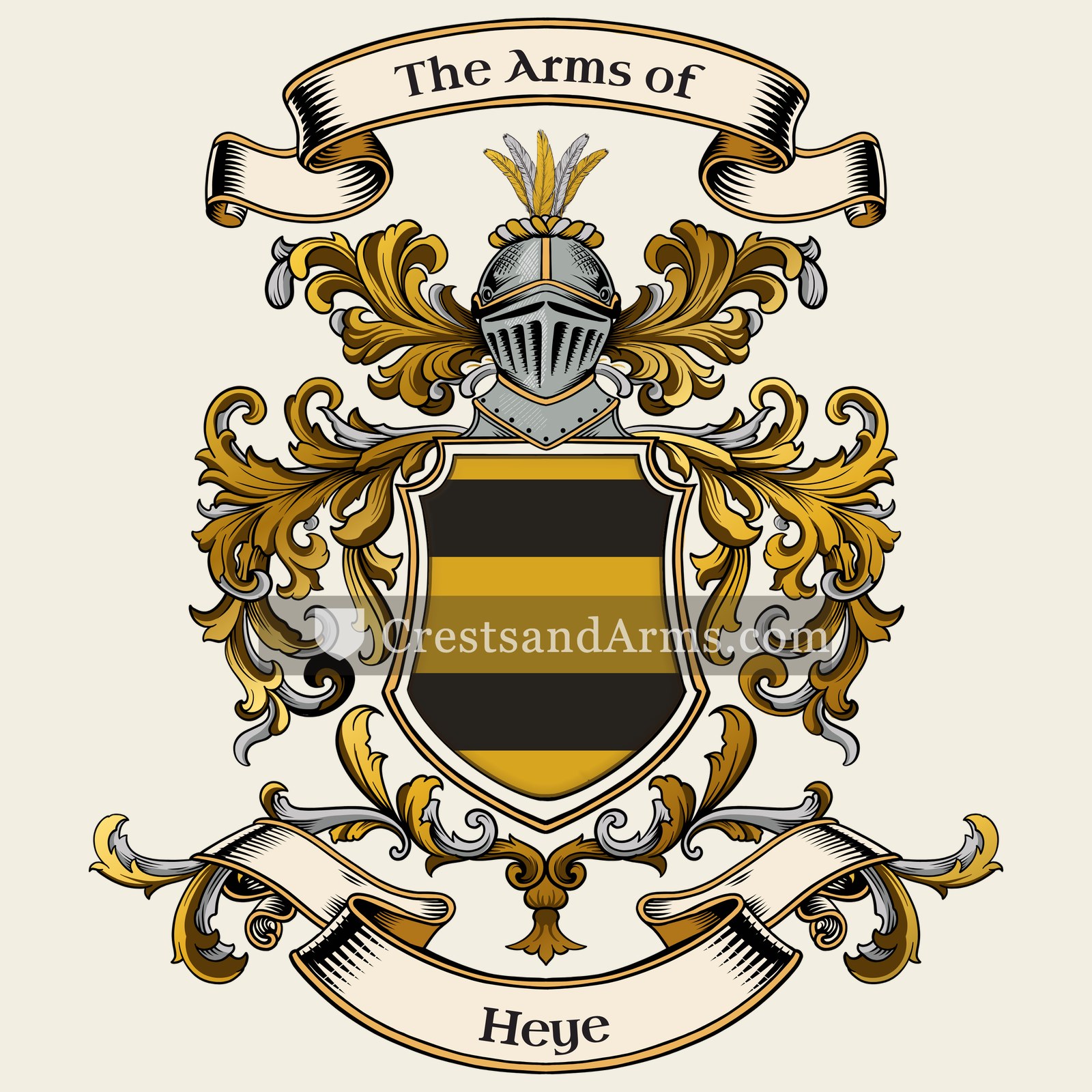


 lionCourage, strength and royalty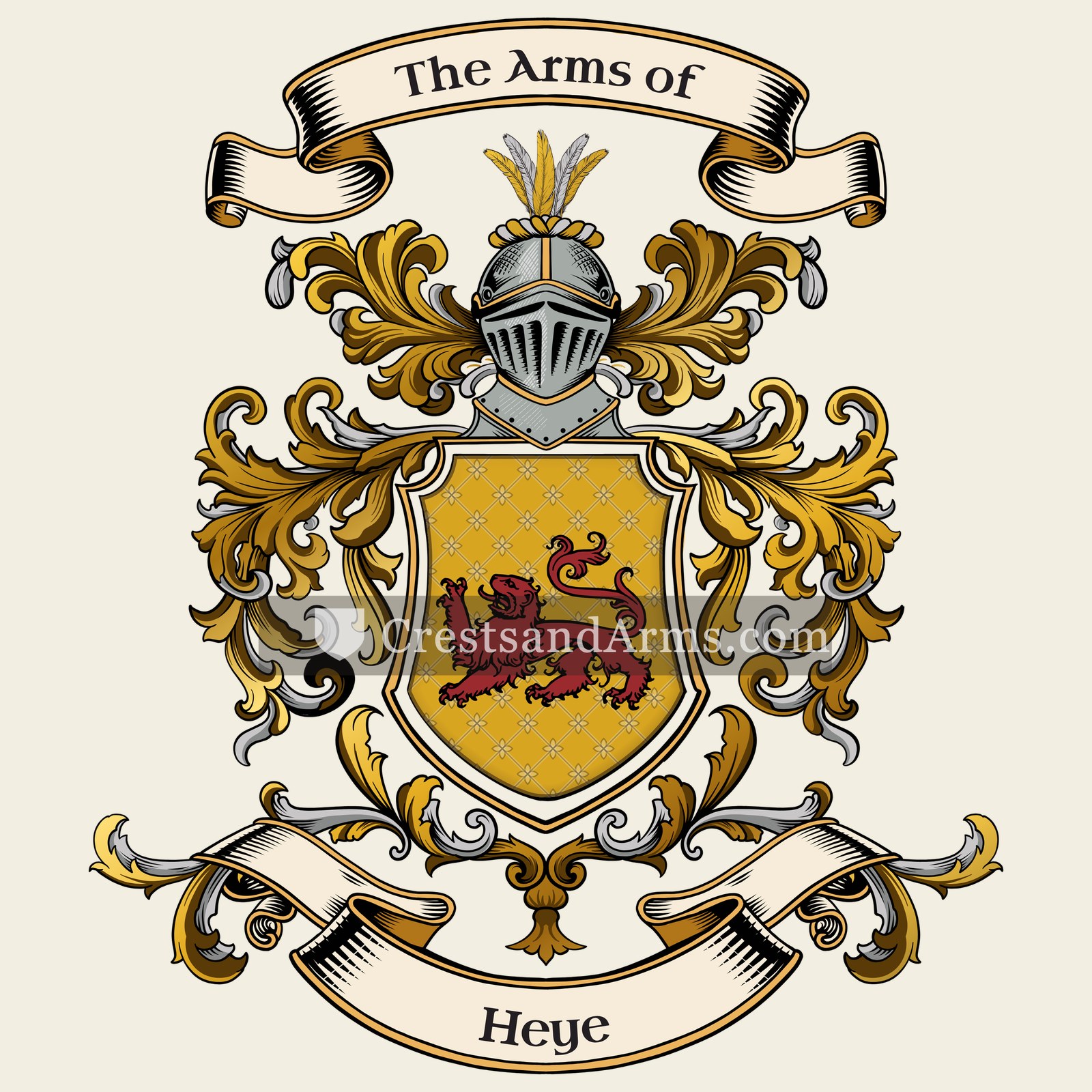


 acornAntiquity and strength from small beginnings